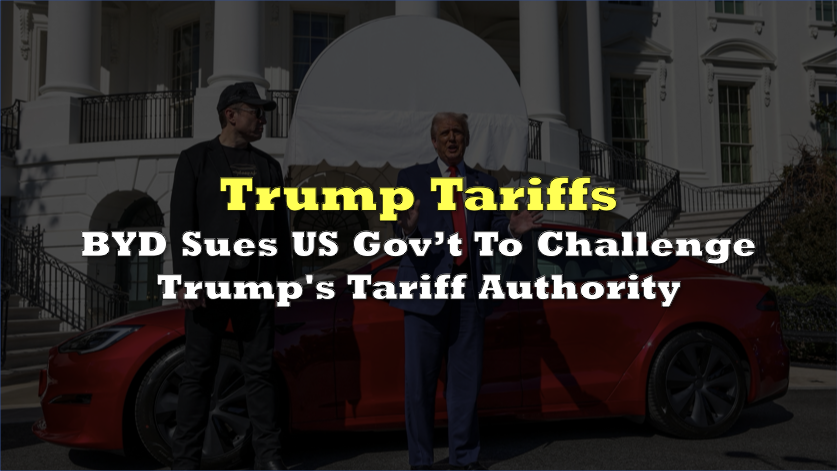

Chinese automaker BYD has sued the US government to challenge President Donald Trump’s use of sweeping authority to impose auto tariffs and to recover all levies it says it has paid since last April, according to court documents.
The case, filed at the Court of International Trade, is positioned as the first lawsuit by a Chinese carmaker over US tariffs, and it arrives amid broader litigation by thousands of global companies with US operations contesting Trump’s approach to border taxes.
Four US subsidiaries brought the complaint and targeted the legal foundation directly, the International Emergency Economic Powers Act. Their core claim is statutory, arguing the law does not authorize tariffs because “the text of IEEPA does not employ the word ‘tariff’ or any term of equivalent meaning.”
BYD also framed the suit as a protective move tied to money already paid, saying it needed an independent complaint to preserve its ability to receive refunds for the tariffs it has already paid rather than waiting on outcomes in other litigation.
BYD is joining other foreign companies in suing the US over tariffs under IEEPA.
— Kyle Chan (@kyleichan) February 9, 2026
This is quite a bold move by BYD and perhaps says something about their view of the balance of risks. They risk potentially angering the Trump admin, but perhaps they think there's a real chance of…
The lawsuit lands alongside a separate, high-stakes Supreme Court case expected to rule on the legality of the tariffs imposed under IEEPA. US Trade Representative Jamieson Greer indicated the Supreme Court’s pace reflects the scale of what is at stake.
BYD’s business footprint in the US is a key factual backdrop in the filing, even as it does not sell passenger cars domestically. Its US activities include buses and commercial vehicles, batteries, energy storage systems, and solar panels.
BYD North America’s operations include a truck plant in Lancaster, California, where the company says it employs 750 workers, according to its website.
The suit’s timing also intersects with Trump’s public messaging on Chinese autos. Trump has repeatedly said Chinese cars threaten the future of the US auto industry, while also saying at times that he would welcome a Chinese automaker that wants to build cars on US soil.
Information for this story was found via Reuters and the sources and companies mentioned. The author has no securities or affiliations related to the organizations discussed. Not a recommendation to buy or sell. Always do additional research and consult a professional before purchasing a security. The author holds no licenses.