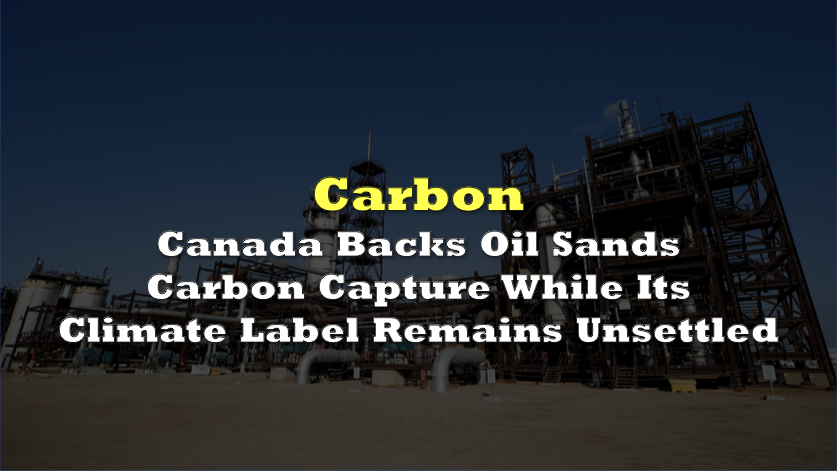

Canada is advancing a major oil sands carbon-capture project with tax incentives, planned operating support, and regulatory commitments. But the independent council writing Canada’s sustainable-investment rulebook still has not decided whether emissions-reduction work at existing oil and gas operations belongs in its framework.
The Taxonomy and Transition Planning Council released its final methodology on Tuesday, establishing green and transition investment categories while withholding a decision on a third category for emissions-abatement measures.
It said more research was needed to determine whether that category could meet the framework’s objectives.
 Sponsored · Cambria Gold Mines
The gap is clearest in the July 2 memorandum between Ottawa, Alberta, and the Oil Sands Alliance. The agreement sets out a Pathways carbon-capture project intended to cut emissions by six million tonnes annually by January 2035, with shared transportation and storage infrastructure expected to operate by January 2032. Additional measures target another 10 million tonnes of reductions by 2045.
The alliance comprises Canadian Natural Resources, Suncor Energy, Cenovus Energy, Imperial Oil, and ConocoPhillips.
Under the federal carbon-capture investment tax credit, eligible capture equipment generally qualifies for a 50% refundable credit, while eligible transportation and storage equipment qualifies for 37.5%. The July agreement also commits Ottawa to advance financing support for carbon-capture operating costs and Alberta to extend its carbon-capture incentive program to 2035.
The July memorandum is nonbinding, with definitive agreements targeted for November 15.
The classification dispute concerns a different question: whether lowering emissions during oil production should earn a climate-aligned investment label when the oil itself produces emissions after sale and use.
The council initially proposed a distinct abatement category for selected emissions cuts at existing oil and gas operations, with safeguards intended to prevent longer-term emissions increases. After nearly 200 consultation submissions, it concluded it lacked enough evidence either to include or exclude the category.
TMX Group, which operates Canada’s principal stock exchanges, challenged that design in its consultation submission. It argued that investors might not recognize a separate abatement label and advocated placing eligible oil-and-gas emissions reductions within the transition category.
The group also warned that postponing technical work would leave the sector in “regulatory limbo,” creating uncertainty for capital markets. Environmental groups opposed the proposed category for a different reason, arguing that it risked legitimizing prolonged fossil-fuel production.