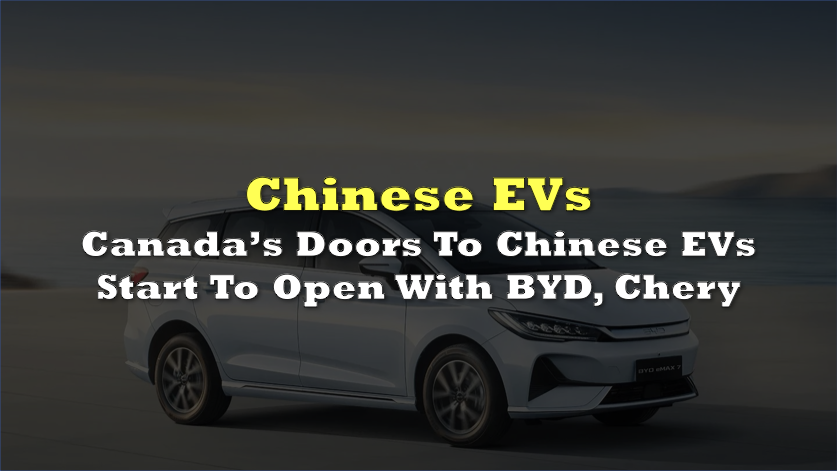

Canada’s outreach to BYD and Chery signals Ottawa is actively teeing up Chinese automakers as early beneficiaries of a redesigned market-access regime tied to local production.
Industry Minister Mélanie Joly met BYD and Chery Automobile in Beijing during Prime Minister Mark Carney’s visit, alongside a meeting with Canadian auto parts supplier Magna International, as Canada prepares to unveil an Auto Plan in February that could reshape which automakers get preferential access to the Canadian market.
The policy pivot accelerated after Canada agreed to allow up to 49,000 Chinese electric vehicles annually at a 6.1% tariff, a dramatic drop from the 100% tariff imposed in 2024. The agreement also included a commitment by Chinese companies to explore major auto investments in Canada, with Ottawa set to review compliance in three years. 
The coming strategy is expected to grant preferential market access to companies that build vehicles in Canada, creating a direct incentive for onshore assembly rather than pure import volume. Chinese manufacturers could be allowed to assemble vehicles in Canada for the first time, but under restrictions that may require Canadian software and joint ventures with domestic firms, according to a government official cited in reporting on the plan’s design.
The implied trade-off is straightforward: lower border friction for Chinese EVs in the near term, while the highest-value access over time shifts toward “made-in-Canada” units that align with safeguards around technology and employment.
A government official also indicated Canada can require domestically built EVs to use a secure technology platform that does not pose security risks.
BYD’s volume, Chery’s brand
BYD, based in Shenzhen, is positioned as a volume leader with the capacity to feed an import quota while exploring investment commitments tied to the three-year review window. The automaker delivered 4.6 million vehicles in 2025, up 7.7% year over year, after meeting a lowered goal it set in September, and reported 2.3 million fully electric vehicles within that total.
The firm had planned a Canadian market entry before the 2024 tariff move blocked direct momentum, and its overseas footprint highlights the type of market concentration it can achieve when policy access is supportive. Outside China, Brazil is described as its biggest market, where it accounts for 80% of EV sales.
Meanwhile, Chery Group, headquartered in Wuhu, has framed its expansion with a 2026 group sales goal of 3.2 million vehicles, a targeted 14% increase from 2025, including a 3.0 million vehicle goal across its five core brands. The flagship Chery brand posted 1.7 million unit sales in 2025, with Jetour at 622,590 units, Exeed at 120,369, iCAR at 96,989, and Luxeed at 90,493.
Those brand-level volumes matter for Canada because an Auto Plan that rewards in-country builds could encourage multi-brand strategies, from entry models under price thresholds to higher-margin trims that justify local assembly economics and joint-venture structures.
The tariff shift drew criticism from US Transportation Secretary Sean Duffy and US Trade Representative Jamieson Greer, with Duffy saying Canada would regret allowing Chinese EV imports and that those vehicles would not be permitted to enter the US.
President Donald Trump nonetheless praised the agreement, saying Canada “should” pursue a deal with China.
Canada’s longer-run objective, as described by a government official, is to export vehicles globally without relying on US market access, leaning on Canada’s free trade agreements with Europe and Asia as a structural advantage.
Information for this story was found via Electric-Vehicles.com and the sources and companies mentioned. The author has no securities or affiliations related to the organizations discussed. Not a recommendation to buy or sell. Always do additional research and consult a professional before purchasing a security. The author holds no licenses.