

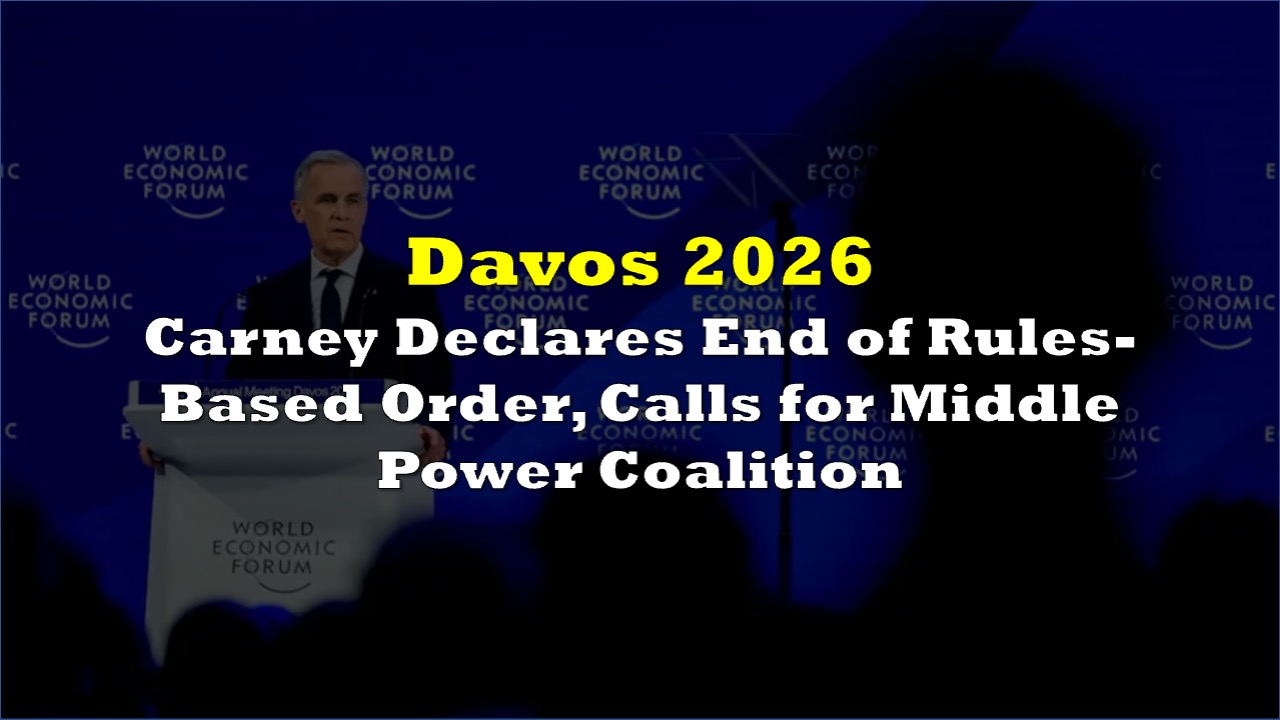

Canadian Prime Minister Mark Carney told global leaders Monday that the international rules-based order has collapsed and middle powers must unite to avoid subordination to great powers in an era of intensifying geopolitical rivalry.
Speaking at the World Economic Forum, Carney framed the current moment as a fundamental rupture rather than a transition. He argued that decades of participating in what he called a “partially false” system had created vulnerabilities that powerful nations now exploit through economic coercion.
“We are in the midst of a rupture, not a transition,” Carney said. “You cannot live within the lie of mutual benefit through integration when integration becomes the source of your subordination.”
🇨🇦 Canadian Prime Minister Mark Carney told the World Economic Forum at Davos that the U.S.-led “rules-based international order” is finished and “will not return.”
— Drop Site (@DropSiteNews) January 20, 2026
“For decades, countries like Canada benefited from what was called the rules-based international order,” Carney… https://t.co/iLkI0daMBW pic.twitter.com/Ty2P59dR0c
Carney outlined how Canada has repositioned itself since he took office in March 2025, doubling defense spending and signing 12 trade and security agreements across four continents in six months. He announced recent strategic partnerships with China and Qatar and ongoing free trade negotiations with India, ASEAN, Thailand, Philippines and Mercosur.
Carney directly addressed escalating tensions over Greenland, stating Canada stands firmly with Denmark and Greenland in supporting their right to determine the territory’s future. He called for talks focused on Arctic security and prosperity while opposing tariffs related to the dispute.
“Our commitment to Article 5 is unwavering,” Carney said, referring to NATO’s collective defense provision. “We are working with our NATO allies to further secure the alliance’s northern and western flanks.”
The speech proposed what Carney termed “variable geometry” — different coalitions for different issues based on shared values and interests rather than relying on diminished multilateral institutions like the World Trade Organization and United Nations.
Carney invoked Czech dissident Václav Havel’s concept of “living within a lie” to describe how countries had long participated in rituals of the rules-based order while privately acknowledging its inconsistencies. He argued middle powers must now “take the sign out of the window” by acknowledging reality and building genuine cooperation.
“Great powers can afford to go it alone,” Carney said. “Middle powers do not. But when we only negotiate bilaterally with a hegemon, we negotiate from weakness.”
The prime minister emphasized Canada’s economic advantages, including energy resources, critical minerals, an educated population, and strong pension funds. He positioned the country as a stable partner willing to lead middle powers in creating what he called “a third path” between competing hegemons.
Carney concluded by rejecting nostalgia for the previous order: “The old order is not coming back. We should not mourn it. Nostalgia is not a strategy.”
The speech drew significant international attention as one of the most consequential addresses on global affairs by a Canadian prime minister in recent memory.
Information for this story was found via the sources and companies mentioned. The author has no securities or affiliations related to the organizations discussed. Not a recommendation to buy or sell. Always do additional research and consult a professional before purchasing a security. The author holds no licenses.





One Response
The only world leader that had what it took to say it like it is. Mostly went over DJTs head. He just thought it was about Greenland where he was busy lying about “making” a deal, which was not really a deal. Yup, they will all use it as part of the “Golden Dome.” Of course, this just makes sense. No money changed hands, it is not his territory. Go away with your childish posts with the flag draped over Greenland, Canada and Denmark. You are literally 12 years old.