
China’s state media elevating a viral Tesla failure is a high-signal moment because it coincides with a sharp deterioration in Tesla’s China sales trajectory and rising competitive pressure from domestic EV makers.
Earlier this month, a 2022 Tesla Model Y reportedly suffered a sudden and complete loss of propulsion on a highway in Zhejiang while traveling from Shanghai toward Taizhou, stopping about 2 km before the Shengzhou service area. The driver, identified as Ms. Chen, said the dashboard showed about 72 km of remaining range when the vehicle began decelerating, followed by a shutdown of electrical systems including the central display going dark, loss of steering assist, and inability to activate hazard lights, with the car guided into the emergency lane on momentum before becoming immobilized.
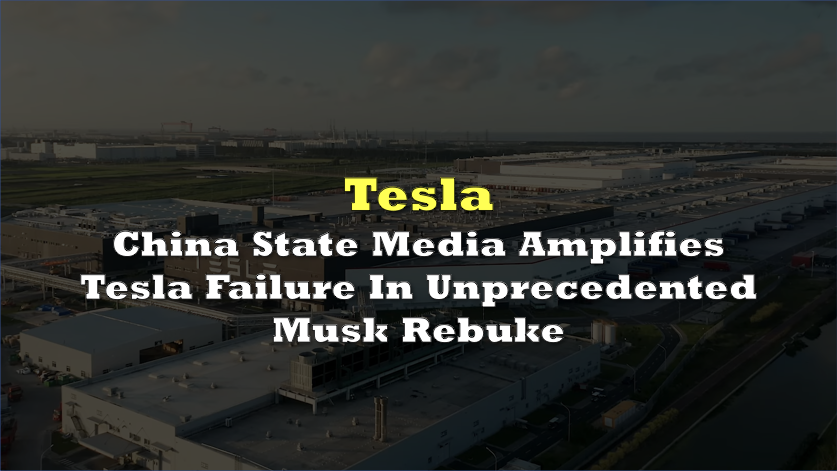
The incident went viral across Weibo and other platforms. China.com published and amplified the report, described as operating under China’s State Council Information Office.
It appears China has gotten what it wanted from Tesla and is now moving on.
— Fred Lambert (@FredLambert) February 17, 2026
While useful during Giga Shanghai's build-up, innovation from Chinese EV companies is now outpacing Tesla's. Not much to learn now, and it's better if domestic sales go to Chinese companies. https://t.co/mjr0pIWD0e
This is integral since with over 1.5 million Teslas on Chinese roads and annual sales cited at roughly 657,000 units in 2024 and about 626,000 units in 2025, individual failures are inevitable at fleet scale. Amplifying the report through a state-linked media outfit comes across beyond just mere reporting.
The coverage also sits against a described media and legal backdrop favorable to Tesla in prior years. An AP investigation is cited as finding Tesla sued customers and journalists in China over safety and quality disputes and won nearly 90% of civil cases, while Chinese car journalists were reportedly told not to be negative on Tesla.
The timing is tight with Tesla’s demand shock. Tesla’s China domestic sales in January 2026 reportedly fell 45% year-over-year to 18,485 units, stated as the lowest level in more than three years.
Full-year 2025 retail sales also went down 4.78% to 625,698 units, with Tesla’s share of China’s NEV market falling from 10% to 8%, despite a Model Y refresh and record discounts.
In contrast, Chinese competitors are positioned as the momentum trade. Xiaomi is said to have delivered 258,164 SU7 units in 2025, nearly 30% more than the Model 3 in China, and newer models aimed at the Model Y are described as stacking demand, with the Xiaomi YU7 and Xpeng G7 believed to have accumulated more than 300,000 combined orders.
Operationally, Tesla’s Shanghai output is portrayed as shifting from China-demand engine to export hub. January wholesale volume is stated at 69,129 vehicles, with 50,644 exported, meaning over 73% shipped abroad rather than sold into the domestic market.
The notes add a political layer around Elon Musk’s public role and scrutiny, including his previous leadership at US Department of Government Efficiency (DOGE) and broader backlash. In January 2026, Chinese state media also reportedly debunked Musk’s claims about Tesla FSD approval, and prior restrictions on Tesla vehicles entering government compounds over camera-related security concerns.
Information for this briefing was found via Electrek and the sources mentioned. The author has no securities or affiliations related to this organization. Not a recommendation to buy or sell. Always do additional research and consult a professional before purchasing a security. The author holds no licenses.