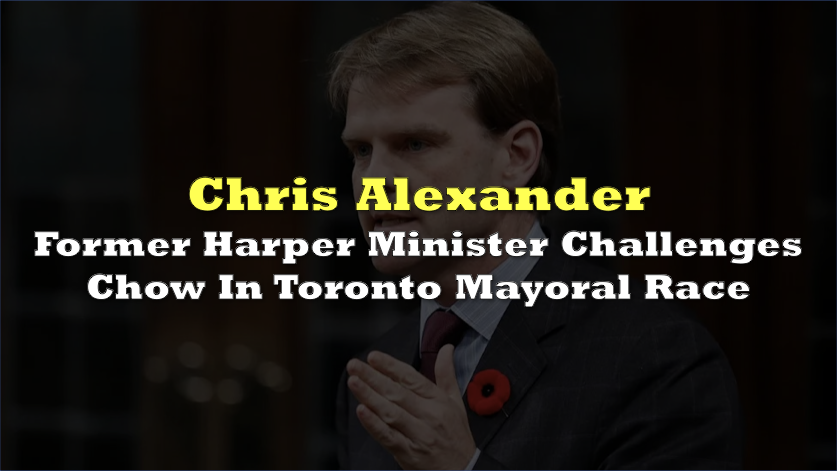

Chris Alexander is entering Toronto’s mayoral election without an established municipal voting base, a detailed city platform, or public polling that measures his support. What the former Conservative cabinet minister does bring is a nationally recognized name that could disrupt a race increasingly organized around incumbent Olivia Chow and city councillor Brad Bradford.
Alexander announced his candidacy on July 28 and was expected to register with the City of Toronto the following morning, according to his campaign. The election is scheduled for October 26, leaving him less than three months to establish himself in a field that already includes more than 30 registered candidates.
His initial message focuses on Toronto’s economy, transit, housing, infrastructure, and public services. Alexander said the city has been “standing still,” but his launch did not include specific tax commitments, spending reductions, housing targets, or transit projects.
 Sponsored · Selkirk Copper Mines
“A city with this much talent, strength and potential should not be underperforming, and it doesn’t have to be,” Alexander said in his campaign announcement, as reported by Global News. “At our best, we are a city of great achievements. With vision and teamwork, we can get back on that track, and I believe we will.”
Alexander enters as Chow continues to lead Bradford, but by a narrower margin than earlier in the campaign. A Liaison Strategies survey released July 29 placed Chow at 49% and Bradford at 41% among decided voters.
Among all respondents, Chow received 39%, Bradford received 33%, 8% selected another candidate, and 20% were undecided. The poll was conducted before voters had an opportunity to assess Alexander as a declared candidate.
Alexander’s entry may be most consequential if he competes directly with Bradford for voters seeking to replace Chow. Bradford, a two-term city councillor, has built his challenge around municipal experience and criticism of the incumbent’s record. Alexander is instead presenting an outsider campaign built on federal government, diplomatic, and private-sector credentials.
 Sponsored · Altamira Gold Corp.
The former minister has not held elected office since losing his federal seat in 2015. He represented Ajax-Pickering after winning the riding for Stephen Harper’s Conservatives in 2011. Harper appointed him citizenship and immigration minister in 2013, placing him in charge of the department during the government’s final two years.
His tenure became closely associated with the Conservative government’s response to the Syrian refugee crisis and its proposed tip line for reporting “barbaric cultural practices.” Alexander defended the policy at the time as a measure intended to protect women and girls from forced marriage and other abuse.
He lost the newly configured Ajax riding to Liberal Mark Holland in the 2015 federal election. Alexander later entered the 2017 Conservative leadership race and finished near the bottom of the field won by Andrew Scheer.
Since leaving elected office, Alexander has worked as an executive, adviser, and corporate director. He returned to Toronto in 2022 after spending time in Kenya, according to his campaign biography.
On the other hand, Chow has spent much of her career in Toronto politics. She served on the Toronto District School Board before joining city council in 1991, where she remained for more than a decade. She later represented Trinity—Spadina in Parliament as a New Democrat from 2006 to 2014, then returned to municipal politics, first as a mayoral candidate in 2014 and eventually as Toronto’s mayor in 2023.
Toronto’s nomination period closes on August 21, according to the City of Toronto. Advance voting will run from October 6 through October 11, followed by election day on October 26.