

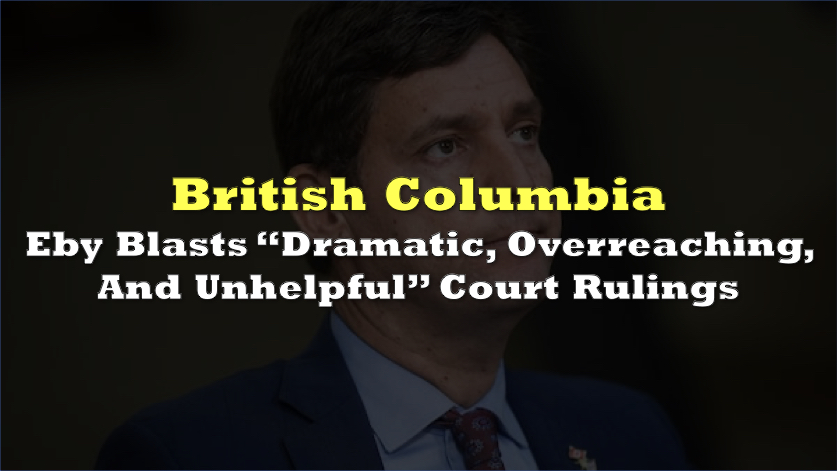

Premier David Eby escalated a public fight with the judiciary, arguing two recent decisions on Indigenous rights and title are injecting uncertainty into BC economy and threatening progress on reconciliation that has allegedly supported roughly $100 billion in resource projects.
Speaking at a BC Chamber of Commerce luncheon, Eby criticized a BC Supreme Court ruling awarding Aboriginal title in a developed part of Metro Vancouver that includes private lands, and a BC Court of Appeal ruling that the province has a binding obligation to apply the United Nations Declaration on the Rights of Indigenous Peoples to existing legislation.
“To face such dramatic, overreaching and unhelpful court decisions as we have seen over the last couple of months, is deeply troubling,” Eby said, tying the rulings to investment risk across new and expanded mines, port expansions, and proposed liquefied natural gas facilities moving forward with First Nations partnerships.
Eby pointed to negotiated agreements that have provided project certainty in a province where few treaties exist, and said an approval of LNG Canada phase two would eclipse the recently completed phase one as “the largest private sector investment in Canadian history.”
Cowichan
The premier has repeatedly raised alarms about the Cowichan decision and its implications for private property rights, while the Cowichan Tribes rejected his framing as “at best, misleading, and at worst, deliberately inflammatory.”
On Wednesday, Eby said his government intends to undo the Cowichan ruling, describing its uncertainty as economically corrosive.
“We will fix this because the uncertainty this case creates is toxic to the work we have to do with First Nations and businesses and the economy that we have to grow,” he said.
In the Cowichan decision last August, the BC Supreme Court held the Cowichan Tribes have Aboriginal title to roughly 800 acres in Richmond, including private properties, calling the title a “prior and senior right” to the land.
The province has already said it will appeal the Cowichan decision and intends to seek a stay, while Eby announced Wednesday the government is working on a plan to offer a guarantee to affected homeowners and business owners so they can keep accessing necessary financing.
UNDRIP
Eby also targeted the Court of Appeal’s Gitxaała decision, which followed a challenge by two First Nations to the province’s mineral claims staking system. The court found the system inconsistent with UNDRIP and said the province is bound to uphold its UNDRIP commitments “with immediate legal effect.”
“It’s hard to understate the damage that could be done or has already been done to public support for the delicate, critical and necessary work we have to do with First Nations,” Eby said, adding, “British Columbians, not judges, have to decide our path forward. There are no judicial shortcuts to this work.”
Recently, a BC Resource Sector Coalition called for an immediate pause on all implementation and action under the Declaration on the Rights of Indigenous Peoples Act, arguing that federal and provincial policymaking has become unpredictable enough to warrant a halt. In a letter to Eby and Prime Minister Mark Carney, the coalition said it represents “thousands of British Columbians” connected to forestry, mining, energy, fisheries, agriculture, and tourism.
Uncertainty tied to the Richmond title ruling is already bleeding into operations and financing, including concerns affecting private landowners, business operators, and federal port operations in the area near the south arm of the Fraser River on Lulu Island.
Montrose Industries filed notice last week seeking to participate in the appeal, arguing private property owners were never informed or allowed to participate in the case and citing operational impacts. In court filings, Montrose said it recently lost financing and a tenant for a newly completed unit in its Richmond Industrial Centre project on a former municipal landfill.
Montrose said it has spent $330 million on its operations on the property, including environmental management, and carries $200 million in mortgages, stating its capital investment relies on the province’s “explicit system of indefeasible land title.”
Remember folks:
— Peter McCaffrey (@peteremcc) December 11, 2025
If Danielle Smith disagrees with a court overruling laws passed by a democratically elected government, she's an authoritarian dictator.
But if David Eby disagrees with a court upholding laws passed by a democratically elected government, he's a hero. https://t.co/Bo9PVa6GVl
Information for this story was found via The Globe And Mail and the sources mentioned. The author has no securities or affiliations related to the organizations discussed. Not a recommendation to buy or sell. Always do additional research and consult a professional before purchasing a security. The author holds no licenses.






One Response
This is the logical outcome from the Trudeau Liberals adoption of the unwelcome UNDRIP fro the united nations, and the irresponsible echo legislation from the Eby NDP of DRIPA. Why Eby who claims to be an educated lawyer is surprised by this is a surprise to me. Undo UNDRIP.
Ric Pow, P. Eng.