The Federal Reserve has finally decided to take a more hawkish stance on its bottomless money printing, and will be pulling back its rate of monthly asset purchases beginning in November.
Following its two-day policy meeting on Wednesday, the Federal Open Market Committee (FOMC) decided to scale back its monthly Treasury purchases by $10 million, while reducing its purchases of mortgage-backed securities by $5 billion per month. The latest decision comes as the Fed declares “substantial further progress” on its two goals— maximum employment and inflation that reaches 2% (or, in other, less sugar-coated words, surging inflation that is gaining more persistent momentum across the US economy— but I digress).
The Fed is expected to begin its tapering sometime in November, with an incremental decrease in purchases in the subsequent months through to June 2022. As a refresher, the Fed has been buying Treasuries and MBS at a pace of $80 billion and $40 per month, respectively. However, the FOMC said that it is “prepared to adjust the pace” of its asset purchases in the event there is a substantial shift in the direction of the economic recovery, with Fed Chair Jerome Powell noting that the central bank could “speed up or slow down” the process as needed.
 Sponsored · Selkirk Copper Mines
However, the biggest eye-roll came when Powell stressed that the pull back in asset purchases does not mean interest rates will increase anytime soon. “We don’t think it is a good time to raise interest rates because we want to see the labor market heal further,” he explained following the FOMC meeting. As a result— and perhaps in an acknowledgement of defeat— the Federal Reserve adjusted its wording on inflation to reflect more ambiguity on how long current price pressures will persist.
“Inflation is elevated, largely reflecting factors that are expected to be transitory,” Fed officials wrote in a statement. “Supply and demand imbalances related to the pandemic and the reopening of the economy have contributed to sizable price increases in some sectors.” In his speech, Powell briefly addressed supply chain woes and their longer-than-expected persistence, but dodged reporters’ questions on the potential implications of persistent price pressures.
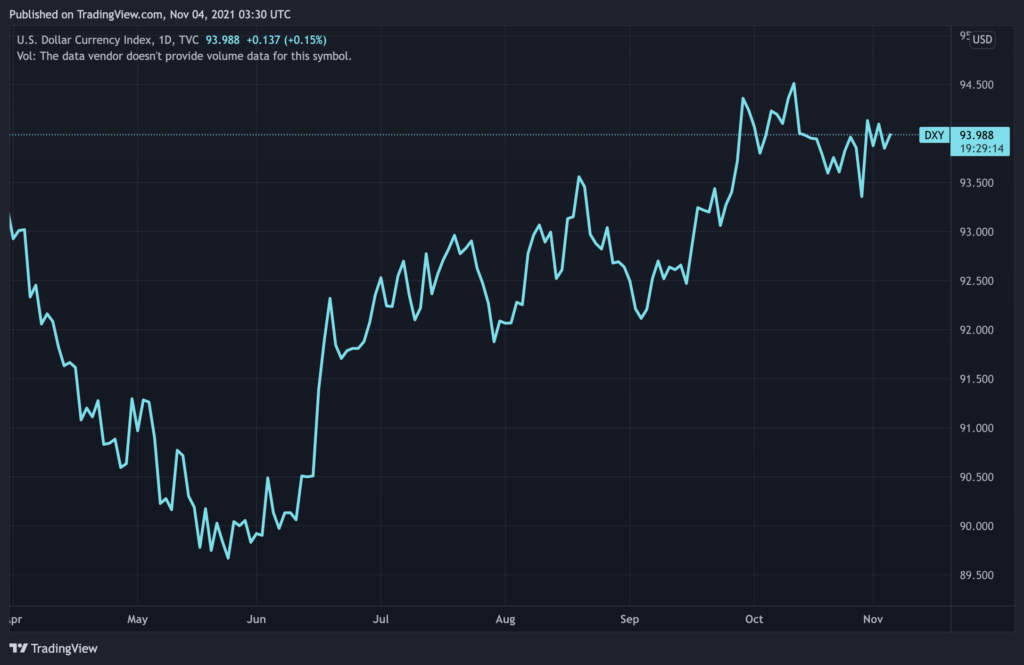
Following the taper unveiling, the US dollar was sent plummeting, while stocks soared to new record-highs— something not witnessed since January 2018.
Information for this briefing was found via the Federal Reserve. The author has no securities or affiliations related to this organization. Not a recommendation to buy or sell. Always do additional research and consult a professional before purchasing a security. The author holds no licenses.