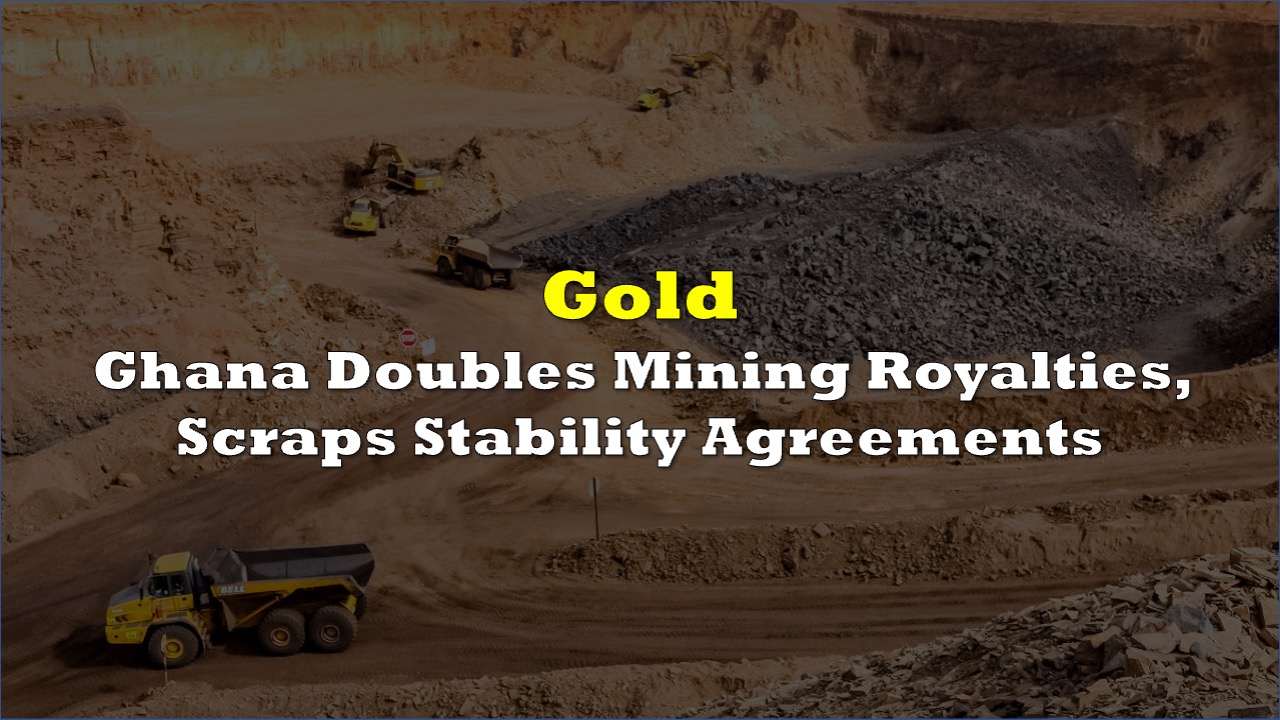

Ghana has finalized plans to double mining royalties as part of broader regulatory changes announced last year, with a draft bill heading to Parliament next month that marks the concrete implementation of the government’s promise to restructure how mining benefits reach local communities.
The Minerals Commission confirmed this month that royalties will start at 9% and rise to 12% when gold exceeds $4,500 per ounce, approximately twice the existing 3%-5% rate. The announcement fulfills commitments made in July 2025 when Lands and Natural Resources Minister Emmanuel Armah Kofi Buah first outlined the biggest restructuring of mining regulations in almost 20 years.
Related: Ghana Unveils Mining Law Reforms to Boost Community Investment
Acting Minerals Commission CEO Isaac Tandoh told Reuters that officials designed the reforms to maintain a favorable investment climate while ensuring Ghana captures more value from its mineral wealth.
Ghana doubling royalties on gold producers. Talk of 12% if gold over $4500. $nem $gfi $auhttps://t.co/Yotr7tR9sV
— The Mining Bartender (@jtourzan) January 15, 2026
“Renewal of investment stability agreements is not going to happen,” Tandoh said during an interview last week. “Renewal is conditional, not automatic.”
The reforms eliminate the development agreement system that critics say mining companies abused. “We’ve seen companies use revenue from Ghana to buy mines elsewhere while refusing to pay even basic obligations like contributions to district assemblies,” Tandoh said. “That cannot continue.”
Ghana’s approach contrasts with that of its neighbors, Mali and Burkina Faso, which applied mining reforms retroactively. “In Ghana, we don’t do retrospective laws,” Minister Buah said in July. “Existing agreements are sanctified and will be respected.”
The reforms reduce the maximum mining lease term from 30 years, eliminate automatic license renewals for companies failing environmental or production commitments, and mandate direct revenue-sharing with local communities rather than central government payments.
Newmont, AngloGold Ashanti, and Gold Fields currently operate under stability agreements. Newmont’s pact expired in December and will not be renewed, while agreements held by AngloGold Ashanti and Gold Fields will expire in 2027 without renewal.
Traditional leaders endorsed the reforms. “This time, if the Minerals Commission is to license for mining, I urge that they prioritize giving it to the people of Ghana,” Asantehene Otumfuo Osei Tutu said in July when addressing the Ashanti Region House of Chiefs.
Ghana produced 4.8 million ounces of gold in 2024, maintaining its position as Africa’s leading producer. With spot gold trading around $4,670 per ounce, the royalty increase would immediately trigger the higher rate once legislation passes.
Information for this story was found via Bloomberg, and the sources and companies mentioned. The author has no securities or affiliations related to the organizations discussed. Not a recommendation to buy or sell. Always do additional research and consult a professional before purchasing a security. The author holds no licenses.