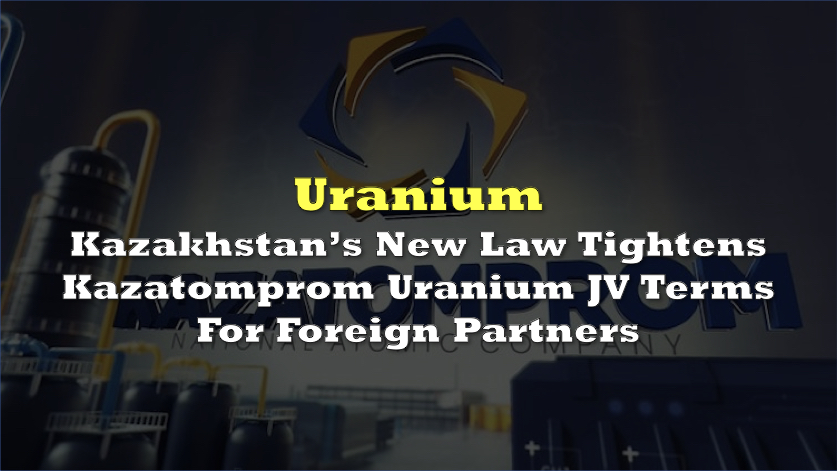

Kazatomprom on Monday stated that Kazakhstan’s president has signed a law that gives the national uranium company more control over new discoveries and tighter conditions for extending or expanding uranium joint ventures with foreign partners.
In essence, Kazakhstan is saying “new uranium finds and future growth decisions should be mostly ours,” using two big thresholds, 75% and 90%, to enforce it.
Kazatomprom said it now has priority rights to get exploration licenses for prospective uranium areas and can reserve blocks that contain uranium mineralization or deposits. If another company finds uranium on certain solid mineral blocks it holds, Kazatomprom said the other company can only extend its license if it gives up the relevant blocks to the state.
The firm also said that if another subsoil user discovers a uranium deposit in a solid mineral formation, that party does not automatically get priority rights to produce uranium from it.
🎆World's largest #Uranium miner Kazatomprom $KAP announces signing of new law in #Kazakhstan that raises state ownership level to 75% for new U #mining permits and 90% for extensions, expansion, production increases in existing JVs with foreigners🤯⚛️🇰🇿⛏️🤠🐂… pic.twitter.com/QiDe5Nswdm
— John Quakes (@quakes99) December 29, 2025
Kazatomprom said that for new uranium production subsoil use agreements (SUAs) awarded to the national company, any later transfer of that agreement can only go to an entity where Kazatomprom holds more than 75%, up from more than 50% under the previous code. Kazatomprom said this rule applies only to new SUAs, not existing ones.
For existing uranium production SUAs, the law links future flexibility to either ownership or technology. Extension of the term, or increases in production volumes or reserves beyond the currently approved levels, are allowed only if either: Kazatomprom’s ownership in the JV is at least 90%, or the foreign partner transfers uranium conversion and enrichment technologies to Kazatomprom (or a jointly created entity), under terms that include building a plant and signing a contract to buy at least 50% of the plant’s output for the entire extension period.
In short, foreign partners can keep a path to expansion, but they must either accept a much smaller ownership role or bring high-value fuel-cycle tech plus long-term demand.
Kazatomprom said the amendments also clarify grounds for early termination of SUAs, including cases where reserves under existing SUAs were fully depleted or developed as of January 1, 2024, and cases where obligations tied to raising Kazatomprom ownership or transferring technology are not met.
On additional exploration at producing deposits, Kazatomprom said that right is reserved to the national company or entities where it holds at least 90%. If another subsoil user explored after January 1, 2024 and increased reserves, Kazatomprom said the incremental reserves do not transfer to that subsoil user, but the national company must reimburse actual exploration costs if substantiated and verified by an independent auditor.
Kazatomprom explicitly clarified that the changes do not revise existing JV ownership stakes under current SUAs. The pressure point is forward-looking: new permits, extensions, expansions, and production increases now come with stricter conditions.
Information for this briefing was found via the sources mentioned. The author has no securities or affiliations related to this organization. Not a recommendation to buy or sell. Always do additional research and consult a professional before purchasing a security. The author holds no licenses.