
Venezuela’s government ordered nationwide arrests Monday for anyone accused of backing the US military operation that captured President Nicolás Maduro, publishing an emergency decree signed by Maduro hours before his capture.
The decree instructs police to “immediately undertake the search and capture throughout the national territory of any person involved in the promotion or support of the armed attack by the United States,” according to the text published Monday.
JUST IN 🔴
— Open Source Intel (@Osint613) January 5, 2026
Reuters: Venezuela has issued an emergency decree instructing police to track down and detain anyone suspected of backing the U.S. attacks on the country.
Not good.
It was unclear what charges those detained would face.
The decree, dated Saturday, January 3, was signed by Maduro as one of his final presidential acts before US forces seized him around 2 a.m. local time. Acting President Delcy Rodríguez endorsed the order when it was published on Monday.
The document declares a “State of External Commotion,” invoking a constitutional provision that grants the president near-total authority over political, economic, and social matters during conflicts that “seriously endanger the security of the nation, its citizens, or its institutions.”
This is the first time the emergency provision has been invoked since Venezuela’s current constitution came into force in 1999.
Under the emergency decree, Rodríguez can exercise sweeping authority over political and economic matters, suspend certain constitutional guarantees, mobilize security forces for mass detentions, and control information and restrict movement.
The decree frames the arrests as a response to what Venezuela calls an illegal US invasion, though legal experts say the order could be used to target anyone celebrating Maduro’s removal or supporting a democratic transition.
The decree unleashed an immediate response in Caracas. At least 14 journalists — including 11 from foreign outlets — were detained Monday near the National Assembly building where Rodríguez was being sworn in as interim president, according to the National Union of Press Workers of Venezuela. All were later released.
Gunfire being reported in Venezuela's capital Caracas.
— Faytuks News (@Faytuks) January 6, 2026
pic.twitter.com/i18rAEZyWp
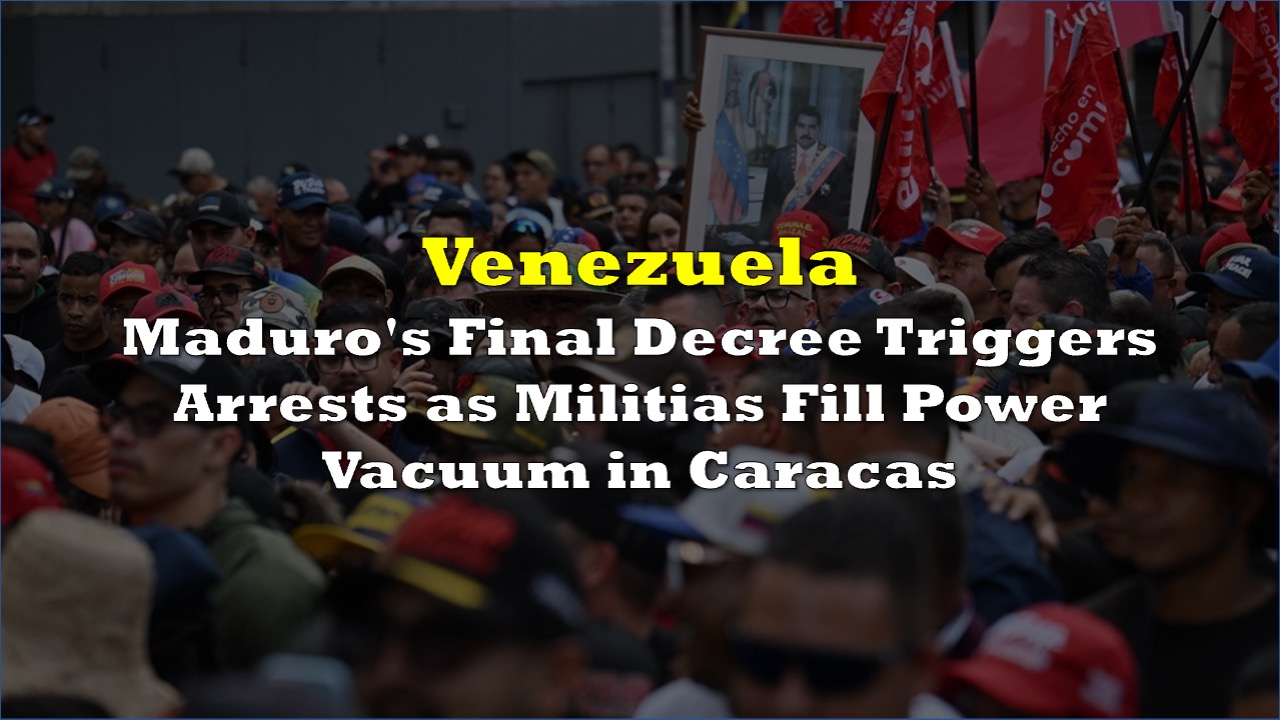
But the most visible enforcement came from colectivos, pro-government armed civilian groups that have operated for years as an informal security apparatus. These paramilitary groups flooded the streets of Caracas, intimidating residents and setting up checkpoints, according to multiple witnesses.
Heavily armed security forces and pro-government motorcycle gangs stopped drivers and checked their phones. Military counterintelligence officials patrolled the capital, according to at least two witnesses.
🚨 BREAKING
— Emmanuel Rincón (@EmmaRincon) January 5, 2026
Chavismo's paramilitary colectivos are out on the streets of Caracas, terrorizing citizens. They've started kidnapping people who are celebrating Maduro's capture.
It looks like we need a second strike very soon. pic.twitter.com/cwePn9uibu
The US State Department has said colectivos have been responsible for killings. Human rights organizations have documented them attacking protesters, journalists, and opposition figures. During protests following the disputed July 2024 election, at least 24 people died in a government crackdown that included colectivo activity.
“I think this is all part of a strategy to prevent any spontaneous protests for democracy,” Christopher Hernandez-Roy, senior fellow at the Center for Strategic and International Studies, told reporters Monday.
The crackdown has created an atmosphere of fear rather than freedom. Much of Caracas remains eerily quiet. Businesses are shuttered, workers skip jobs, and residents stay indoors. The streets that should have been filled with celebration remained largely empty.
“I see a somewhat warlike atmosphere. Silence can say many things,” a driver from eastern Caracas told CNN, asking not to be identified for security reasons.
Defense Minister Vladimir Padrino López appeared on television alongside Rodríguez, declaring the armed forces and militias remain loyal to the Bolivarian Revolution.
Three days after Operation Absolute Resolve, the gap between President Trump’s promise to “run” Venezuela and the reality on the ground has become starkly clear. While US forces achieved tactical success in capturing Maduro, they have not established control over the country itself.
Donald Trump announced that his Secretary of War will “run” Venezuela until the United States can carry out what he calls a “safe, proper and judicious transition.” This is not happening.
— Sizwe SikaMusi (@SizweLo) January 5, 2026
As of right now, Venezuela’s militias, specifically the Bolivarian Militia and the urban… pic.twitter.com/oraUJanOZs
“While Delta Force achieved overwhelming tactical dominance during the brief raid, they have not established persistent control over residential neighborhoods,” the Robert Lansing Institute said in its post-operation analysis. “That vacuum has been filled locally, block by block.”
The Institute’s assessment outlines two scenarios for Venezuela’s future, neither promising:
Limited US presence scenario: If the US restricts itself to air power and special operations while leaving Venezuelans to manage the transition, insurgency will likely emerge as urban unrest, terrorism, and targeted attacks on perceived collaborators rather than classic guerrilla warfare against US troops.
Large troop deployment scenario: A large and prolonged US military presence would almost certainly catalyze a broader, more organized armed resistance — what analysts call “the Iraq model.”
“In the next 6-12 months, the most probable pattern is episodic violence: bombings, armed clashes in pro-Chavista strongholds, targeted assassinations, and cartel-linked criminal activity exploiting the breakdown in authority,” the Institute warned.
Despite signing off on the decree that enables mass arrests, Rodríguez has struck a more conciliatory tone with Washington than Maduro did. On Sunday, she wrote on social media that Venezuela aspires to “balanced and respectful international relations” with the US.
“We invite the US government to collaborate with us on an agenda of cooperation oriented towards shared development within the framework of international law,” she said.
“We invite the US government to collaborate with us on an agenda of cooperation oriented towards shared development within the framework of international law to strengthen lasting community coexistence.”
— Apple Lamps (@lamps_apple) January 5, 2026
Read between the lines. pic.twitter.com/zEMp6jrCEQ
President Trump has said Rodríguez is “cooperating” but warned she would pay a “very big price” if she doesn’t “do what’s right.”
The diplomatic dance reflects the reality that neither side has full control. While Rodríguez manages the government apparatus and security forces in Caracas, Trump’s administration maintains military dominance and economic leverage through sanctions. Meanwhile, colectivos control the streets.
Related: ‘It Was One Dance Move Too Many’: How Maduro’s Videos Triggered Deadly US Invasion
Maduro pleaded not guilty Monday in Manhattan federal court to narcoterrorism and drug trafficking charges. He remains held at the Metropolitan Detention Center in Brooklyn, with his next court date set for March 17.
Information for this story was found via the sources and companies mentioned. The author has no securities or affiliations related to the organizations discussed. Not a recommendation to buy or sell. Always do additional research and consult a professional before purchasing a security. The author holds no licenses.