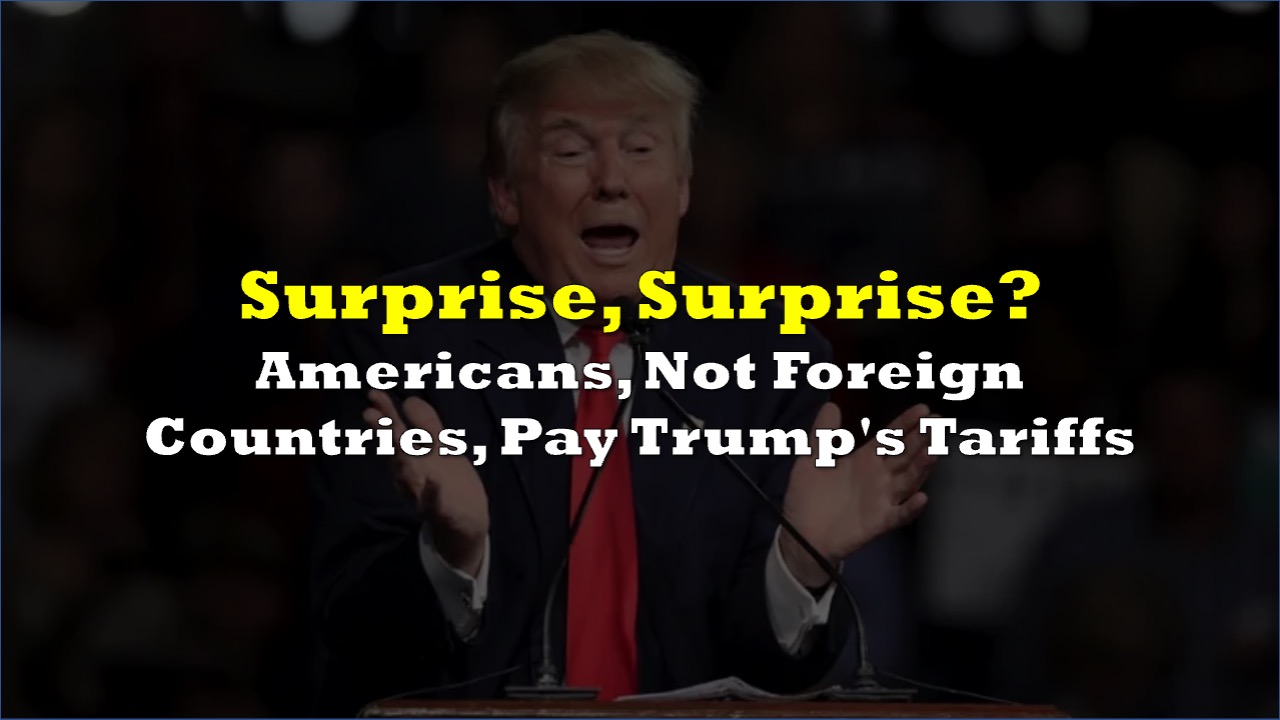

Americans bear nearly the entire financial burden of tariffs imposed by President Donald Trump, according to new research that challenges the administration’s claims that foreign countries pay these import taxes.
A study by the Kiel Institute for the World Economy analyzed more than 25 million shipment records covering almost $4 trillion in US imports. The findings reveal that American importers and consumers shoulder 96% of tariff costs, while foreign exporters absorb only 4%.
“The tariffs are an own goal,” said Julian Hinz, Research Director at the Kiel Institute. “The claim that foreign countries pay these tariffs is a myth. The data show the opposite: Americans are footing the bill.”
The research examined unexpected tariff increases on Brazil and India in August 2025. When tariffs on Brazilian imports jumped to 50% and Indian imports rose from 25% to 50%, trade volumes collapsed by up to 24%. However, the prices foreign exporters charged remained unchanged, contradicting predictions that exporters would lower prices to offset the tariffs.
US customs revenue increased by approximately $200 billion in 2025, money extracted directly from American businesses and consumers rather than foreign governments.
Tariffs as political leverage
Trump has increasingly deployed tariffs as his primary tool to achieve political objectives. On Saturday, he announced 10% tariffs on eight European countries — Denmark, Norway, Sweden, France, Germany, the United Kingdom, the Netherlands, and Finland — until a deal allows the US to purchase Greenland. Those rates escalate to 25% if no agreement materializes by June 1.
Read: Trump imposes EU tariffs until he buys Greenland
“China and Russia want Greenland, and there is not a thing that Denmark can do about it,” Trump wrote on Truth Social. “Only the United States of America, under PRESIDENT DONALD J. TRUMP, can play in this game, and very successfully, at that!”
European leaders rejected the threats. Swedish Prime Minister Ulf Kristersson responded firmly: “We will not allow ourselves to be blackmailed. Only Denmark and Greenland decide on issues concerning Denmark and Greenland.”
The European Union now considers imposing €93 billion in retaliatory tariffs on US goods and potentially restricting access for American businesses to Europe’s massive single market.
Economic consequences for Americans
The Kiel Institute research demonstrates that tariffs function as a consumption tax on imported goods. When foreign suppliers face higher tariffs, they reduce shipment volumes rather than absorb costs through lower prices. This results in both higher prices and reduced product variety for American consumers.
The tariff announcements come as the Trump administration battles widespread cost-of-living concerns. Increasing tariffs on European countries could drive up prices on pharmaceuticals, aircraft parts and industrial goods. Germany, one of the targeted nations, represents a major source of industrial and pharmaceutical imports to the US.
European Union investors maintain a massive presence in nearly all 50 US states and employ 3.4 million Americans, according to BBC reporting. Retaliatory measures would likely affect these operations and the jobs they support.
‘Uncharted territories’
European leaders expressed alarm at Trump’s approach. “We’re living through uncharted territories. We’ve never seen this before. An ally, a friend of 250 years, is considering using tariffs… as a geopolitical weapon,” said France’s Finance Minister Roland Lescure.
EU foreign policy chief Kaja Kallas warned that the tariff threats benefit adversaries. “China and Russia must be having a field day. They are the ones who benefit from divisions among allies,” she wrote on X. “If Greenland’s security is at risk, we can address this inside NATO.”
China and Russia must be having a field day. They are the ones who benefit from divisions among Allies.
— Kaja Kallas (@kajakallas) January 17, 2026
If Greenland’s security is at risk, we can address this inside NATO.
Tariffs risk making Europe and the United States poorer and undermine our shared prosperity.
We also…
The research team at the Kiel Institute used daily shipment-level data from Panjiva, official US Census Bureau statistics and Indian customs records to trace tariff effects. Their analysis compared Indian exports to the US with shipments to Europe and Canada, identifying clear patterns showing that exporters shipped less product rather than lowering prices.
“We compared Indian exports to the US with shipments to Europe and Canada and identified a clear pattern,” Hinz explained. “Both export value and volume to the US dropped sharply, by up to 24%. But unit prices — the prices Indian exporters charged — remained unchanged. They shipped less, not cheaper.”
The findings indicate that tariffs ultimately disadvantage everyone: US companies face shrinking margins, consumers pay higher prices, and exporting countries scramble to find alternative markets.
Information for this story was found via the sources and companies mentioned. The author has no securities or affiliations related to the organizations discussed. Not a recommendation to buy or sell. Always do additional research and consult a professional before purchasing a security. The author holds no licenses.