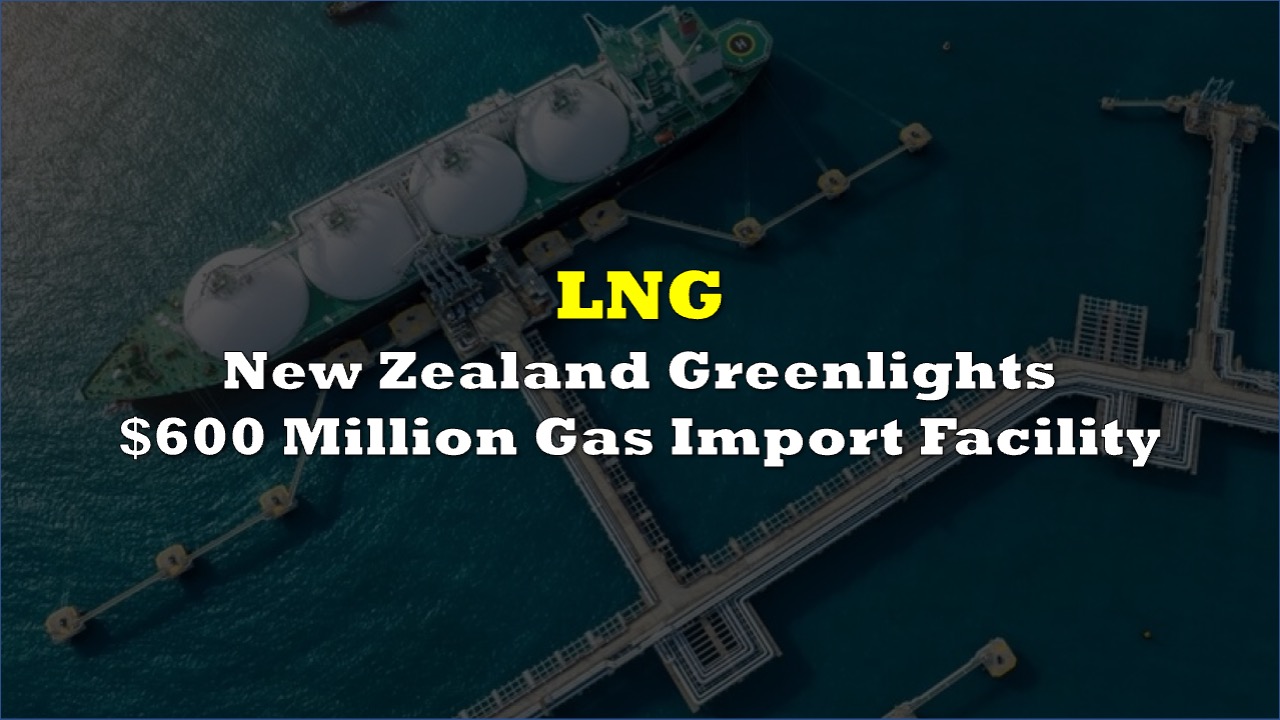

The New Zealand government will construct the country’s first facility to receive imported liquefied natural gas, officials announced Monday, though Opposition Labour immediately attacked the plan as a new tax on households.
Officials plan to finalize a construction agreement by the middle of this year for the Taranaki region terminal, which may start receiving shipments as early as 2027. Energy Minister Simon Watts said the project addresses vulnerabilities in New Zealand’s electricity system.
“New Zealand is experiencing a renewable electricity boom, but a rapidly declining gas supply has left our electricity sector exposed during dry years, when our hydro lakes run low,” Watts said. “The result is greater reliance on coal and diesel, and ultimately higher electricity prices.”
Officials estimate the project will require NZ$1 billion to build, with the US dollar equivalent at approximately $600 million. Government fact sheets show electricity customers will fund the infrastructure through charges added to power bills, estimated between NZ$2 and 4 for each megawatt-hour consumed.
Opposition Labour Party energy spokeswoman Megan Woods criticized the funding arrangement, telling Parliament the government planned to impose “an additional cost on New Zealand households” through what she characterized as a gas tax.
Watts rejected that description, telling the New Zealand Herald the levy represents “a net benefit to New Zealand households” rather than a tax on ordinary citizens. He explained the charge would apply to the electricity sector, with consumers ultimately benefiting from reduced price volatility.
“The Government has clearly signalled that we need to increase the powers of the Electricity Authority to be a more effective regulator,” Watts said.
Officials project the imported gas will stabilize electricity markets by reducing forward price volatility by a minimum of NZ$10 per megawatt-hour, an amount exceeding the proposed levy. The net result should save households approximately NZ$265 million annually, translating to roughly NZ$50 per home each year, according to government estimates.
Prime Minister Christopher Luxon told reporters Monday the terminal would “provide a reliable back-up source” during hydroelectric shortfalls caused by drought conditions. He dismissed Labour’s characterization of the funding mechanism.
“This is about lowering power bills across New Zealand. There will be lower power. Without this, New Zealanders will have higher power bills,” Luxon said.
Coalition partner Act’s deputy leader David Seymour distinguished between levies and taxes when questioned, while New Zealand First’s Winston Peters stated the levy would not affect households directly.
Research firm Sense Partners calculated that elevated energy costs erased NZ$5.2 billion from the nation’s economic output last year.
The planned terminal will accommodate annual imports reaching 12 petajoules. By 2035, imported gas access could add NZ$1.2 billion to annual economic activity if domestic production keeps falling, according to government projections. The backup supply may preserve employment for roughly 2,000 workers in gas-dependent industries, Watts said.
New Zealand lifted its prohibition on offshore energy exploration last year following a seven-year moratorium. Development of new domestic gas fields will take several years, making imports necessary in the interim.
Information for this story was found via Bloomberg, and the sources and companies mentioned. The author has no securities or affiliations related to the organizations discussed. Not a recommendation to buy or sell. Always do additional research and consult a professional before purchasing a security. The author holds no licenses.