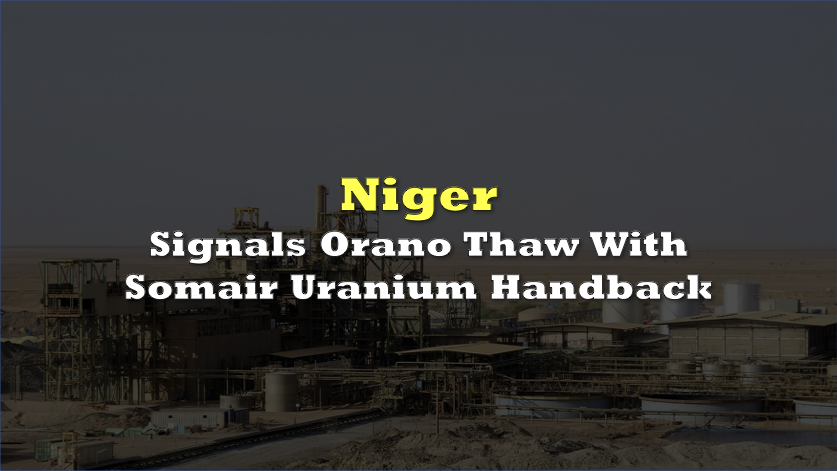

Niger’s military government said it will return uranium produced at the Somair mine to Orano, a reversal from last year’s seizure dynamics.
On Friday, Niger President Abdourahamane Tiani said on state television that the government would return uranium produced at Somair after Niger seized control of the operation in 2024. The country is planning to hand back 95,000 tonnes of concentrated uranium, or yellowcake, to Orano, an amount described as roughly 63% of output produced under the French state company’s oversight.
That 63% figure is presented as aligning with Orano’s pre-seizure share in Somair before Niger’s authorities assumed control in 2024. However, past reporting on Niger’s nationalization decision stated Niger claimed Orano extracted 86.3% of uranium output while holding a 63% ownership stake, a mismatch that Niger cited as a key grievance.
The custody issue had become acute after the junta moved the yellowcake from the facility despite an arbitration tribunal’s directive, Bloomberg reported, raising concerns about moving radioactive material through areas affected by armed groups. An attack last month also threatened Niamey’s international airport was within striking distance of an air force base where the regime was storing the yellowcake.
Niger’s move follows its Council of Ministers adopting an ordinance back in June 2025 authorizing a full takeover of Somair, ending more than 50 years of French-controlled operations at a mine where production began in 1971. Orano condemned the takeover plan and threatened legal action, while the dispute deepened a diplomatic rift that began after Niger’s July 2023 coup.
In parallel, this also comes after Mali moved to add another decade to the licence for Barrick Mining’s Loulo-Gounkoto complex, a step that follows a November settlement of a tax dispute. Barrick Mining reportedly paid $430 million in November to settle the dispute, which had closed its mine for most of last year and forced it to write off $1.0 billion in revenue.
Niger, described as the world’s seventh-largest uranium producer, has also attracted newer developers, including Global Atomic advancing the Dasa project and GoviEx Uranium with Madaouela, as the country’s policy signal shifts from blanket confrontation toward negotiated outcomes.
Information for this story was found via Northern Miner, and the sources and companies mentioned. The author has no securities or affiliations related to the organizations discussed. Not a recommendation to buy or sell. Always do additional research and consult a professional before purchasing a security. The author holds no licenses.