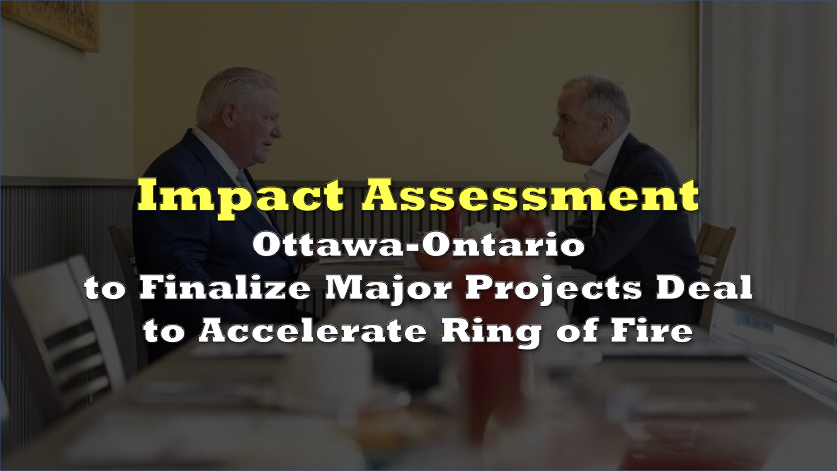

Ontario and the federal government are finalizing a major-projects deal designed to cut review duplication, with a side letter that accelerates federal timelines for parts of Ontario’s proposed Ring of Fire road to as early as June 2026.
The draft agreement, unveiled last month, mirrors Ottawa’s accords with Manitoba, Prince Edward Island, and BC’s earlier 2019 deal, and is built around Ottawa deferring to provincial processes for environmental assessments and Indigenous consultations for projects captured by the federal Impact Assessment Act.
The near-term catalyst is a letter from the head of the Impact Assessment Agency of Canada, signed by president Terence Hubbard, indicating IAAC could complete reviews of segments of the Ring of Fire road by June 2026 and allow some preliminary work to begin next year, which Ontario had expected to be three years later.
The IAAC letter says the federal regional impact assessment of the overall mining effects will continue, but it will not affect timelines for the road projects or “create any obligations on Ontario.”
Marten Falls and Webequie, two First Nations near the Ring of Fire, have signed co-operation agreements with Ontario and support development, and they have led the years-long environmental assessments for road segments themselves.
Marten Falls Chief Bruce Achneepineskum framed the deal as a practical fix to duplication, citing repeated study demands across processes, while still supporting the federal regional assessment that includes 15 local First Nations, some of which oppose Ring of Fire mining.
A provincial source said the package will be announced in Ottawa on Thursday, while the Prime Minister’s Office declined comment.
Timeline math and cost ceiling
Even with an accelerated federal review for road segments, mining in the Ring of Fire remains “many years away” on the numbers in play: the final road segment’s environmental assessment is still expected to take another three years, and construction could take a decade or more after that.
Ontario has repeatedly asked Ottawa to help fund the road, with projected costs described as close to $2 billion, a price tag that remains unchanged by process streamlining.
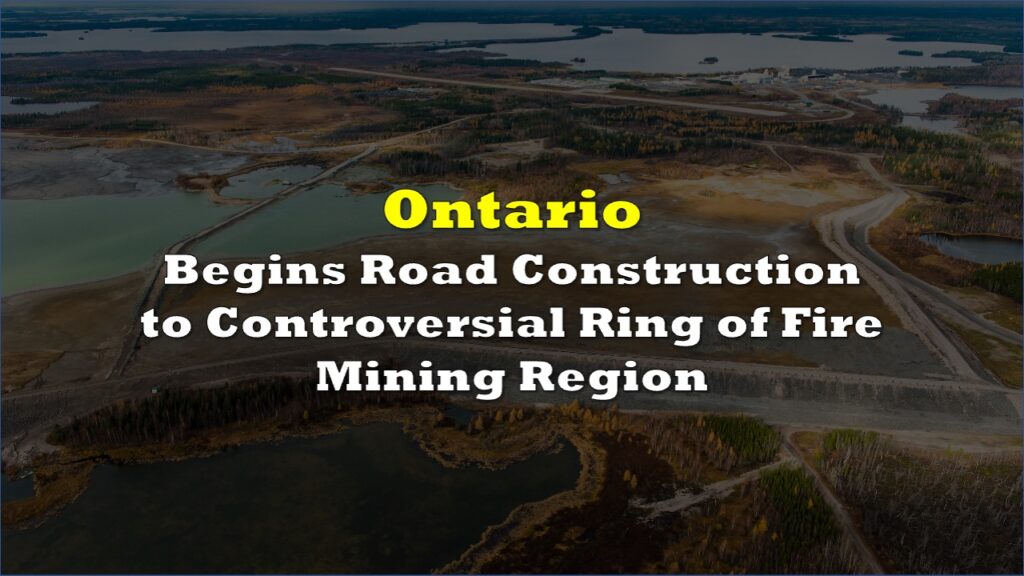
The geography remains fixed too as the Ring of Fire is described as about 500 km north of Thunder Bay, and the remoteness is a core driver of both the infrastructure scope and the multi-year sequencing.
On the other hand, Premier Doug Ford signaled he may still use Ontario’s Bill 5 powers, which allow designation of temporary “special economic zones” that can suspend provincial or municipal laws to speed projects, arguing it “moves things along a lot quicker” and is aligned with cutting red tape and regulations.
Nishnawbe Aski Nation Grand Chief Alvin Fiddler, whose organization represents 49 Northern Ontario Indigenous communities including Marten Falls and Webequie, said it was disappointing that Ontario and Canada made an agreement “regarding our lands” with limited input, emphasizing that streamlining is acceptable only if it does not diminish environmental protections or Indigenous rights.
Information for this story was found via The Globe And Mail and the sources and companies mentioned. The author has no securities or affiliations related to the organizations discussed. Not a recommendation to buy or sell. Always do additional research and consult a professional before purchasing a security. The author holds no licenses.