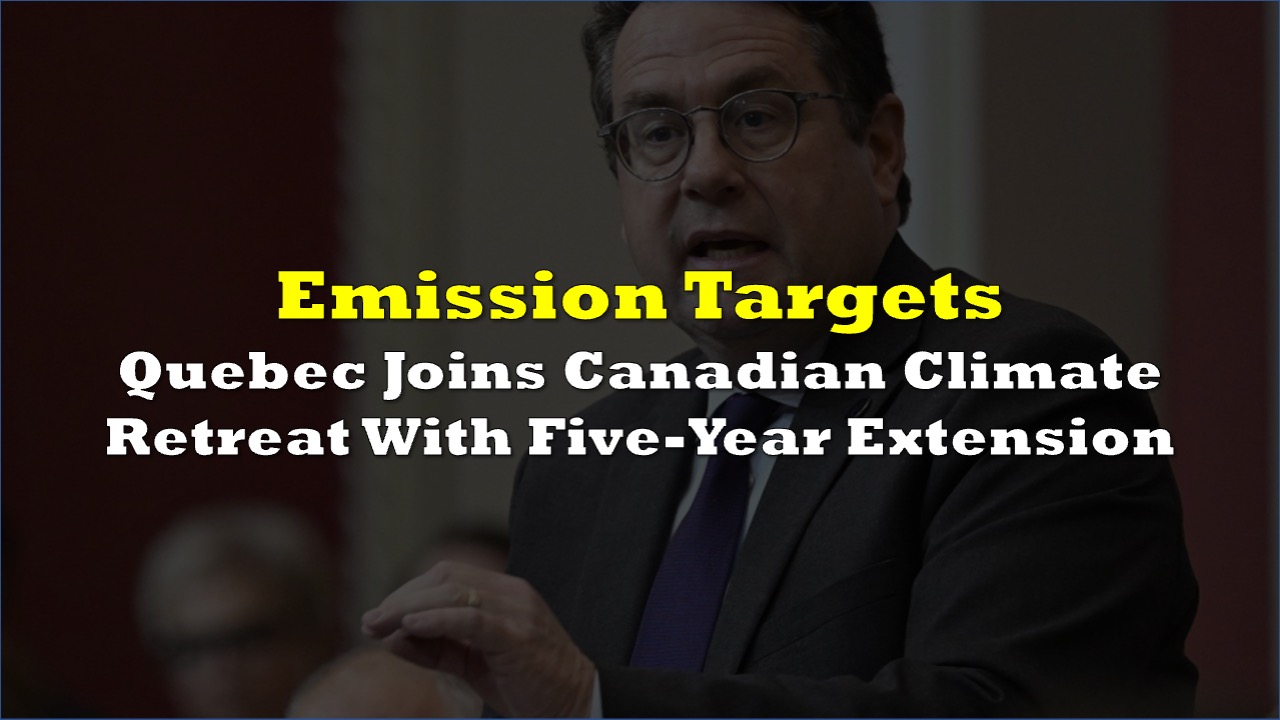

Quebec will take an extra five years to meet its greenhouse gas reduction targets, becoming the latest jurisdiction to scale back climate ambitions as economic uncertainty and trade tensions reshape environmental policy across Canada.
Environment Minister Bernard Drainville announced Thursday the province will extend its deadline to reduce emissions 37.5% below 1990 levels from 2030 to 2035, describing the delay as a pragmatic approach that protects the economy while maintaining environmental commitments.
The extension follows similar retreats across the country. Prime Minister Mark Carney eliminated the federal carbon tax last year. Ontario recently acknowledged it will fall short of the 2030 goals. British Columbia abandoned electric vehicle mandates.
Drainville defended the delay as necessary economic protection, citing US tariff threats and trading partner rollbacks. The minister argued on Radio-Canada that completing half the emissions reductions in five years risked damaging Quebec’s economy during an uncertain period.
In a social media statement, Drainville said economic uncertainty and tariff wars require considering workers, families, and businesses.
🌍 Cibles GES 🌍
— Bernard Drainville (@BDrainvilleQc) January 22, 2026
Pragmatiste vert : protéger notre environnement et protéger nos emplois.
On maintient la cible climatique de 37,5%, mais on se donne plus de temps pour l’atteindre (2035 au lieu de 2030) 🎯.
Le Québec a réduit ses GES de près de 20% depuis 1990. On se donne 10… pic.twitter.com/bKv4QrPmYs
Quebec’s independent climate advisory committee immediately pushed back, contradicting its November recommendation to maintain the 2030 target.
The delay forces much more abrupt and costly emissions reductions later, the Comité consultatif sur les changements climatiques warned. Concentrating cuts into a shorter timeframe increases technical, economic, and social challenges while misaligning Quebec with Paris Agreement objectives, the committee stated.
Liberal opposition critic Désirée McGraw rejected Drainville’s economic rationale during CBC News interviews. She warned that future climate adaptation costs will exceed current reduction expenses, adding that Quebec already holds advantages in clean technology and energy.
Québec Solidaire called the decision neither prudent nor balanced.
A coalition of environmental organizations denounced the delay as contradicting both scientific consensus and public consultations conducted last fall. Groups, including the David Suzuki Foundation and Nature Quebec, accused the government of undermining Quebec’s carbon market credibility.
Marc-André Viau, government relations director at Équiterre, said the government fails to balance economic and environmental concerns despite decades of discussing sustainable development principles.
The coalition noted that while some jurisdictions retreat, others advance. California, the United Kingdom, and the European Union have strengthened climate commitments rather than weakening them.
Quebec claims 20% emissions reductions since 1990, but that figure requires context. The province achieved most reductions through purchasing carbon credits from outside Quebec via its California-linked cap-and-trade system rather than cutting internal emissions.
Actual emissions within Quebec boundaries declined just 8.5% between 1990 and 2023, according to government data.
Drainville maintains Quebec will achieve carbon neutrality by 2050 despite extending intermediate targets. Premier François Legault signaled the policy shift last fall, stating Quebec cannot be North America’s sole climate leader.
The province previously weakened vehicle electrification goals in September, replacing a 2035 gas-car sales ban with a softer 90% hybrid-or-electric target.
Federal projections released in December show Canada falling far short of its 40% to 45% emissions reduction goal for 2030, underscoring the national pattern of climate policy retreat.
Information for this story was found via the sources and companies mentioned. The author has no securities or affiliations related to the organizations discussed. Not a recommendation to buy or sell. Always do additional research and consult a professional before purchasing a security. The author holds no licenses.