

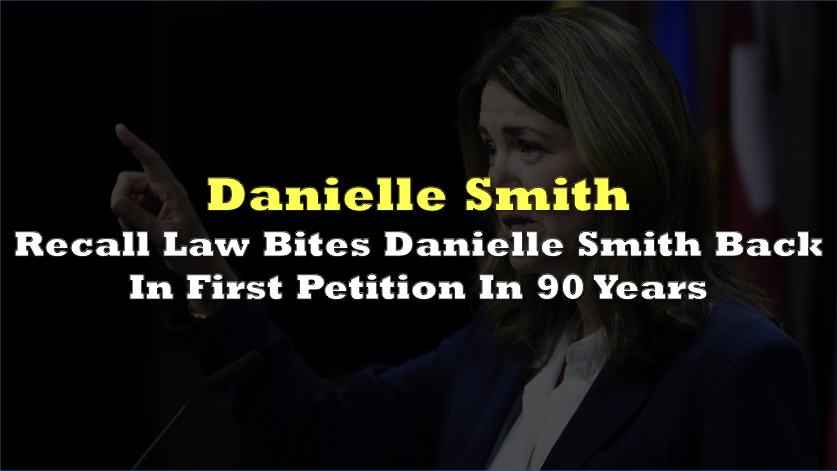

Citizen-led recall petitions against Premier Danielle Smith and 21 other MLAs are testing Alberta’s recall law as a tool of accountability.
Smith has become only the second Alberta premier to face a citizen recall effort, and the first in almost 90 years, after Elections Alberta approved petition drives in her Brooks-Medicine Hat riding and against two cabinet ministers Wednesday.
In total, 20 of the 47-member United Conservative Party caucus and one Opposition New Democrat, Amanda Chapman, are now subject to active recall petitions. Petitioners have three months to collect signatures equal to 60% of ballots cast in each constituency in the 2023 provincial election.
In Brooks-Medicine Hat, petitioner Heather VanSnick must secure just over 12,000 signatures to advance the process against Smith. In her application, VanSnick accuses the premier of sidelining local residents and experts in policy development and of weakening public services in favour of privatization, arguing that “effective leadership requires genuine connection and consistent engagement, both absent in her tenure” and that “Ms. Smith is no longer fit to serve.”
Smith rejected the accusations in her written response to Elections Alberta, saying she “regularly” meets constituents, “routinely” hosts town halls across Brooks-Medicine Hat and uses local feedback to inform “all decisions, big or small” made by her government.
Elections Alberta also issued petitions for Technology Minister Nate Glubish in Strathcona-Sherwood Park and Environment Minister Rebecca Schulz in Calgary-Shaw. Petitioners targeting both ministers argue that they have failed to address constituent concerns and viewpoints, aligning their campaigns with the broader narrative that UCP representatives are not listening to local voices amid contentious policy shifts.
Glubish and Schulz have countered by stressing they are in active communication with residents and delivering tangible constituency results.
The recall drives land in a UCP caucus already deeply entangled with the mechanism’s history. The party ran in 2019 under then-leader Jason Kenney on a pledge to introduce a Recall Act, which his government enacted in 2021 as a between-election accountability tool. Earlier this year, under Smith, the UCP further amended the law to make signature collection easier, lowering procedural barriers for citizen-initiated recall efforts and effectively increasing their potential frequency.
That legislative arc echoes Alberta’s only previous experience with recalling a premier. In 1936, Social Credit leader William Aberhart’s government passed the Legislative Assembly (Recall Act) on a similar accountability rationale, only to see it deployed against Aberhart himself a year later by Okotoks-High River constituents angered by what they called broken promises on monetary reform.
Aberhart responded by blaming “shadowy” behind-the-scenes forces and subsequently used his majority to repeal the law, ending that early recall experiment.
Information for this story was found via Global News and the sources and companies mentioned. The author has no securities or affiliations related to the organizations discussed. Not a recommendation to buy or sell. Always do additional research and consult a professional before purchasing a security. The author holds no licenses.





One Response
yes recall Danielle now! So much money wasted on private blood labs 90 million wasted and so much more; using notwithstanding clause 4 times in 3 months , never done before! autocratic domineering govt.