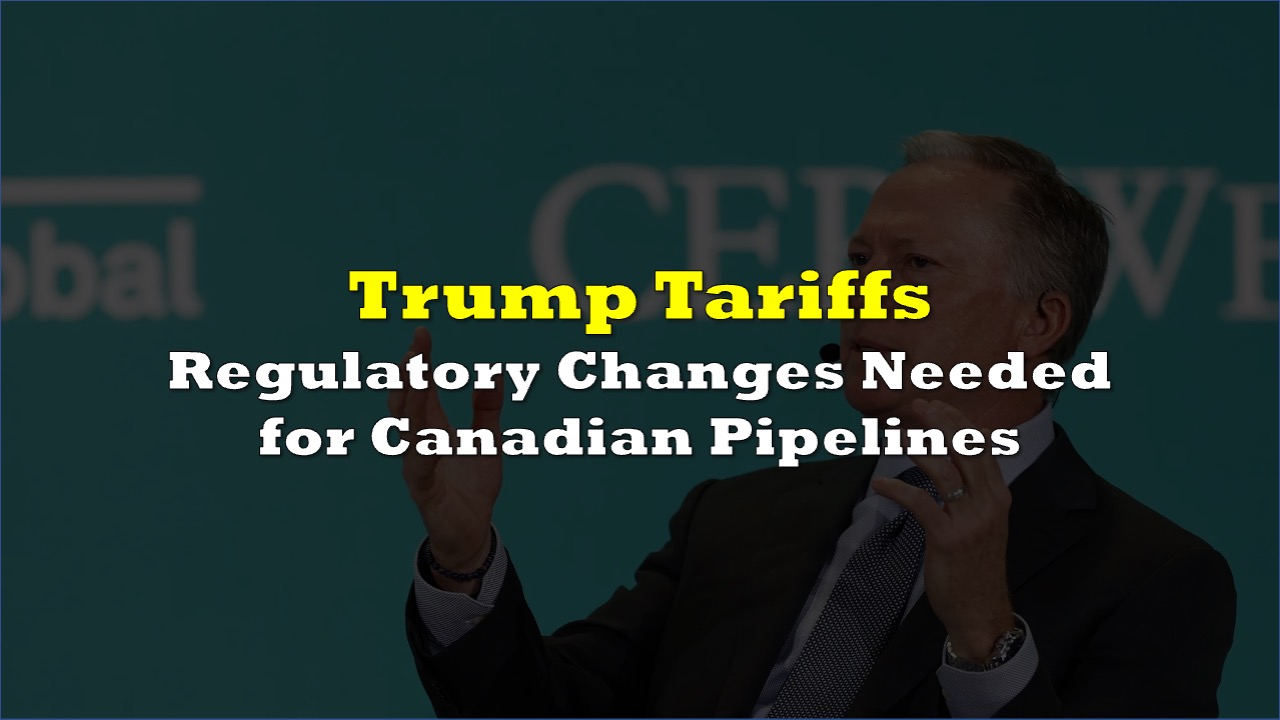

Enbridge Inc (TSX: ENB) Chief Executive Greg Ebel said on Tuesday that Canada should declare pipeline projects in the national interest to expand energy-market access as the country faces US tariff threats.
“The ability to actually get anything done would take significant legislative changes,” Ebel told reporters following an investor day event.
The only way to achieve these legislative changes, he said, would be for the government to deem projects in the national interest or to declare an energy emergency.
 Sponsored · Selkirk Copper Mines
Canada’s pipeline debate reignited after US President Donald Trump threatened in February to impose 10% tariffs on oil and gas imports.
Canadian Natural Resources Minister Jonathan Wilkinson subsequently called for a national discussion about potentially building a new east-west oil pipeline.
Read: Moe Declares Pipeline Permits ‘Pre-Approved’ as Trump Renews Keystone Push
Northern Gateway, a $7.9-billion, 1,177-kilometre pipeline proposed by Enbridge in 2006 to carry Alberta oil to British Columbia’s coast, was cancelled in 2016 when Prime Minister Justin Trudeau’s government revoked its permits.
 Sponsored · Cambria Gold Mines
Despite tariff concerns, Ebel expects cross-border pipeline shipments to continue, citing US refineries’ dependence on Canadian crude, particularly in the Midwest where facilities are designed to process heavier oil sands crude.
Read: Trump Wants Keystone XL Pipeline “Now” After Saying The US Doesn’t Need Canadian Oil
“It would be very difficult for them to find other sources of supply and, equally so, very difficult for the producers in Canada to be able to find other sources of demand,” Ebel said.
Enbridge announced a $2-billion investment through 2028 to improve its Mainline pipeline system’s reliability and efficiency. Ebel indicated these plans can be adjusted to match supply growth even amid trade tensions.
The Canadian Association of Petroleum Producers said the trade dispute underscores the importance of opening additional markets for oil and gas.
However, Chris Severson-Baker, executive director of environmental think tank Pembina Institute, cautioned against “kneejerk reactions” to tariffs such as expanding oil and gas infrastructure, suggesting Canada should instead focus on developing low-carbon energy solutions.
Information for this story was found via The Globe and Mail, and the sources and companies mentioned. The author has no securities or affiliations related to the organizations discussed. Not a recommendation to buy or sell. Always do additional research and consult a professional before purchasing a security. The author holds no licenses.