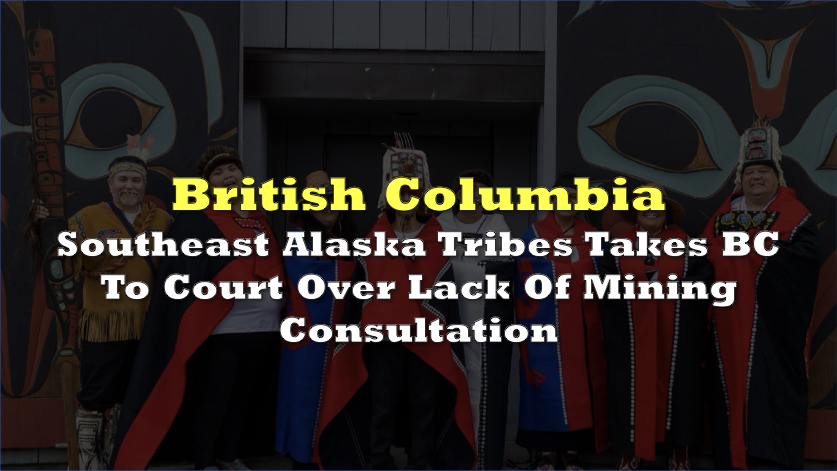

Southeast Alaska Tribes, through the Southeast Alaska Indigenous Transboundary Commission, have filed a judicial review in the Supreme Court of British Columbia challenging how the province handled consultation on major mining projects proposed in northwest BC.
SEITC says BC failed to consult the commission and its 14 member tribes on projects in the headwaters of the Taku, Stikine, and Unuk rivers, which flow across the US-Canada border and underpin rights and use on both sides.
The commission represents Tribal Nations whose traditional territory spans the border and says its members formally requested consultation on any mining project that could affect their lands or rights in the shared watersheds.
The central procedural complaint is that the province required it to submit extensive ethnographic evidence demonstrating historic and ongoing ties to the affected watersheds, that SEITC complied, and that BC’s cabinet nonetheless issued an order in council denying “participating Indigenous nation” status.
That cabinet decision, SEITC alleges, reduced the tribes’ engagement from meaningful participation to a notification level process, effectively limiting their ability to influence decisions on projects they argue may affect their rights in Canada and outcomes downstream in Alaska.
SEITC points to specific projects driving its concern, including Skeena Gold and Silver’s proposed Eskay Creek project and Newmont’s Red Chris mine, both located in the province’s northwest mining corridor.
The filing lands as Red Chris is described as among the first five major projects slated to undergo fast-track approval under Canada’s new Major Projects Office, and the mine has the support of the Tahltan nation, highlighting that affected Indigenous interests are not presented as uniform.
The commission also situates the dispute in the recent political record around Eskay Creek, noting that in 2024 a consortium of Alaska First Nations voiced opposition to the project, described as a large open-pit gold mine positioned near the Alaska-Canada border.
To ground standing and rights claims, SEITC invokes a Supreme Court decision recognizing that Indigenous groups based in the United States, whose traditional territories were severed by the border, may nonetheless hold constitutionally protected Aboriginal rights in Canada.
“While the imposition of the colonial border has partially displaced our Tribes, preventing access to traditional fishing, harvesting, spiritual, and habitation sites, and making it more difficult to maintain relationships with relatives in British Columbia, our Tribes have never surrendered or abandoned their claims to their traditional territories on the Canadian side of the border,” said SEITC President Esther Reese.
Information for this story was found via Mining.com and the sources mentioned. The author has no securities or affiliations related to the organizations discussed. Not a recommendation to buy or sell. Always do additional research and consult a professional before purchasing a security. The author holds no licenses.