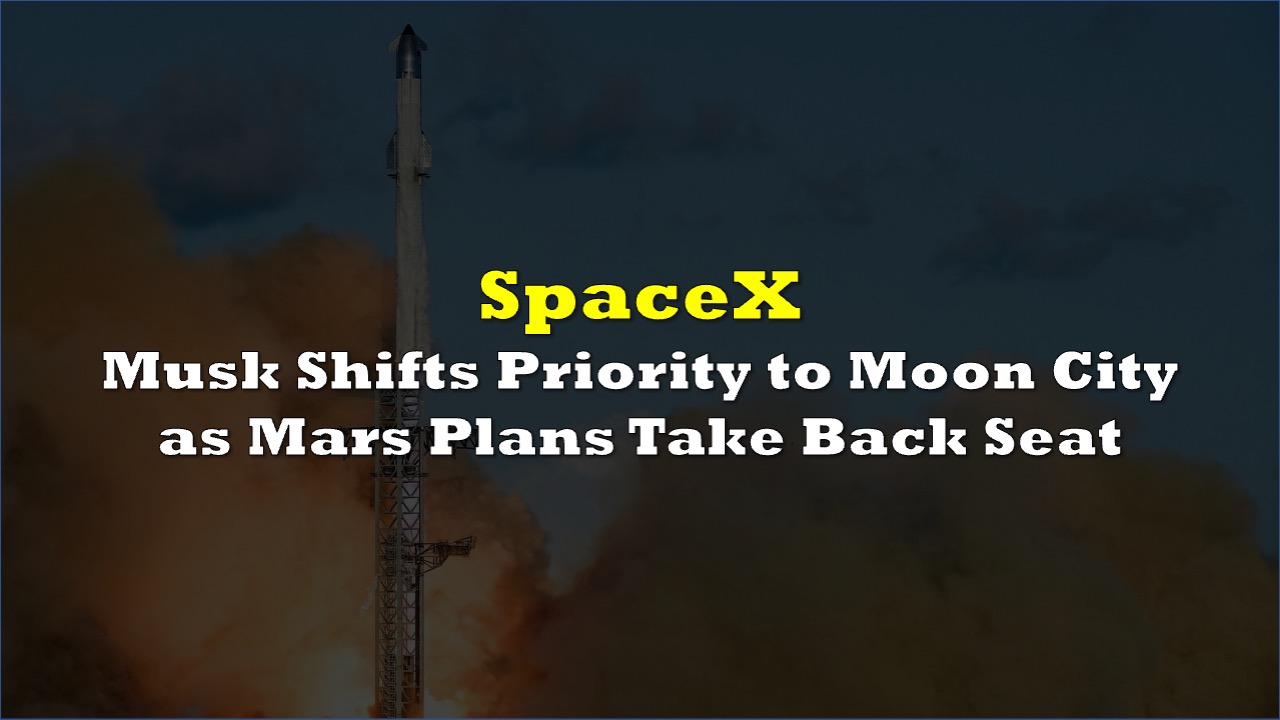

Elon Musk announced Sunday that SpaceX has redirected its primary focus toward building a self-sustaining city on the Moon, delaying his long-held ambition to colonize Mars.
The SpaceX chief executive said on X that the company now prioritizes lunar development because it offers a faster path to establishing humanity’s first off-world settlement. He estimates a Moon city could take less than 10 years to achieve, compared to more than 20 years for Mars.
Holy shit he’s officially giving up on Mars. It’s always been a lie pic.twitter.com/rdwMSRGPMZ
— evan loves worf (@esjesjesj) February 8, 2026
“The mission of SpaceX remains the same: extend consciousness and life as we know it to the stars,” Musk wrote. “But the overriding priority is securing the future of civilization, and the Moon is faster.”
He claims that the shift is brought about by orbital mechanics. Mars launch opportunities occur only every 26 months, with journeys lasting six months. Moon missions can launch every 10 days and take just two days to complete.
“This means we can iterate much faster to complete a Moon city than a Mars city,” Musk explained.
SpaceX still intends to pursue Mars colonization, with preliminary work beginning in approximately five to seven years, at least according to Musk’s statement.
In a presentation in May last year, Musk outlined plans to send five uncrewed Starships to Mars in the 2026-2027 launch window. As recently as last year, he targeted an uncrewed Mars mission by late 2026.
The Wall Street Journal reported Friday that SpaceX informed investors it would prioritize lunar missions first, targeting March 2027 for an uncrewed Moon landing.
SpaceX also recently acquired xAI, Musk’s artificial intelligence company. The merger values the combined rocket and AI operation at approximately $1.25 trillion.
SpaceX holds a nearly $3 billion NASA contract to develop the Starship lunar lander for the Artemis program, which aims to return astronauts to the Moon’s surface. The US faces growing competition from China in the renewed race for lunar exploration.
Musk posted the company’s first Super Bowl ad on Sunday, promoting its Starlink satellite internet service. He said on Monday that NASA will make up less than 5% of SpaceX’s revenue this year, with most income derived from commercial Starlink operations.
Information for this story was found via the sources and companies mentioned. The author has no securities or affiliations related to the organizations discussed. Not a recommendation to buy or sell. Always do additional research and consult a professional before purchasing a security. The author holds no licenses.