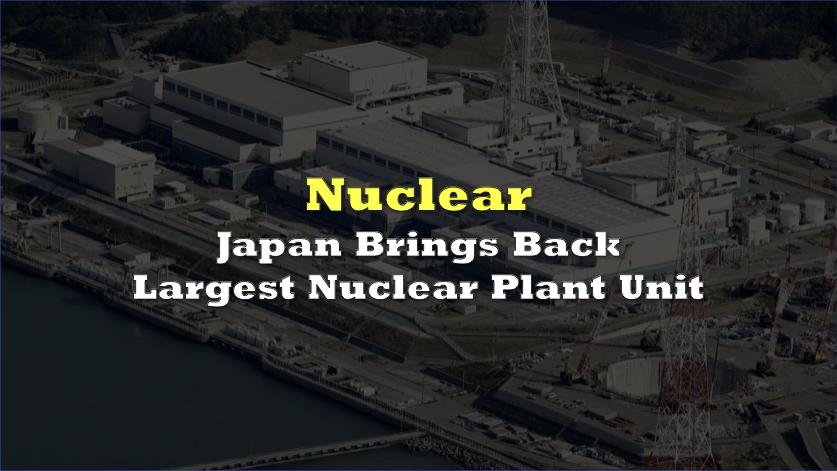

The world’s largest nuclear power plant restarted a reactor Wednesday in north-central Japan for the first time since the 2011 Fukushima disaster, marking Tokyo Electric Power Company’s first return to nuclear generation since the meltdowns.
TEPCO said operators at Kashiwazaki-Kariwa’s No. 6 reactor initiated the process toward criticality Wednesday evening, beginning a nuclear chain reaction intended to become self-sustaining. The step was delayed by one day after a faulty alarm setting was found over the weekend.
All seven Kashiwazaki-Kariwa units have been dormant since 2012, part of Japan’s post-Fukushima nationwide shutdowns, even though the plant was not affected by the 2011 quake and tsunami. The site sits about 220 kilometers northwest of Tokyo in an isolated, quake-prone region that has long fueled local distrust of evacuation planning.
If fully brought back into service, No. 6 could add 1.35 million kilowatts of electricity, which authorities estimate is enough to supply more than 1 million households in the capital region.
No. 6 was among two reactors that cleared safety tests in 2017, but it later faced an operational ban by the Nuclear Regulation Authority after serious safeguarding problems were identified in 2021. The unit received a greenlight in 2023.
The restart arrives as regulators and the public remain sensitive to nuclear oversight issues after another utility was recently found to have falsified seismic data during safety screenings for one of its reactors.
Under a government draft evacuation framework, about 18,600 residents within 5 kilometers of Kashiwazaki-Kariwa would be required to evacuate in the event of radiation leak concerns, while about 400,000 people in a wider zone would be instructed to remain indoors. Nuclear safety officials have warned that earthquake damage could make evacuation plans largely unworkable.
Japan is accelerating reactor restarts as it seeks to secure supply and cut emissions, while anticipating higher power demand from AI data centers. Under updated decarbonization targets, Japan aims to more than double nuclear’s share of its energy mix to 20% by 2040.
TEPCO says it has spent more than ¥1 trillion ($6.33 billion) on safety upgrades at Kashiwazaki-Kariwa, including seawall reinforcement, watertight protection for reactor buildings and key facilities, an emergency water injection reservoir, mobile cooling equipment, and filtered venting systems designed to reduce radioactive particle release during emergency gas venting.
The operator further said the reactor is expected to reach 50% output in about a week, then pause for inspection from late January to early February, before resuming toward full startup and commercial power generation in late February.
Information for this story was found via ABC News and the sources and companies mentioned. The author has no securities or affiliations related to the organizations discussed. Not a recommendation to buy or sell. Always do additional research and consult a professional before purchasing a security. The author holds no licenses.