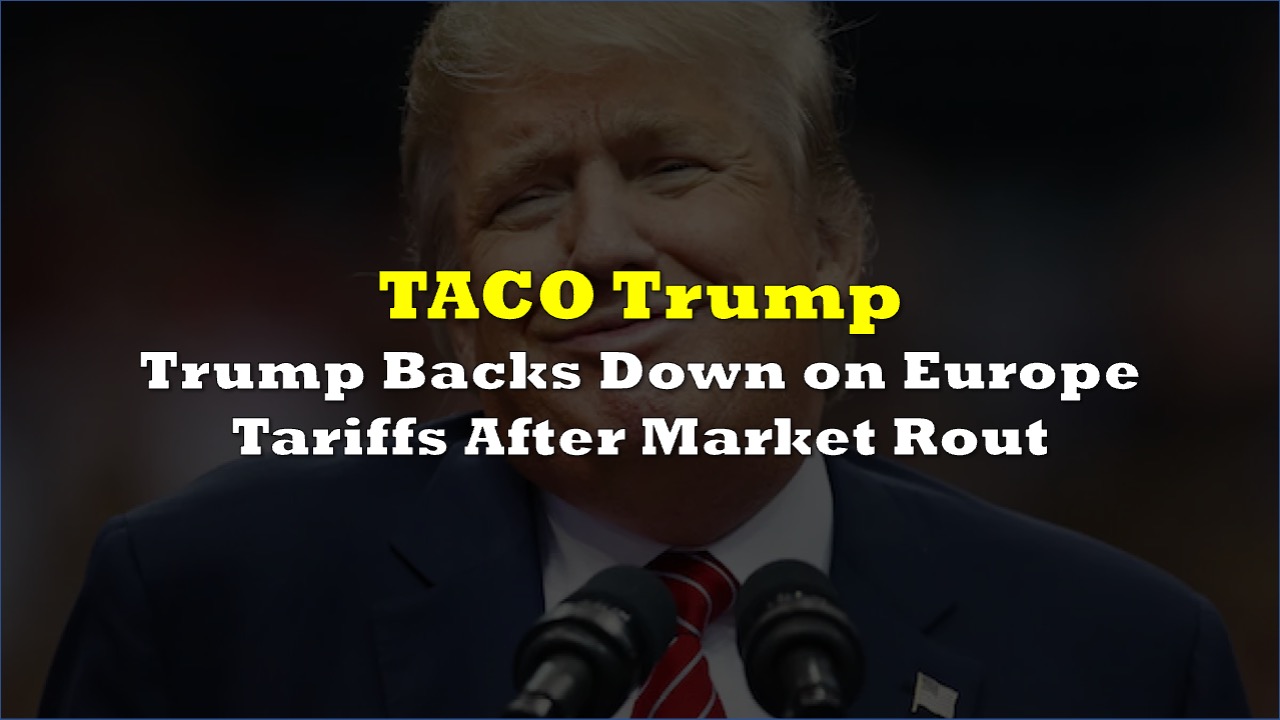

Wall Street’s TACO playbook scored another win Wednesday when President Donald Trump suspended threatened tariffs against eight European countries after markets suffered their worst selloff in three months.
The reversal came less than 24 hours after the S&P 500 plunged 2.1% — wiping out more than $1.2 trillion in value — following Trump’s refusal to rule out military force to seize Greenland from Denmark. By Wednesday afternoon, after Trump announced a tariff pause and NATO “framework” deal, the S&P 500 surged 1.16% to recover most of those losses.
Read: Markets Plunge as Trump Presses Greenland Takeover, Denmark Dumps Treasuries
The whiplash vindicated investors betting on the “TACO trade,” an acronym for Trump Always Chickens Out, a strategy that emerged last spring when Trump backed down from his “Liberation Day” tariffs after bond market turmoil. The trade involves buying stocks cheaply after tariff announcements push prices lower, then selling at a profit when Trump inevitably retreats.
“Markets were realizing that the US administration does not have a very high tolerance for market and economic pressure, and will be quick to back off when tariffs cause pain,” Financial Times journalist Robert Armstrong wrote in May 2025, coining the TACO term.
Former Vice President Al Gore, speaking at the World Economic Forum in Davos on Wednesday, suggested market pressure drove Trump’s about-face on Greenland. “I think perhaps because of the stock market’s reaction yesterday, he appeared to back down from his previous threat to use military force,” Gore told reporters.
Gore compared Trump’s Greenland push to his literal demolition of the White House East Wing. “NATO has been a tremendous foreign policy achievement for the United States,” Gore said. “And to try to take a wrecking ball to these alliances, the way he took a wrecking ball to the East Wing is literally insane.”
Asked if Trump’s claim that seizing Greenland would make NATO more secure made sense, Gore responded: “No, of course not. It’s ridiculous.”
Tuesday’s market panic had all the hallmarks of the crisis that forced Trump’s hand in April 2025. Treasury yields spiked as investors dumped bonds, the dollar weakened sharply, and gold surged to record highs above $4,700 per ounce. The Dow dropped 870 points while the Nasdaq plunged 2.4%.
European markets tumbled in tandem. Germany’s DAX fell 1%, Britain’s FTSE 100 dropped 0.7%, and the STOXX Europe 600 slid 0.7%. The volatility gauge on Wall Street, the CBOE Volatility Index, jumped to its highest level since mid-November.
Analysts had warned that only sustained bond market stress, similar to April’s “Liberation Day” crisis, would force Trump to retreat. “The US government bond market, in particular, might have to come under a lot more pressure, like it did after ‘Liberation Day’, to prompt the president to back down,” John Higgins, chief markets economist at Capital Economics, said in a note.
By Wednesday, Trump appeared to cave to that pressure. After meetings with NATO Secretary General Mark Rutte in Davos, Trump announced on Truth Social that he and Rutte had “formed the framework of a future deal with respect to Greenland and, in fact, the entire Arctic Region.”
“Based upon this understanding, I will not be imposing the Tariffs that were scheduled to go into effect on February 1st,” Trump wrote.
Trump had threatened 10% tariffs beginning February 1 against Denmark, Norway, Sweden, France, Germany, the United Kingdom, the Netherlands and Finland, with rates rising to 25% by June unless Denmark ceded Greenland. The countries had participated in NATO exercises in Greenland and issued a joint statement defending Danish sovereignty.
In a CNBC interview on Wednesday, Trump described the agreement as “the concept of a deal” but provided few details, saying it was “a little bit complex, but we’ll explain it down the line.” He declined to say whether the US would acquire Greenland, calling it “a long-term deal.”
Kernen: “Can you go into what you just talked about with the NATO meeting?”
— The Bulwark (@BulwarkOnline) January 21, 2026
Trump: “Well, we have a concept of a deal.” pic.twitter.com/igCUhKeSXH
The TACO phenomenon has become so ingrained on Wall Street that some analysts warn the pattern itself creates a paradox. If investors don’t panic when Trump makes threats, markets remain stable — potentially giving the president confidence to follow through on policies investors bet against.
“The paradox is that as markets discount the tariffs and perform strongly, that’s actually making the higher tariffs more likely as the administration grows in confidence,” Henry Allen of Deutsche Bank said last year.
Matt Maley, chief market strategist at Miller Tabak + Co., said Trump may need to see more market pain before fully retreating. “If history is any guide, President Trump will back off from the most aggressive stance he is taking,” Maley said. “However, I think it won’t happen until or unless the markets see some meaningfully negative moves.”
The pattern dates to Trump’s first term, when traders called it the “Trump put” — his tendency to change policy when markets reacted badly. During his second term, Trump has repeatedly threatened tariffs with future effective dates, using the time to pressure negotiations before backing down or reaching deals.
In April 2025, Trump’s “Liberation Day” tariffs sent Treasury yields spiking so dramatically that his administration paused most planned tariffs for 90 days. Bond investors were getting “yippy,” Trump said at the time.
Wednesday’s market rally suggested investors remain confident in the TACO trade despite Trump’s increasingly aggressive rhetoric. The Dow surged 588 points while the Nasdaq gained 1.18%. Treasury yields fell, signaling relief after two days of volatility.
However, Ethan Harris, former head of global economics at Bank of America, cautioned that TACO may be temporary. “A couple days sell-off in the stock and bond market doesn’t really move the needle,” Harris said. “The markets have learned that these corrections don’t last, therefore, no reason to panic.”
Harris suggested a different acronym: “Trump Always Tries Again,” or TATA, noting that Trump has paused policies to appease markets but eventually pursued his original goals.
Treasury Secretary Scott Bessent told reporters in Davos Wednesday morning, before Trump’s announcement, that the administration was “not concerned” about Tuesday’s selloff, though sustained bond market stress could push borrowing costs higher across the economy.
European leaders welcomed Trump’s retreat. Danish Foreign Minister Lars Løkke Rasmussen said, “The day is ending on a better note than it began. We welcome that President Trump has ruled out to take Greenland by force and paused the trade war with Europe.”
Trump’s reversal meant the EU’s “trade bazooka” remained holstered — at least for now. The bloc had scheduled an emergency summit for Thursday to discuss activating its Anti-Coercion Instrument and imposing retaliatory tariffs exceeding $100 billion on US goods. The European Parliament had halted approval of a trade deal reached with Trump last summer. Danish pension fund AkademikerPension had announced plans to sell $100 million in US Treasuries in response to Trump’s threats.
EXCLUSIVE: Germany has joined France in saying it will ask the European Commission to explore unleashing the EU's so-called trade "bazooka" in response to Trump's threat to seize Greenland, according to five diplomats with knowledge of the situation.
— POLITICOEurope (@POLITICOEurope) January 20, 2026
🔗 https://t.co/3ZMHd3zmzU pic.twitter.com/7EcNwDP2E8
The Anti-Coercion Instrument, adopted in 2023 but never before used, would have allowed the EU to restrict US suppliers’ access to European markets, exclude American companies from public procurement, impose additional taxes on US tech firms, and limit foreign direct investment. Germany had aligned with France to consider activating the mechanism, marking a significant shift from Berlin’s typically cautious stance.
Despite Wednesday’s rally, all three major indexes remained in the red for the week. The pattern raised questions about how long the TACO trade can continue before either markets stop reacting to Trump’s threats — or Trump stops responding to market pressure.
Information for this story was found via the sources and companies mentioned. The author has no securities or affiliations related to the organizations discussed. Not a recommendation to buy or sell. Always do additional research and consult a professional before purchasing a security. The author holds no licenses.