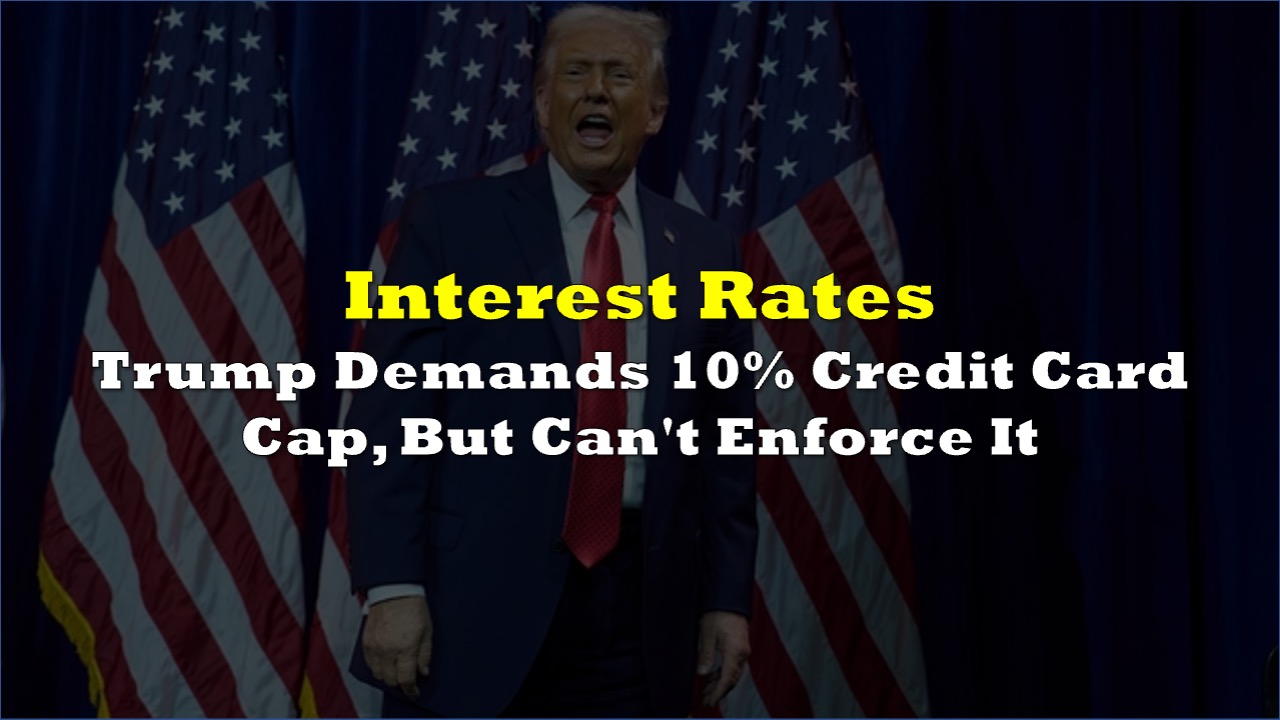

President Donald Trump called Friday for a one-year cap on credit card interest rates at 10%, reviving a campaign promise as Americans carry $1.23 trillion in credit card debt, the highest level on record.
Trump posted on Truth Social late Friday that he wants the cap to take effect January 20, 2026, but did not specify whether he would pursue it through executive action or legislation.
“We will no longer let the American Public be ‘ripped off’ by Credit Card Companies that are charging Interest Rates of 20 to 30%, and even more,” Trump wrote.
Interest Rates Near Historic Highs
Americans currently pay between 19.65% and 21.5% in credit card interest on average, according to Federal Reserve data. The rates have climbed from roughly 12% a decade ago and now sit near the highest levels since regulators began tracking credit card rates in the mid-1990s.
Researchers estimate Americans could save roughly $100 billion in interest annually if rates were capped at 10%, though credit card rewards and perks might be scaled back as a result.
Growing Financial Strain
Credit card balances have surged 60% since bottoming at $770 billion during the pandemic, reaching $1.233 trillion in the third quarter of 2025.
The 30-day delinquency rate dipped to 2.98% in the third quarter, marking the fifth consecutive quarterly decrease after 11 straight quarters of increases. However, serious delinquencies of 90 days or more have surged, driven primarily by credit cards and student loans.
Banking Industry Pushes Back
The proposal drew swift opposition from the financial sector. The American Bankers Association and allied groups warned that a 10% cap would “reduce credit availability” and “only drive consumers toward less regulated, more costly alternatives” like payday lenders.
Billionaire investor Bill Ackman, who backed Trump in 2024, called the proposal a “mistake,” warning that card issuers would “cancel cards for millions of consumers who will have to turn to loan sharks.”
Hey, Bill, stop kissing his ass. When it comes to economics he's an unhinged whirligig of statist humbug, hoo-doo and ham-handed hammering of free markets and economic liberty. The very idea of government intervention in the credit card market is neither "worthy" nor "important".… https://t.co/OaOszkTk8T
— David Stockman (@DA_Stockman) January 10, 2026
Legal and Political Hurdles
Credit card rates operate under the National Bank Act, which allows banks to charge interest based on their home state’s rules. A 1978 Supreme Court case established that banks can export these rates nationwide, meaning a president cannot override this framework through executive order. Any cap would require congressional action and face court challenges.
Sen. Roger Marshall, R-Kan., said he would work on legislation with Trump’s “full support.” Sens. Bernie Sanders, I-Vt., and Josh Hawley, R-Mo., introduced similar legislation in February.
Sen. Elizabeth Warren, D-Mass., dismissed Trump’s call as “a joke,” saying “begging credit card companies to play nice” would accomplish nothing without congressional action.
Credit card rates are governed by the National Bank Act, which lets nationally chartered banks charge interest based on the rules of their home state. That’s why so much credit card lending runs through places like Delaware and South Dakota. That setup was locked in by the 1978… https://t.co/utH3KMa2wN
— EndGame Macro (@onechancefreedm) January 10, 2026
The Real Picture
The announcement comes as Republicans face an uphill battle in the 2026 midterm elections. The GOP holds just a 220-215 House majority, where Democrats need only three seats to reclaim control, and a 53-47 Senate advantage with 22 Republican-held seats on the ballot.
Affordability has become Trump’s central vulnerability. During the campaign, he promised voters he would “immediately bring prices down, starting on Day One.” Instead, food costs have ticked up 0.2% to 0.4% monthly since he took office.
The Trump administration has simultaneously pursued deregulatory policies favoring banks. Capital One faced little resistance when it finalized its merger with Discover Financial, creating the nation’s largest credit card company.
Banking stocks have climbed nearly 40% since his November 2024 election, while the Consumer Financial Protection Bureau has been largely nonfunctional since Trump took office.
Information for this story was found via the sources and companies mentioned. The author has no securities or affiliations related to the organizations discussed. Not a recommendation to buy or sell. Always do additional research and consult a professional before purchasing a security. The author holds no licenses.