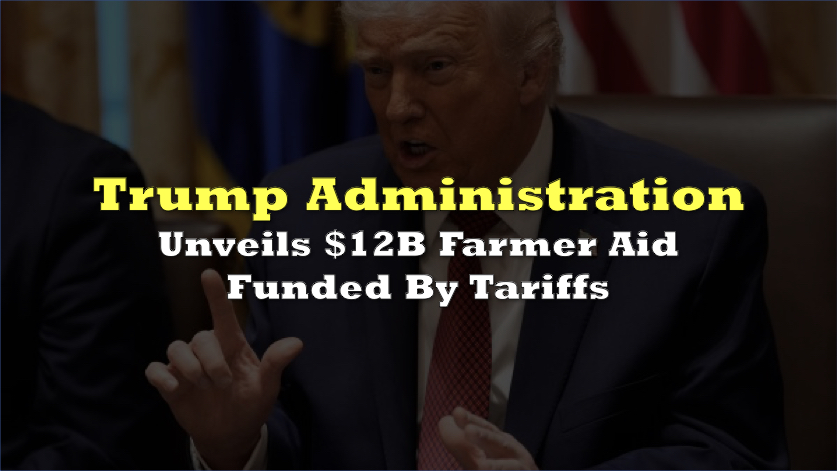

President Donald Trump’s $12 billion farm aid package is said to be a “bridge” designed to keep producers liquid through the next season while export demand, especially to China, remains uneven.
Trump announced the program at a White House roundtable alongside Agriculture Secretary Brooke Rollins and farm-state lawmakers, with the White House framing the money as coming from tariff revenue.
TRUMP: WE WILL PROVIDE $12 BILLION IN AID TO FARMERS
— *Walter Bloomberg (@DeItaone) December 8, 2025
TRUMP: U.S. WILL TAKE SMALL PORTION OF TARIFF REVENUES TO GIVE IT TO FARMERS
— *Walter Bloomberg (@DeItaone) December 8, 2025
Rollins pegged the immediate program value at $11 billion for one-time payments to row-crop farmers, with another $1 billion reserved for specialty crops as USDA refines its assessment of those producers’ circumstances.
Rollins said the aid would move by the end of February, with Reuters reporting disbursement by February 28.
USDA is expected to set per-acre payment rates later this month using a formula that estimates production costs for each crop type, converting the $11 billion pool into crop-specific, acreage-based checks. Payments will be capped at $155,000 per farm or person, and eligibility is limited to entities earning under $900,000 annually.
The package is explicitly tied to farmers’ twin squeeze of weaker crop sales and higher costs, with Reuters noting the aid is meant to help cover near-term expenses like seeds and fertilizer for the upcoming growing season. Trump also framed farmers’ pain as inflation and policy-driven cost pressure, blaming “crippling restrictions on energy, water, and countless other necessities” while pinning responsibility on the Biden era.
“Unfortunately, under Sleepy Joe Biden–he was a sleepy guy–our farmers were crushed by the worst inflation in modern history and crippling restrictions on energy, water, and countless other necessities for our farmers,” Trump said.
LMAO
— Spencer Hakimian (@SpencerHakimian) December 8, 2025
Trump blames Joe Biden for Farmers needing a bailout.
🤣🤣🤣
pic.twitter.com/zYraxmyMQ0
Soybeans and sorghum were identified as among the hardest hit because more than half of those crops are exported each year, with much of the harvest historically going to China, the world’s largest soybean buyer that has increasingly shifted purchases toward Brazil and other South American suppliers. 
After Trump met Chinese President Xi Jinping in South Korea in October, the White House said Beijing promised at least 12 million metric tons of US soybeans by the end of the calendar year, plus 25 million metric tons a year for each of the next three years. Yet reported purchases since the end-of-October announcement total more than 2.8 million metric tons, roughly one quarter of the 12 million target, while Treasury Secretary Scott Bessent said China is “on track” by the end of February, which is two months later than the original end-of-year framing.
The $12 billion headline figure is not small relative to the trade corridor it is trying to stabilize: the package size is described as roughly equal to total US soybean exports to China in 2024 and about half of total US farm-goods exports to China in 2024.
At the roundtable, Iowa farmer Cordt Holub called the funding a lifeline, telling Trump, “With this bridge payment, we’ll be able to farm another year.”
Information for this story was found via ABC and the sources and companies mentioned. The author has no securities or affiliations related to the organizations discussed. Not a recommendation to buy or sell. Always do additional research and consult a professional before purchasing a security. The author holds no licenses.