

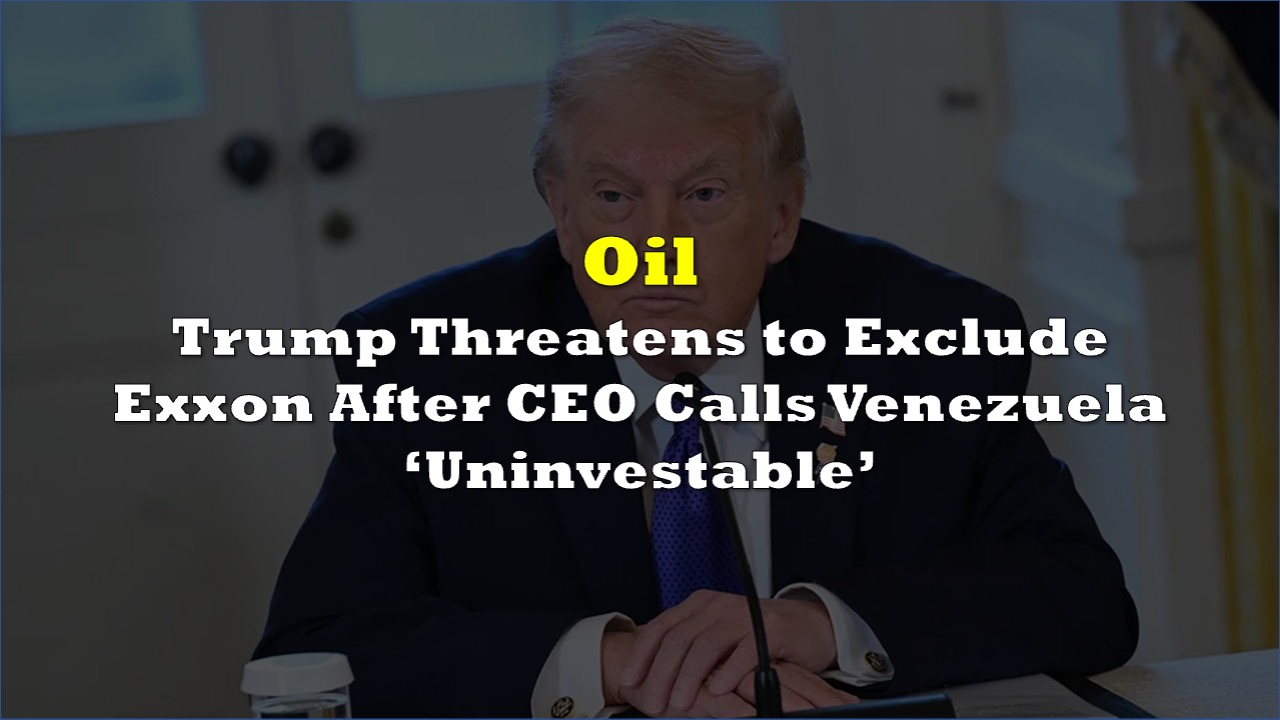

President Donald Trump’s White House meeting with oil executives on Friday produced no firm commitments to rebuild Venezuela’s petroleum industry, with the CEO of Exxon Mobil delivering a blunt message: the South American nation is currently “uninvestable.”
The tepid response from major oil companies threatens to complicate Trump’s unprecedented intervention in Venezuela, which he envisions as a yearslong effort to remake the country’s oil-dependent economy following last week’s capture of former President Nicolás Maduro.
Trump had urged the nearly 20 executives gathered in the White House East Room to spend at least $100 billion revitalizing Venezuela’s dilapidated oil infrastructure, promising “total safety, total security” for their investments.
ExxonMobil, ConocoPhillips, and Chevron all told Trump in their own ways that they won't be committing to spending billions of dollars in Venezuela soon.
— Anna Kramer (@anna_c_kramer) January 9, 2026
Exxon was most direct — called VZ "uninvestable" and described the huge lift needed to change thathttps://t.co/5oeG5aUZWF
But Exxon CEO Darren Woods told the president his company had already lost assets in Venezuela twice — in the 2007 nationalization and subsequent seizures — and returning for a third time would require fundamental changes.
“If we look at the legal and commercial constructs and frameworks in place today in Venezuela, it’s uninvestable,” Woods said during the televised portion of the meeting. “Significant changes have to be made to those commercial frameworks, the legal system. There has to be durable investment protections, and there has to be change to the hydrocarbon laws in the country.”
Woods’ skepticism quickly dominated headlines, undercutting the administration’s hopes of demonstrating industry enthusiasm for the Venezuela plan.
Trump responded Sunday evening aboard Air Force One, saying he would likely exclude Exxon from Venezuela deals.
After Exxon CEO Darren Woods called Venezuela 'uninvestable’ at the White House. Trump says he "didn’t like Exxons response and he’d be "inclined to keep Exxon out" of any deals – Newsnation
— Faytuks Network (@FaytuksNetwork) January 12, 2026
“I didn’t like Exxon’s response,” Trump told reporters en route to Washington from his Florida estate. “I’d probably be inclined to keep Exxon out. I didn’t like their response. They’re playing too cute.”
Companies Cite Legal Concerns
The creditor issue took on added significance Friday when Trump signed an executive order declaring a national emergency to block courts from seizing Venezuelan oil revenues held in US Treasury accounts.
Trump has *checks notes* seized foreign oil and ordered that U.S. companies with legitimate claims against the value of that asset should fuck off.
— Dal Riata Capital (@ReganCoda) January 10, 2026
I will never understand the oil bros who support him. He literally hates your guts. https://t.co/pC0MGSXxjP
The order explicitly prohibits “any attachment, judgment, decree, lien, execution, garnishment, or other judicial process” against Venezuelan oil funds, stating the money constitutes “sovereign property of Venezuela” unavailable to private creditors.
The move shields Venezuelan revenues from roughly $150 billion in outstanding debt claims — including the billions owed to ConocoPhillips and Exxon from arbitration awards.
Trump’s simultaneous request for $100 billion in new investments while blocking collection of existing debts created an apparent contradiction that wasn’t lost on executives.
ConocoPhillips CEO Ryan Lance, whose company describes itself as Venezuela’s largest non-sovereign creditor with claims totaling roughly $12 billion, called for a complete restructuring of state oil company Petróleos de Venezuela (PDVSA) and said banks would need to help restructure the country’s debt.
“As we think that big and bold, we need to be also thinking about even restructuring the entire Venezuelan energy system including PDVSA,” Lance told Trump.
Trump dismissed concerns about past losses, telling executives the administration would not help recover assets seized under previous governments.
Well, the White House meeting on Venezuelan oil isn’t going well for ConocoPhillips — Trump pretty much told CEO Ryan Lance to forget about the $12 billion the company is owed by Caracas (no way that’s going to happen)
— Javier Blas (@JavierBlas) January 9, 2026
“We’re not going to look at what people lost in the past, because that was their fault,” Trump said. “That was a different president. You’re going to make a lot of money, but we’re not going to go back.”
Trump asks a Halliburton Exec. when they left Venezuela.
— KevinlyFather 🇺🇲🇨🇦🇲🇼🇸🇿 (@KevinlyFather) January 10, 2026
They were forced out in 2019.
By Trump's sanctions. pic.twitter.com/olpHwzcxTC
Chevron Offers Cautious Optimism
Only Chevron — the lone US oil major still operating in Venezuela through joint ventures with PDVSA — expressed near-term readiness to expand, though with caveats.
Vice Chairman Mark Nelson said Chevron could increase production from its current 240,000 barrels per day “essentially effective immediately” with proper permissions, and could boost output 50% within 18 to 24 months.
“We have a path forward here very shortly to be able to increase our liftings from those joint ventures 100%,” Nelson told Trump.
Even Chevron sounded a note of caution in a statement after the meeting, saying its focus remained on “the safety of our people, and the integrity of our assets in strict compliance with all laws and regulations applicable to its business, as well as the sanctions frameworks provided for by the US government.”
Independents Show Interest
Several smaller independent oil companies expressed more enthusiasm than the majors.
Jeffery Hildebrand, chairman of Hilcorp Energy, told Trump his firm was “fully committed and ready to go to rebuilding the infrastructure in Venezuela.”
Treasury Secretary Scott Bessent had signaled Thursday that the administration might rely more heavily on such independents rather than cautious major oil companies.
“The big oil companies who move slowly, who have corporate boards, are not interested,” Bessent said at the Economic Club of Minnesota. “I can tell you that the independent oil companies and individuals, wildcatters — our phones are ringing off the hook.”
Energy Secretary Chris Wright echoed that optimism after the meeting, predicting Venezuelan production would be rising by summer and that $100 billion in investments could materialize over the next decade.
“They are going to ramp up investment immediately in the next few weeks,” Wright said on Bloomberg Television.
Security Questions Remain
Multiple executives raised concerns about security guarantees for personnel and equipment in Venezuela, where political uncertainty remains high despite Maduro’s removal.
Trump sought to reassure the group they would have federal protection but offered no specifics and declined to commit major military resources.
BREAKING: US calls on nationals to leave Venezuela as armed militias are 'setting up roadblocks and searching vehicles for evidence of U.S. citizenship or support for the United States'
— The Spectator Index (@spectatorindex) January 10, 2026
“You’re dealing with us directly and not dealing with Venezuela at all,” Trump told the executives. “We don’t want you to deal with Venezuela.”
When asked Sunday what guarantees his administration would provide, Trump replied: “There’s going to be no problem.”
Oil firms had experienced problems in the past “because they didn’t have Trump as a president, they had stupid people,” he added.
Wright told reporters after the meeting that the administration’s initial plan was simply to “change the behavior of the government in Venezuela” and “drive better business conditions.”
Long Road Ahead
Energy analysts say restoring Venezuela to its late-1990s peak of 3.5 million barrels per day would likely require a decade and potentially more than $100 billion in investment.
Scholars at Columbia University’s Center on Global Energy Policy estimate that expanding output by just 500,000 to one million barrels per day would require over $10 billion over two to three years. Growing production to 2.5 million barrels daily would need an estimated $80 billion to $90 billion over six or seven years, according to Daniel Sternoff, a senior fellow at the center.
Venezuela’s production currently stands at roughly 800,000 barrels per day, down from its 1990s peak, following decades of mismanagement, underinvestment, and US sanctions.
Woods said Exxon would need to send a technical team to assess the current state of Venezuela’s oil infrastructure before making any decisions — a process that could take months.
“We think it’s absolutely critical in the short term that we get a technical team in place to assess the current state of the industry and the assets,” Woods said. “With the invitation of the Venezuelan government and with appropriate security guarantees, we are ready to put a team on the ground there.”
Domestic Producers Sound Alarm
Meanwhile, US shale producers — many of whom weren’t invited to the White House meeting — expressed fury that Trump’s Venezuela push would drive down oil prices and potentially cripple domestic production.
Shale chiefs warn Trump that Venezuelan oil will hobble US drillers
— Giovanni Staunovo🛢 (@staunovo) January 9, 2026
President’s effort to drive down crude prices will hit sector struggling to sustain output growth#oott https://t.co/Z0sK3JHeUU
“We’re talking about this administration screwing us over again,” one senior oil executive told the Financial Times, calling the strategy “against American producers.”
Another warned: “If the US government starts providing guarantees to oil companies to produce or grow oil production in Venezuela I’m going to be pissed.”
Kirk Edwards, CEO of Latigo Petroleum, said the message from the administration was clear: “We’d rather spend our American money on propping up a Venezuelan oil business than supporting our current independent businesses.”
US oil prices already sit at $59 per barrel — below the $65 level many shale producers need to break even — prompting layoffs, idled equipment and spending cuts across the industry. The number of active US rigs has fallen to 412, down 15% in a year, and the Energy Information Administration expects US output to drop in 2026, the first annual decline since the pandemic.
Shares of major shale producers, including Diamondback Energy, APA Corp, and Devon Energy, each fell as much as 9% this week.
“This recent move to redirect Venezuelan crude to the US, potentially tens of millions of barrels, will put pressure on domestic shale producers,” said Linhua Guan, CEO of Surge Energy America. “With US output near record highs, smaller US shale operators face tighter margins and increased vulnerability in an already oversupplied market.”
Jasen Gast, CEO of Houston oilfield service company Oilfield Service Professionals, called the influx “more than a supply shift — it is a stress test for the American shale model.”
Trump signed the executive order on Friday — the same day as the oil executives meeting — declaring a national emergency to protect Venezuelan oil revenues from creditors. The order blocks any judicial process against the funds, which Trump said are held “solely for sovereign purposes” and must be preserved “for the good of the American and Venezuelan people.”
The White House said attachment or seizure of the funds would “materially harm the national security and foreign policy” of the United States.
Information for this story was found via the sources and companies mentioned. The author has no securities or affiliations related to the organizations discussed. Not a recommendation to buy or sell. Always do additional research and consult a professional before purchasing a security. The author holds no licenses.



One Response
…..seizure of the funds would “materially harm the national security and foreign policy” of the United States. HUH?? But they are held “solely for sovereign purposes”. Completely contradictory. Takes out a ruler of a sovereign nation……something about national security (Venezuela doesn’t traffic fentanyl Mexico does), now it is protecting funds owed to its own oil companies on foreign soil. This, while hurting the domestic oil industry, dissing legit big oil companies for having the sense to know it is a money pit…….nobody sees how nonsensical this is….how it is simple self aggrandizing ego decision making at everyone else’s expense?