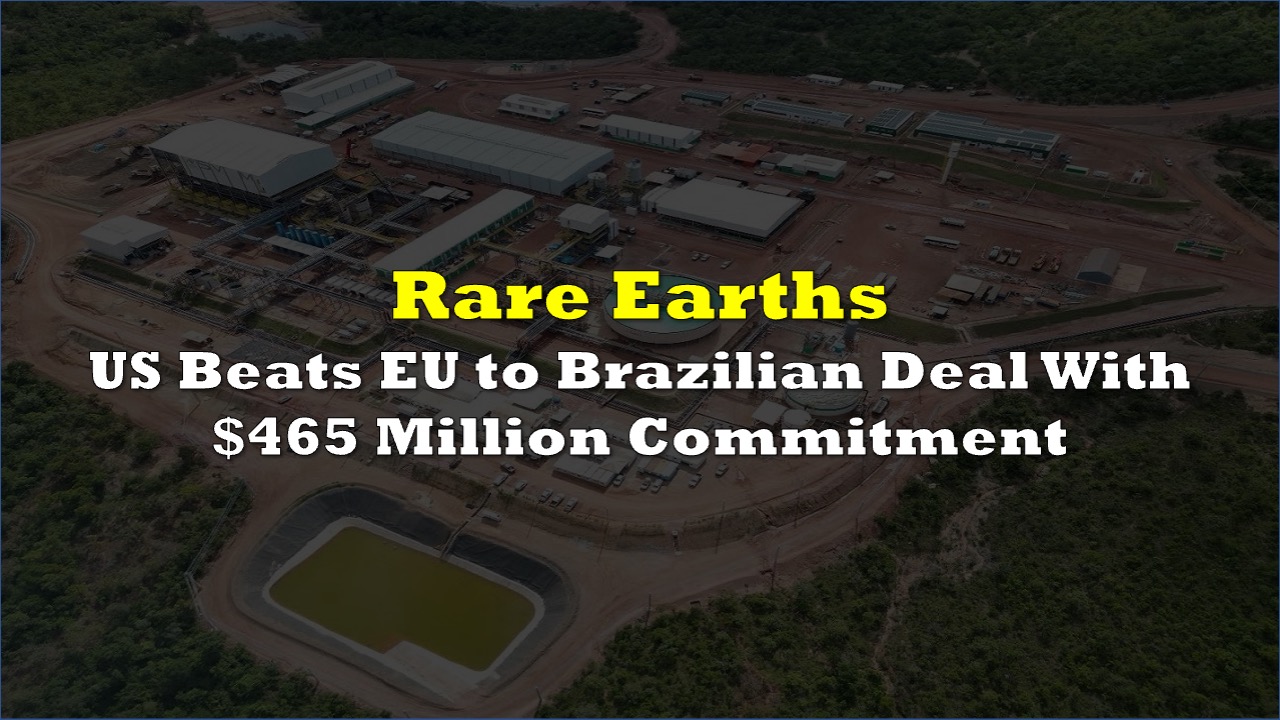

The United States secured production rights from a Brazilian rare earth mine, swooping in just days before European Union officials were planning to negotiate for the same supply, the EU’s industry chief said in an interview published Thursday.
Stéphane Séjourné, the European Commission’s executive vice president for prosperity and industrial strategy, told Dutch newspaper NRC that American officials closed the deal just days before his scheduled visit to Brazil in November.
Absolutely brutal… 🇺🇸🇪🇺
— Geiger Capital (@Geiger_Capital) December 9, 2025
The EU Commissioner of Industry:
"Last month, I was supposed to go to Brazil to discuss a rare earth mine. 3 days before, we were told that the Americans had already come, put money on the table, and bought all production until 2030." pic.twitter.com/rYLfLJcD0s
“Three days beforehand we were told that the Americans had come by, put money on the table, and bought up all production until 2030,” Séjourné said. “We knew they were busy, but we assumed that because of the shutdown no money was available.”
Séjourné did not identify the specific mine in the interview. However, the timing and details align with the US International Development Finance Corporation’s approval of up to $465 million in November to support Serra Verde’s Pela Ema mine in Brazil’s Goiás state. The announcement came on November 8, consistent with Séjourné’s reference to events “last month.”
Serra Verde operates Brazil’s first commercial-scale rare earth production facility. The mine produces neodymium, praseodymium, terbium, and dysprosium — critical elements that manufacturers use in permanent magnets for electric vehicles, wind turbines, and defense systems. The company aims to produce between 4,800 and 6,500 metric tons of rare earth oxides annually by early 2027.
Western powers are racing to reduce dependence on China, which dominates global rare earth supply. Beijing controls roughly 70% of worldwide mining operations and processes 85% of rare earths globally.
Related: US Commits $100 Billion to Break China’s Grip on Critical Minerals
Séjourné’s comments came as the European Commission unveiled its RESourceEU plan on December 4, allocating €3 billion to reduce reliance on Chinese supplies of critical materials. The plan establishes partnerships with resource-rich countries, including Brazil and South Africa.
“We want to limit our risks if it comes to a major conflict between China and the United States,” Séjourné told NRC, adding that Europe must become more self-sufficient in strategic materials.
China tightened export controls on rare earth materials in April 2025, disrupting supply chains for European automotive and clean energy manufacturers. Beijing announced potential additional restrictions in October.
Brazil holds the world’s second-largest rare earth reserves at approximately 21 million metric tons, though the country produced only 20 metric tons in 2024, according to the U.S. Geological Survey.
The European Union aims to source no more than 65% of any strategic raw material from a single country by 2030 under its Critical Raw Materials Act. Current EU dependence on China for rare earths exceeds 90%.
Information for this story was found via the sources and companies mentioned. The author has no securities or affiliations related to the organizations discussed. Not a recommendation to buy or sell. Always do additional research and consult a professional before purchasing a security. The author holds no licenses.