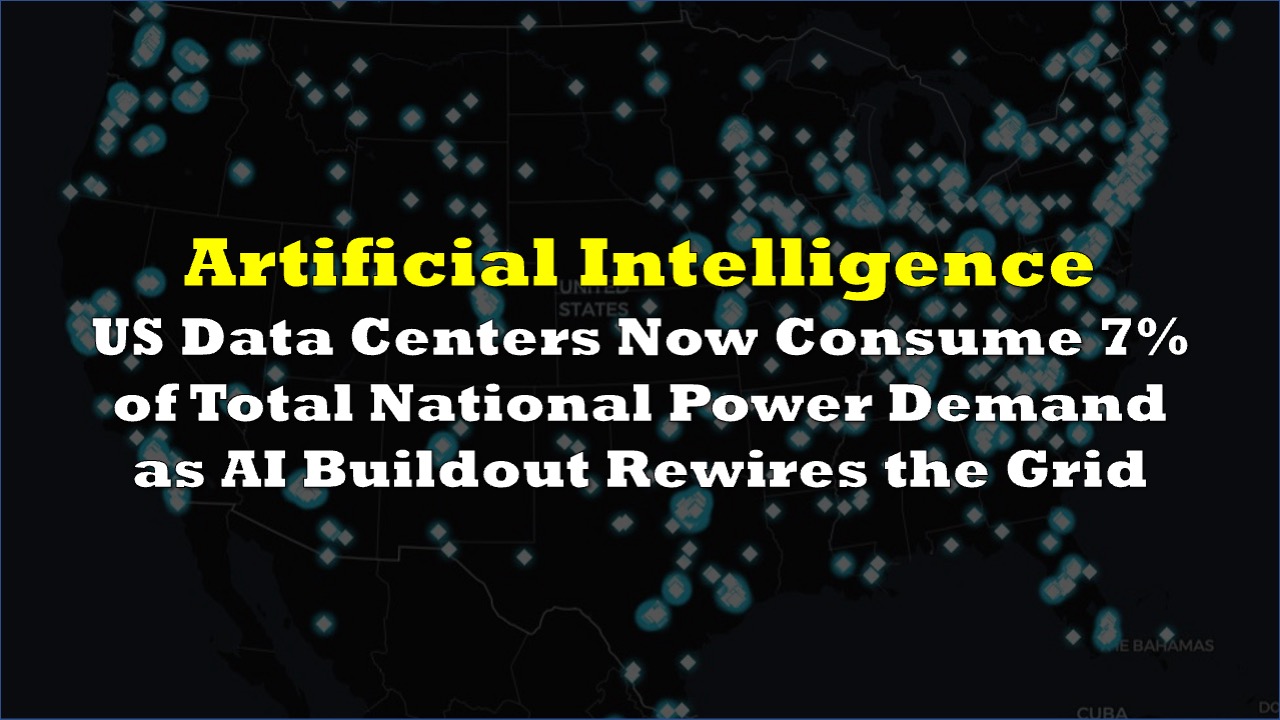

US data centers now account for roughly 7% of the country’s total electricity demand — a milestone the International Energy Agency confirmed in its Global Energy Review published on Monday, which found data center electricity demand grew 17% in 2025 alone.
The figure marks a sharp climb from 4.4% in 2023, when the Department of Energy’s Lawrence Berkeley National Laboratory last published a comprehensive count. The IEA had projected that US data center consumption would reach approximately 6% of national power use by 2026; AI infrastructure buildout arrived ahead of schedule and higher than anticipated.
Data centers drove approximately half of all US electricity demand growth in 2025, with that share projected to hold through 2030. American electricity demand climbed 2.1% last year — roughly double the previous decade’s average — and the IEA expects that pace to continue, with data centers responsible for the majority of new load.
 Sponsored · Selkirk Copper Mines
The EIA separately identified large computing facilities as the primary driver behind what it called the strongest four-year demand growth period since 2000.
The buildout’s physical scale is unprecedented. Amazon (Nasdaq: AMZN), Microsoft (Nasdaq: MSFT)), Google (Nasdaq: GOOG), and Meta (Nasdaq: META) committed a combined $320 billion in capital expenditure in 2025, up from $230 billion the prior year.
AI-driven server racks that consumed 8 kilowatts in 2021 now routinely exceed 50 kilowatts, requiring entirely new cooling infrastructure and dedicated power agreements. The largest AI training campuses draw anywhere from 100 megawatts to a full gigawatt — enough to power entire cities.
But the grid is not keeping pace. The North American Electric Reliability Corporation has warned of elevated risk of summer electricity shortfalls across all three major US grid regions through 2026 and beyond. Utilities in Virginia, Texas, Oregon, and Arizona face generation and transmission backlogs, delaying construction of facilities already financed and permitted.
In the PJM market stretching from Illinois to North Carolina, data centers drove an estimated $9.3 billion increase in capacity market costs for 2025–26, adding roughly $16–18 a month to residential electricity bills in parts of Ohio and Maryland.
Fortune noted on Monday that the buildout has made data centers a focal point for public anger at the tech industry, with residents near major hubs in Virginia, Texas, and Georgia mounting opposition to new facilities even as utilities scramble to keep up.
Information for this story was found via the sources and companies mentioned. The author has no securities or affiliations related to the organizations discussed. Not a recommendation to buy or sell. Always do additional research and consult a professional before purchasing a security. The author holds no licenses.