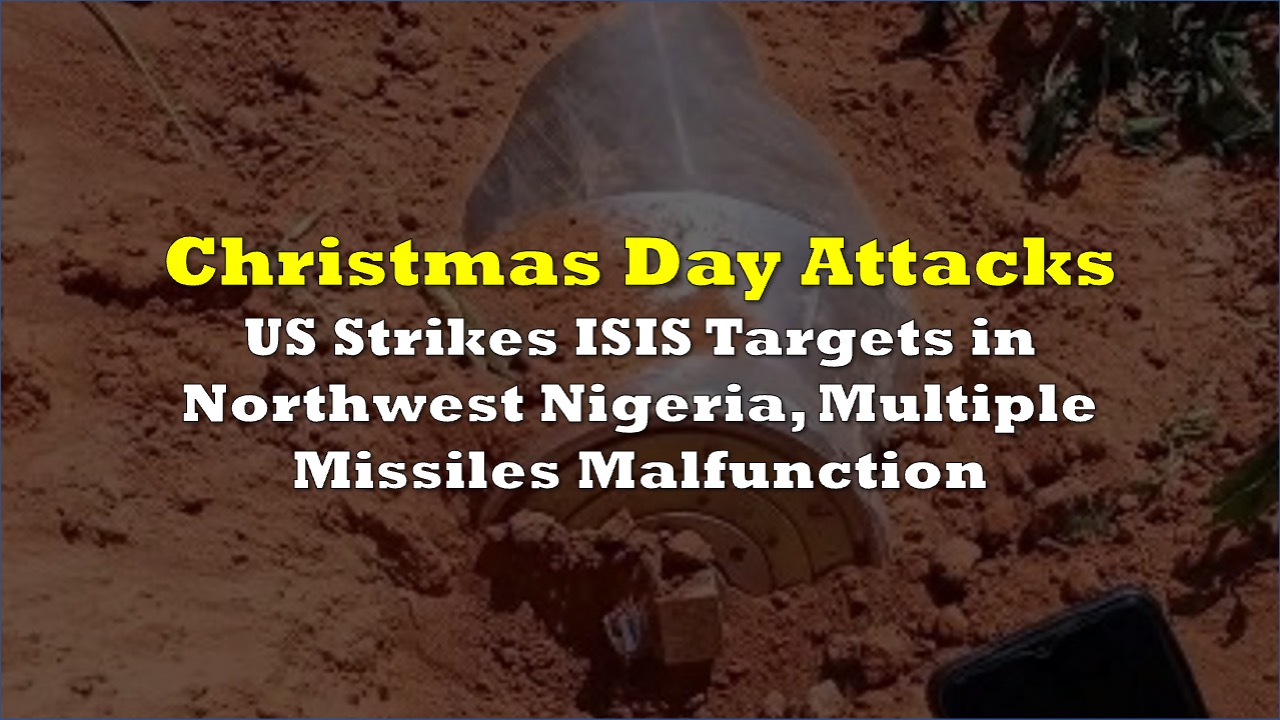

The United States launched cruise missile strikes against alleged Islamic State camps in northwest Nigeria on Christmas Day, but military analysts confirmed that multiple Tomahawk missiles malfunctioned during flight, with unexploded warheads and debris landing in populated villages.
US Africa Command conducted the operation between 12:12 a.m. and 1:30 a.m. local time on December 26, firing 16 GPS-guided precision munitions using MQ-9 Reaper drones at two ISIS camps in Bauni forest near Tangaza, according to Nigerian Information Minister Mohammed Idris Malagi.
Trump’s Christmas Day attacks on Nigeria a complete failure and cost nearly $30 million.
— Anonymous (@YourAnonCentral) December 27, 2025
Witnesses report the US struck fields and farmland in areas with no history of terrorist activity or presence. On top of that multiple US missiles failed to detonate & sunk into the dirt. pic.twitter.com/UlclSRvfaM
A Navy vessel also launched Tomahawk cruise missiles from the Gulf of Guinea, US officials confirmed. However, multiple missiles malfunctioned during flight, with unexploded warheads and debris landing in Jabo village in Sokoto State and near a hotel in Offa, Kwara State.
Conflict researcher Trevor Ball of Bellingcat documented fragments consistent with Tomahawk cruise missiles, including intact WDU-36/B high-explosive warheads weighing approximately 310 kilograms. Defense analysts suggest the missiles’ safety mechanisms prevented detonation after detecting flight-path deviations.
Nigerian authorities reported five civilians sustained injuries in Offa, where four buildings suffered damage. In Jabo, the strikes destroyed farmland approximately 500 meters from the village’s only primary health center.
President Donald Trump announced the operation Thursday evening, stating he delayed the strikes by one day to coincide with Christmas. Trump framed the military action as protecting Christians from ISIS persecution in Nigeria.
Nigerian Foreign Minister Yusuf Tuggar told CNN he spoke twice with US Secretary of State Marco Rubio before the operation — once for 19 minutes — and that President Bola Tinubu authorized the strikes.
“This is not about religion. It is about Nigerians, innocent civilians, and the wider region as a whole,” Tuggar said, emphasizing that both Muslims and Christians face terrorism threats in Nigeria.
Residents of Jabo expressed confusion about the strikes. Suleiman Kagara, a local farmer, told CNN his village has no history of ISIS activity. State lawmaker Bashar Isah Jabo described the community as peaceful with “no known history of ISIS, Lakurawa, or any other terrorist groups operating in the area.”
Did Hegseth bomb the wrong people again? pic.twitter.com/Such0WOS0H
— Spencer Hakimian (@SpencerHakimian) December 27, 2025
The strikes likely targeted Lakurawa, a relatively new armed group that Nigeria classifies as a terrorist organization due to suspected ISIS affiliations. Security researchers document the group as primarily comprising foreign fighters from the Sahel region.
US Africa Command stated its initial assessment indicates “multiple ISIS terrorists were killed in the ISIS camps.” Gen. Dagvin Anderson, AFRICOM commander, said the command works “with Nigerian and regional partners to increase counterterrorism cooperation efforts.”
Nigeria’s Foreign Ministry confirmed the operation resulted from “structured security cooperation” involving intelligence sharing and strategic coordination. The ministry emphasized the strikes targeted “foreign ISIS-linked elements” attempting to infiltrate from neighboring Sahel countries.
The operation is the first known direct US military intervention in Nigeria, a country of approximately 237 million people, roughly divided between Christians and Muslims. Nigeria has battled various militant groups for more than a decade, including Boko Haram and Islamic State-affiliated organizations.
Defense Secretary Pete Hegseth posted on social media that there was “more to come” following the strikes, though he provided no additional details.
Security analysts note that while the intended targets in Bauni forest may have been successfully struck, the missile malfunctions that scattered debris across populated areas have raised questions about targeting accuracy and civilian safety in future operations.
Nigerian Defence Minister Christopher Musa has stated that military intervention against Islamic militants addresses only 30% of the conflict, with the remaining 70% requiring improved governance in Nigeria’s northern regions, where government authority remains limited.
Information for this story was found via the sources and companies mentioned. The author has no securities or affiliations related to the organizations discussed. Not a recommendation to buy or sell. Always do additional research and consult a professional before purchasing a security. The author holds no licenses.