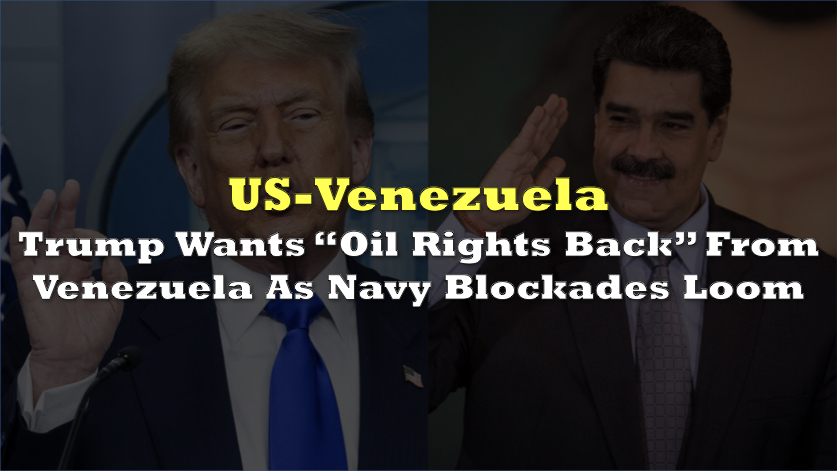

Trump’s Venezuela posture is being operationalized through oil-centric demands and maritime pressure, while Venezuela has begun naval escorts for outbound cargoes and the US House rejected a War Powers check by a two-vote margin.
In his remarks, Trump said Venezuela was “getting land, oil rights, whatever we had,” adding, “They took our oil rights… They threw our companies out. And we want it back.”
Trump on Venezuela: "Getting land, oil rights, whatever we had — they took it away because we had a president that maybe wasn't watching. But they're not gonna do that. We want it back. They took our oil rights. We had a lot of oil there. They threw our companies out. And we… pic.twitter.com/qP6DhQGNY5
— Aaron Rupar (@atrupar) December 17, 2025
It’s always about oil.
— Javier Blas (@JavierBlas) December 17, 2025
(Must admit, at least the Trump administration is crystal clear about it) pic.twitter.com/wS9bn1fiDN
The maritime lever is Trump’s “total and complete blockade” framing, described publicly as targeting tankers to and from Venezuela that violated US trade sanctions.
On Capitol Hill, a proposed resolution failed 211–213 with 9 not voting, which, if it were to pass, would have directed the president, under War Powers procedures, to remove US Armed Forces from hostilities “within or against Venezuela” absent a declaration of war or specific authorization for force.
The Venezuela War Powers resolution has failed in a vote of 211-213, with nine members not voting. An absolute dereliction of duty from Congress. pic.twitter.com/vHf2sXoYfO
— Dave DeCamp (@DecampDave) December 17, 2025
My honest reaction is exactly this https://t.co/CtieaD42Js
— Tommy Vietor (@TVietor08) December 18, 2025
Venezuela’s immediate response, per reporting that cited ship-tracking data and people familiar with the moves, was to order its Navy to escort ships carrying petroleum products as they departed the country’s east coast between Tuesday evening and Wednesday morning.
The escorted vessels were described as departing Puerto José bound for Asian markets, with cargoes including urea and petroleum coke and other oil-based products.
PDVSA said vessels connected to its operations were continuing to sail “with full security, technical support and operational guarantees” in what it called the legitimate exercise of the right to free navigation. 
The new escort posture lands on top of a recent enforcement precedent: the US seizure of the tanker Skipper after it departed José with about 1.8 million barrels of Venezuelan crude.
Risk metrics in the background are explicit in the reporting chain: roughly 40% of tankers that have transported Venezuelan crude in recent years have been placed under US sanctions.
President Nicolás Maduro reportedly “calls on Colombia’s army to come to Venezuela’s aid, if necessary,” as Trump “escalates his standoff with Caracas,” while also noting Colombia’s historical status as the closest US military partner in Latin America and that ties between Washington and Bogotá are “deeply strained right now.”
Maduro reportedly called for a “unión perfecta” with Colombia’s military to defend sovereignty, describing the context as a US deployment in Caribbean waters framed as counternarcotics.
Maduro calls on Colombia's army to come to Venezuela's aid, if necessary, as Trump escalates his standoff with Caracas. Colombia has long been the closest U.S. military partner in Latin America — but ties between Washington and Bogota are deeply strained right now. https://t.co/GfQG2FefHY
— Phil Stewart (@phildstewart) December 18, 2025
Information for this story was found via The New York Times and the sources and companies mentioned. The author has no securities or affiliations related to the organizations discussed. Not a recommendation to buy or sell. Always do additional research and consult a professional before purchasing a security. The author holds no licenses.