

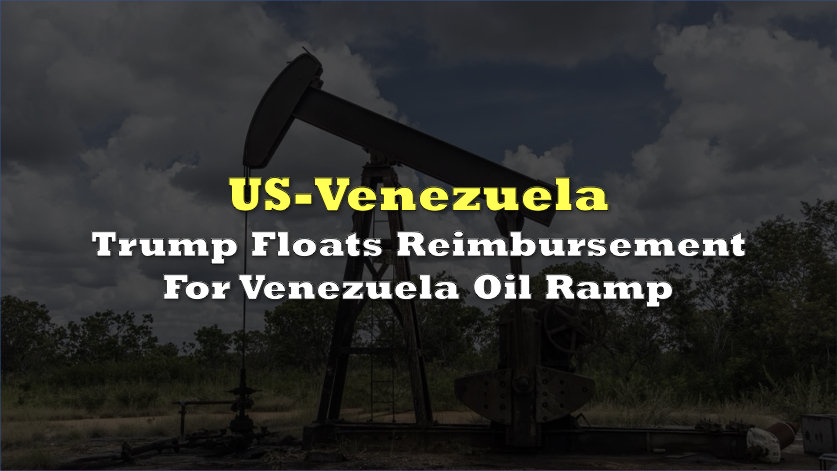

President Donald Trump publicly tied expanded US oil operations in Venezuela to a reimbursement promise, telling NBC News that companies funding repairs and upgrades would “get reimbursed by us, or through revenue,” and pegging an “up and running” timeline at fewer than 18 months.
In the interview, Trump framed the schedule as potentially faster than 18 months, but repeatedly emphasized cost intensity, saying “it’ll be a lot of money,” and that the oil companies will spend it before repayment mechanisms kick in.
Trump declined to quantify the bill, saying only that “a very substantial amount of money will be spent,” while arguing the private-sector economics work.
Call me crazy, but I don’t think we should spend taxpayer dollars to pay oil companies to undercut American oil producers with dirtier Venezuelan crude. https://t.co/Xje04fSvVJ
— Matthew Yglesias (@mattyglesias) January 6, 2026
The reimbursement language establishes two distinct payback paths with very different fiscal implications: direct government reimbursement, which implies taxpayer exposure, versus reimbursement “through revenue,” which implies project cash flows as the repayment source.
For oil companies, the decision set implied by Trump’s phrasing is binary: accept upfront spending with a government backstop, or accept upfront spending with repayment contingent on future Venezuela-linked revenue, which changes risk, cost of capital, and how quickly capital can be recycled.
The political argument against the plan is also binary: if reimbursement is taxpayer-funded, critics can label it an explicit subsidy to foreign-output expansion, while if reimbursement is only “through revenue,” companies face a different question of whether project economics alone justify accelerated reinvestment.
Reuters characterized Trump’s comments as the US potentially subsidizing oil companies to rebuild Venezuela’s energy infrastructure, while also noting the absence of details on the subsidy scale or which companies could participate.
Trump’s operational claim hinges on speed-to-production, but the only hard number provided is the “fewer than 18 months” target.
Information for this briefing was found via the sources mentioned. The author has no securities or affiliations related to this organization. Not a recommendation to buy or sell. Always do additional research and consult a professional before purchasing a security. The author holds no licenses.




One Response
Magical thinking