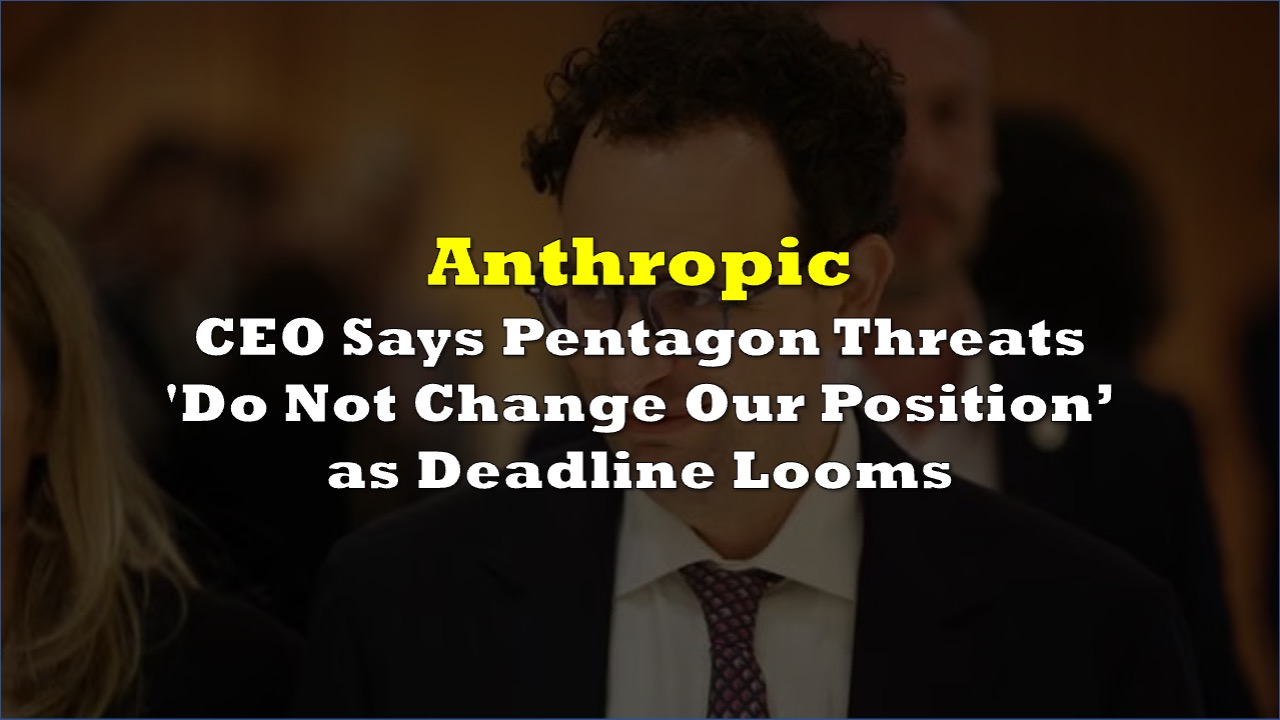

Anthropic CEO Dario Amodei on Thursday publicly rejected the Pentagon’s “best and final offer” in the standoff over military use of its AI model Claude, saying the Defense Department’s threats “do not change our position” and that the company “cannot in good conscience accede” to its demands.
The statement, published as a blog post on Anthropic’s website, came hours before a Friday 5:01 PM ET deadline set by Defense Secretary Pete Hegseth for Anthropic to drop its restrictions on autonomous weapons and mass surveillance of Americans — or face contract termination and designation as a supply chain risk.
Read: Hegseth to Anthropic: Allow Autonomous Weapons and Mass Surveillance of Americans — or Else
Amodei’s rejection appears to set the stage for a direct confrontation between the government and one of the country’s most prominent AI companies.
WASHINGTON (AP) — Anthropic CEO says AI company 'cannot in good conscience accede' to Pentagon's demands to allow wider use of its tech. pic.twitter.com/84dmmQfJaN
— philip lewis (@Phil_Lewis_) February 26, 2026
The Pentagon sent its final contract offer overnight on Wednesday. Anthropic said the new language failed to deliver on either of its core concerns.
“New language framed as compromise was paired with legalese that would allow those safeguards to be disregarded at will,” the company said.
CBS News reported that a source familiar with the negotiations said the Pentagon engineered the new language to look like compromise while embedding clauses that would allow either side to override the restrictions at will.
Amodei’s blog post made clear Anthropic is not walking away — but neither is it surrendering. “Our strong preference is to continue to serve the Department and our warfighters — with our two requested safeguards in place,” he wrote.
He added that if the Pentagon chooses to offboard Anthropic, the company “will work to enable a smooth transition to another provider, avoiding any disruption to ongoing military planning, operations, or other critical missions.”
On the threats themselves, Amodei delivered his sharpest line of the dispute: the Pentagon’s twin ultimatums are “inherently contradictory,” he wrote — “one labels us a security risk; the other labels Claude as essential to national security.”
The public nature of Amodei’s rejection drew an equally public response from the Pentagon. Chief spokesman Sean Parnell posted on X reiterating the 5:01 PM deadline and threatening contract termination and the supply chain risk designation — but notably dropped any mention of the Defense Production Act, which Hegseth had previously said he would invoke to compel Anthropic’s compliance.
The Department of War has no interest in using AI to conduct mass surveillance of Americans (which is illegal) nor do we want to use AI to develop autonomous weapons that operate without human involvement. This narrative is fake and being peddled by leftists in the media.… https://t.co/3pjWZ66aXz
— Sean Parnell (@SeanParnellASW) February 26, 2026
Pentagon official Emil Michael went further, calling Amodei a “liar” with a “God complex” who was “putting our nation’s safety at risk,” according to Axios.
Behind the ultimatums, NBC News reported that Anthropic had offered the Pentagon use of Claude for missile defense — a detail that suggests Anthropic’s position is not an absolute refusal to support military operations, but a targeted objection to two specific applications it considers unreliable or unconstitutional.
Amodei has argued in the blog post and in prior statements that frontier AI systems “are simply not reliable enough to power fully autonomous weapons” and that human oversight cannot be replaced by a model prone to hallucinations and incapable of the battlefield judgment that trained soldiers exercise.
Axios reported that the Pentagon had already begun preparing for the supply chain risk designation, reaching out to defense contractors, including Boeing and Lockheed Martin, to determine how deeply embedded Anthropic’s technology is in their operations.
The dispute drew sharp criticism from Capitol Hill on Thursday. Republican Sen. Thom Tillis, a member of the Armed Services Committee, called the Pentagon’s handling of the matter “sophomoric” and said Anthropic is “trying to do their best to help us from ourselves.”
Democratic Sen. Mark Kelly of Arizona was more direct, saying the Pentagon is “trying to strong-arm Anthropic into providing every tool they have to surveil U.S. citizens” and that the demand is “unconstitutional.”
Multiple senators called for the deadline to be stayed so Congress could weigh in, with Sen. Elissa Slotkin of Michigan saying: “These are fundamental issues of our time.”
Related: Anthropic Safety Head Abandons Tech for Poetry, Warns of Global Crises
Senate Armed Services Committee chair Roger Wicker, a Republican, struck a more pragmatic tone, predicting the dispute would be resolved and adding that “if Anthropic doesn’t choose to follow this business plan, there are other sources.”
The stakes for Anthropic extend well beyond its $200 million Pentagon contract. A supply chain risk designation would require every company with Defense Department contracts to certify it has no exposure to Anthropic’s products — a requirement that could cascade through the enterprise market where Anthropic counts more than 500 customers spending over $1 million annually.
Gregory Allen, a senior adviser at the Center for Strategic and International Studies, in a CNN report, put the broader risk plainly: “You do not want to take one of the crown jewels of your industry and light it on fire over something like this.”
Claude remains the most deeply integrated AI model in classified Defense Department networks — Grok cleared classified access only days ago and is not yet considered a full operational substitute — and the Pentagon has acknowledged that losing it would cause significant disruption to ongoing operations.
Information for this story was found via the sources and companies mentioned. The author has no securities or affiliations related to the organizations discussed. Not a recommendation to buy or sell. Always do additional research and consult a professional before purchasing a security. The author holds no licenses.