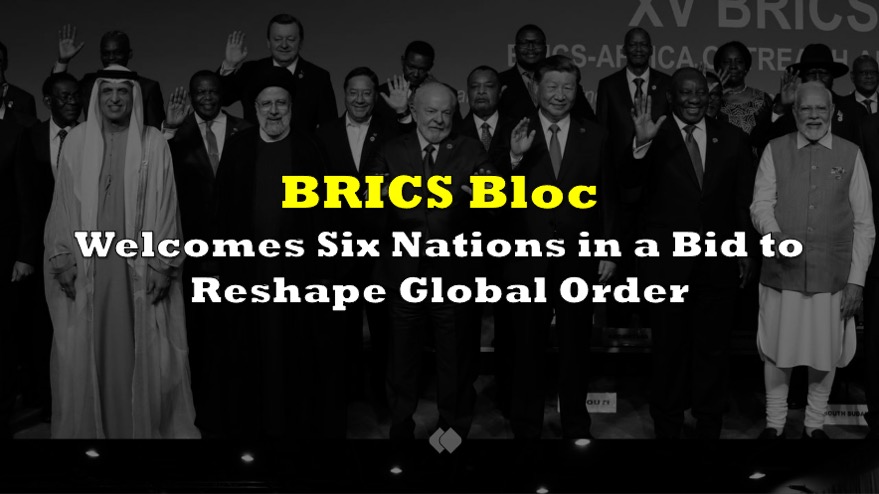

The BRICS alliance, which originally consisted of Brazil, Russia, India, China, and South Africa, made an unprecedented decision to expand its membership.
BRICS has formally announced that they will be accepting:
— Jackson Hinkle 🇺🇸 (@jacksonhinklle) August 24, 2023
– Argentina (IMF)
– Saudi Arabia (de-facto OPEC+ leader, petrodollar nuked)
– Egypt (received over $80 BILLION in U.S. foreign aid since 1978)
– UAE (long-standing close relations w/ US)
– Iran
This changes everything. pic.twitter.com/0afpCbFUKi
In a significant bid to revamp what they perceive as an obsolete global order, the group has welcomed six new nations: Saudi Arabia, Iran, Ethiopia, Egypt, Argentina, and the United Arab Emirates. This growth not only injects economic vigor into the bloc but hints at several oil titans’ gradual pivot away from the US and their aspirations to elevate their global stature.
New composition of BRICS will control 80% of world oil production
— Sprinter (@Sprinter99800) August 24, 2023
With the addition of Saudi Arabia, the United Arab Emirates and Iran to the BRICS, the Union will be able to control the lion's share of the world's oil production.
The same goes for the sharp GDP growth of the… pic.twitter.com/gqVkGbZ7Ic
Despite this growth, the group remains shadowed by inherent tensions. China and Russia envision BRICS as a counterbalance to the West; in contrast though some members, like Brazil and India, continue to foster strong relationships with western nations, pointing towards potential internal disparities in vision and strategy.
Zakharova: The results of the BRICS summit are great, isolation as a weapon of the USA has been defeated forever
— Sprinter (@Sprinter99800) August 24, 2023
"It is not BRICS that threatens the United States of America, it is the state of the USA, its liberal economy, the neoliberal model. I think that the expansion of… pic.twitter.com/dbhBu5G60c
BRICS, which now constitutes about 40% of the global populace and a fourth of its GDP, embodies a myriad of ambitions and mutual interests, many of which stem from the notion that the west’s policies are rigged against their favour. For instance, Brazil championed Argentina’s cause, Russia and Iran unite against US-imposed sanctions, and Beijing’s closeness with Ethiopia aligns with South Africa’s aim to bolster Africa’s global voice.
Meanwhile, on the global scale, BRICS has expanded rather significantly.
— Clandestine (@WarClandestine) August 24, 2023
In terms of oil production and GDP, this is a MASSIVE blow to the West. The petro-dollar is dead. The world are sick of the US government’s shit, so they are building a global economy without us. pic.twitter.com/q4tnBBujop
United Nations Secretary-General Antonio Guterres, acknowledging BRICS’ escalating influence, reinforced the call to restructure key global entities like the UN Security Council and the IMF. However, the alliance’s internal contrasts and differing foreign policies pose challenges, especially when unanimous decisions are imperative.
The recent summit in South Africa was rife with debates, particularly about the pace and magnitude of the expansion. While China and Russia advocate for the bloc’s growth to challenge Western supremacy, nations like Brazil and India maintain amiable ties with the West, highlighting the group’s nuanced dynamics and future challenges.
South African Security Officers physically stop Chinese Officials from entering BRICS main venue behind Xi Jinping. Forcibly shut the door.🤣🤣🤣#Prigojine #Prigozhin #republicanDebate #Wagner #BRICSSummit2023 #XiJinping #BRICS #BRICSSummit2023 #BRICSSummit #ChinaNews #China pic.twitter.com/dY4CgLZadq
— Mr. R V (@Havoc3010) August 24, 2023
Information for this briefing was found via Reuters and the sources mentioned. The author has no securities or affiliations related to this organization. Not a recommendation to buy or sell. Always do additional research and consult a professional before purchasing a security. The author holds no licenses.