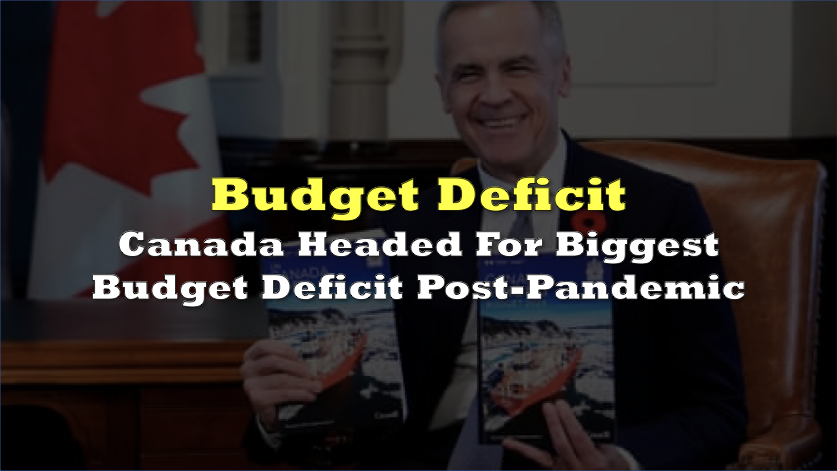

Canada’s federal deficit is on track to widen further over the next decade, with economist Trevor Tombe projecting a baseline shortfall of $117 billion by 2035 if current fiscal policy remains unchanged.
In a new study for the Montreal Economic Institute, the University of Calgary economist said the country’s fiscal path is already anchored by a historically large 2025-26 federal deficit of $78.3 billion, which was projected in the budget tabled in November and marked the largest deficit outside the COVID-19 period.
The same budget also projected annual deficits above $55 billion through 2029-30 and offered no timeline for returning to balance.
Tombe, along with collaborator Gabriel Giguère, identified defence as the largest new pressure point on federal finances. After hitting 2% of GDP for defence spending, Canada would need to raise military expenditures by roughly $100 billion over the decade to meet NATO’s new target of 3.5% of GDP on core defence spending by 2035.
That defence ramp sits on top of other major spending commitments that are already growing faster than revenues. Federal spending on elderly benefits is projected to rise about 50% over the next 10 years, adding roughly $45 billion. Health transfers, equalization payments, and public debt interest charges are also expected to outpace revenue growth over the same period.
Tombe added the current trajectory raises the “looming risk of a 1990s rerun,” referring to a period when debt-servicing costs consumed roughly one-third of federal revenues and overall public net debt was both high and rising at about two-thirds of GDP.
“Together, these pressures will cause overall federal spending to grow faster than revenues in the years ahead unless policy adjustments are made,” Tombe wrote.
And even if Ottawa abandons the 3.5% target and caps direct defence spending at 2% of GDP, Tombe said the deficit in 2035 would still be roughly as large as the deficits projected over the next five years.
Tombe argued that taxes alone are not a credible route back to balance within 10 years. His calculations show that balancing the budget by 2035 without cutting non-discretionary spending would require the GST to more than double from 5% to 12.5%.
Instead, he pointed to elderly benefits as one possible area for restraint. Tombe said trimming their growth rate to align more closely with economic growth would be a prudent starting point. He said this would not require absolute cuts, since benefits would still rise every year, but would stop them from expanding faster than GDP.
He also argued that faster economic growth could ease some of the pressure. Measures such as reducing regulatory burdens on businesses could, in his estimate, generate a 0.5% annual increase in growth, which would translate into roughly $20 billion in additional federal revenue by 2035. That would not close the full gap, but it would reduce the scale of adjustment required.
Canada has run a federal budget deficit in each of the past 18 years since the 2008-09 global financial crisis.
Information for this story was found via National Post and the sources and companies mentioned. The author has no securities or affiliations related to the organizations discussed. Not a recommendation to buy or sell. Always do additional research and consult a professional before purchasing a security. The author holds no licenses.