
Canada posted its weakest result in the 14-year history of the World Happiness Report, falling to 25th out of 147 countries in the 2026 life-satisfaction rankings, down from 6th a decade earlier and out of the top tier it once shared with Nordic countries.
Ten years ago, Canada ranked just behind Finland, Iceland, Denmark, Norway and Switzerland. In the latest period, it sits 15 places below Switzerland, 24 places behind Finland, and outside the top 10 entirely.
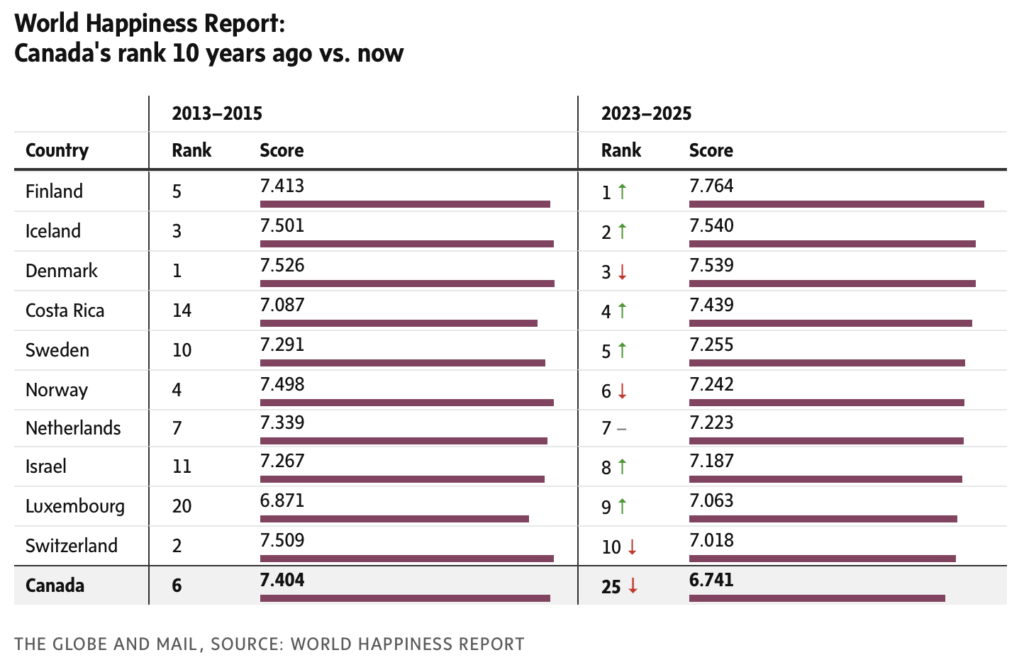
At the top of the current ranking, Finland placed first, followed by Iceland and Denmark. Costa Rica rose to fourth, Sweden placed fifth, and Luxembourg entered the top 10 at ninth.
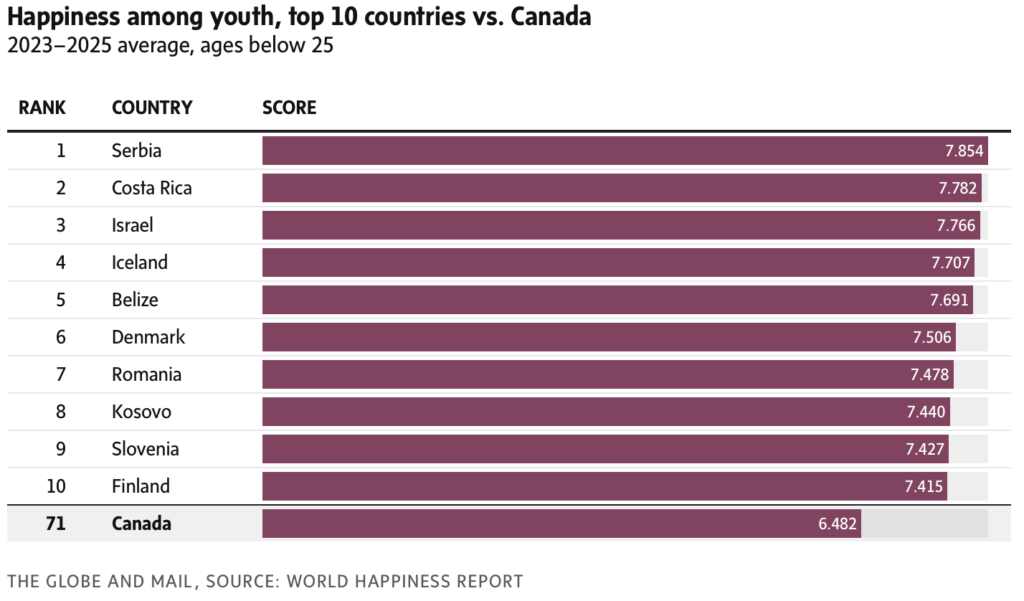
The youth breakdown is worse. Among people under 25, Canada ranked 71st on a 2023–2025 average basis, another record low. Serbia ranks first, followed by Costa Rica, Israel, Iceland, and Belize. Finland, which tops overall happiness, placed only 10th among youth.
By the report’s cross-country comparison, Canada’s 10-year decline in life satisfaction is one of the largest among 136 countries.
The report says young people in English-speaking countries and Western Europe have become less satisfied with life even as the other eight global regions, representing 90% of the world’s population, have seen gains in youth well-being.
The Canada-specific explanations cited by contributors to the report and related analysis skew economic and institutional. Haifang Huang of the University of Alberta points to rising food insecurity, rising housing insecurity among Canadians aged 20 to 34, a strong link between lower well-being and housing affordability concerns, and a “substantial erosion” in institutional trust.
Rosalie Wyonch of the C.D. Howe Institute adds that pessimism about major life milestones can itself change behavior, including decisions around saving and home ownership.
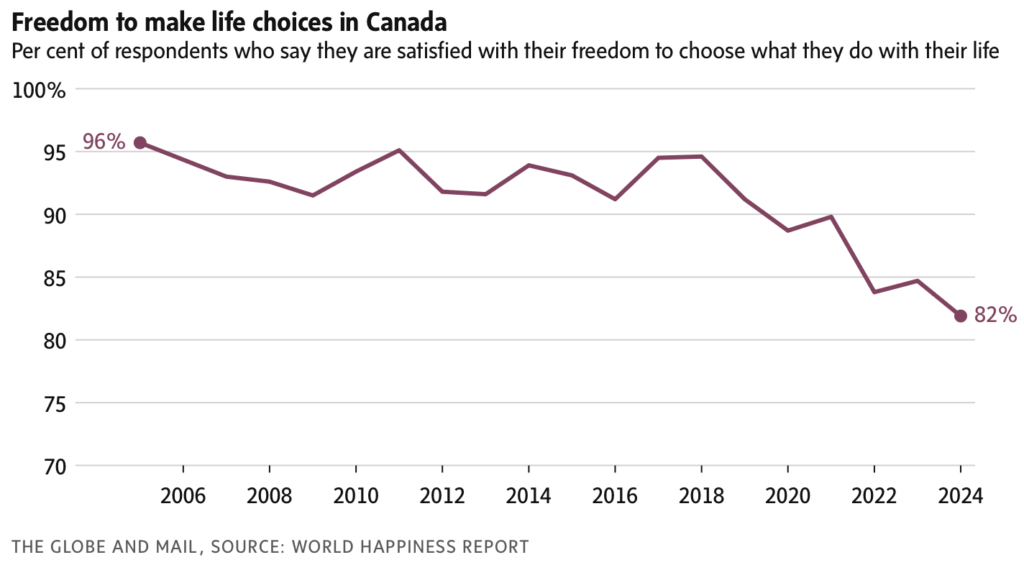
A second measurable fault line is perceived autonomy. Canada’s rank on freedom to make life choices fell to 58th this year from 12th a decade ago. The share of Canadians satisfied with their freedom to choose what they do with their life falling to 82% in 2024 from 96% in 2005.
The report’s internal regional contrast is also striking. If Quebec were measured as a country, it would rank 5th in the 2026 standings, tied with Sweden, while Canada excluding Quebec would fall to 35th. Jacques Forest of the University of Quebec in Montreal attributes Quebec’s stronger performance largely to social programs, including lower tuition, affordable child care and parental leave, which support autonomy, competence and social connection.
Information for this story was found via The Globe And Mail and the sources and companies mentioned. The author has no securities or affiliations related to the organizations discussed. Not a recommendation to buy or sell. Always do additional research and consult a professional before purchasing a security. The author holds no licenses.