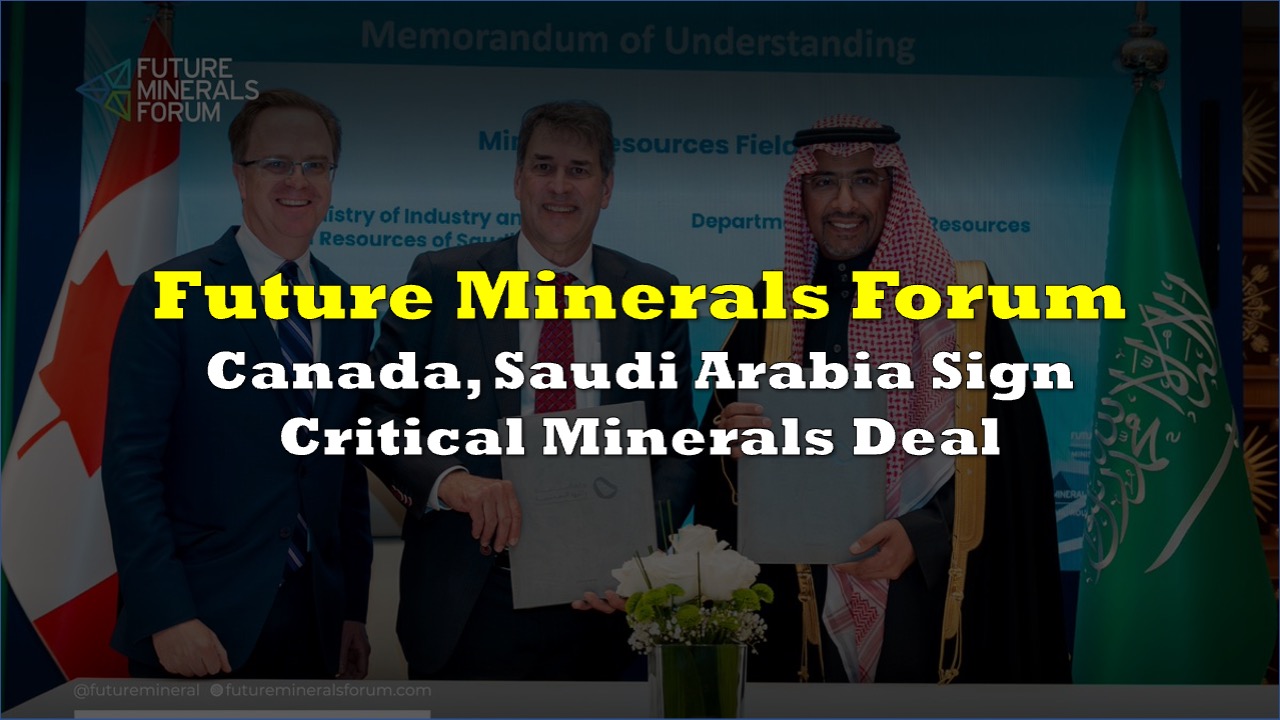

Canada signed a minerals cooperation agreement with Saudi Arabia on January 13, expanding access to critical resources needed for clean energy technology and electric vehicles.
The deal comes as Western countries seek to diversify supply chains away from China, which processes approximately 80 percent of global critical minerals despite mounting geopolitical tensions. Critical minerals, including lithium, cobalt, and rare earth elements, are essential for electric vehicle batteries, solar panels, and wind turbines.
Canadian Parliamentary Secretary Claude Guay and Saudi Minister of Industry and Mineral Resources Bandar Ibrahim Al-Khorayef signed the agreement at the Future Minerals Forum in Riyadh. The agreement will boost trade and investment in critical minerals, enable knowledge exchange between both countries, and strengthen supply chain security.
Trade between Canada and Saudi Arabia totaled approximately $4.1 billion in 2024, with Canadian exports reaching $2 billion and imports at $2.1 billion. Saudi Arabia ranks as Canada’s largest trading partner in the Middle East and North Africa.
Guay represented Canada at the three-day forum, an annual government-led gathering of more than 100 countries focused on critical minerals cooperation. He participated in a panel with Al-Khorayef and held bilateral meetings with Saudi mining companies to explore investment opportunities and showcase Canadian mining expertise.
The agreement aligns with Saudi Arabia’s Vision 2030 plan to diversify its economy beyond oil. The kingdom revised its estimate of unexploited mineral resources from $1.3 trillion to $2.5 trillion in 2024, positioning itself as an alternative supplier to reduce global dependence on Chinese processing.
Canada launched its $3.8 billion Critical Minerals Strategy in 2022 to position itself as a global supplier. The strategy covers exploration, extraction, manufacturing, and recycling to support the country’s net-zero emissions goals.
At the forum, Canada also announced a partnership between Northern Graphite and Saudi Arabia’s Obeikan Investment Group to develop a battery anode material processing facility in Saudi Arabia. Officials described the arrangement as a step toward secure, diversified supply chains.
Saudi Arabia signed two additional minerals cooperation agreements with Chile and Brazil during the forum.
Canadian Minister of Energy and Natural Resources Tim Hodgson stated the partnership strengthens economic diversity and creates opportunities for the Canadian industry.
Big news from the Future Minerals Forum in Riyadh!
— Tim Hodgson (@timhodgsonmt) January 15, 2026
Canada signed a new agreement with Saudi Arabia to deepen cooperation on critical minerals and energy — unlocking new opportunities for trade, investment, and secure supply chains.
Big thanks to PS @ClaudeGuay for advancing… pic.twitter.com/OW28rVGYDL
The mission advances Canada’s strategy to catalyze $500 billion in private sector investments and double non-US exports within the next decade.
Information for this story was found via the sources and companies mentioned. The author has no securities or affiliations related to the organizations discussed. Not a recommendation to buy or sell. Always do additional research and consult a professional before purchasing a security. The author holds no licenses.