

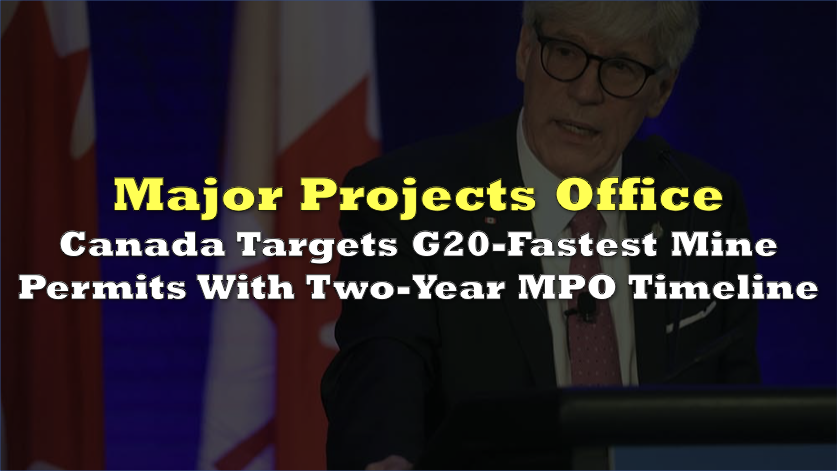

Canada will lead the Group of 20 in permitting speed by issuing a “conditions document” within two years of a project being referred to the federal Major Projects Office, Energy and Natural Resources Minister Tim Hodgson said Tuesday as the PDAC convention in Toronto wound down.
“From the time the project is referred to the MPO, you’ll get a conditions document within two years,” Hodgson said. “That’ll be the best in the G20.”
The acceleration is being driven by reducing duplication between provincial and federal processes, with Hodgson describing a redesigned approach as “one project, one review.”
“We de-pancaked our regulatory provincial, territorial, federal relationship, where we’ve got one project, one review,” he said, adding the goal is a “best in class, predictable permitting process.”
Hodgson pointed to recent federal activity as evidence the government is moving beyond messaging, citing “26 deals in October and 30 deals today” and project value of “$18 billion.”
A recent example highlighted by the minister was the Thompson nickel mine complex in Manitoba, where Vale’s base metals unit agreed last month to bring in partners to keep the operation running, with funding from the Canada Growth Fund. Hodgson said the transaction “saved Thompson” by moving it to “a new Canadian owner who’s dedicated to expanding the mine instead of shutting it.”
Within the MPO portfolio, Foran Mining’s McIlvenna Bay copper project in Saskatchewan is slated to begin producing next year, while Canada Nickel in Ontario may require two years of construction following a construction decision expected this year.
The office is also advancing Northcliff Resources’ tungsten proposal in New Brunswick, Nouveau Monde Graphite’s project in Quebec, and the Red Chris copper and gold mine expansion in British Columbia owned 70-30% by Newmont and Imperial Metals, respectively.
On infrastructure, Hodgson formally launched a $1.5 billion First and Last Mile fund on Tuesday. He said five projects were marked for $115.0 million to move metals from mines to markets, within a broader $165.2 million allocation across 22 projects, and alongside 30 projects that received small-scale funding on Monday during the convention.
The minister also said the timing for legislation enabling a $2.0 billion sovereign fund depends on a bill currently blocked by the Conservative opposition in Parliament.
Processing capacity remains a parallel pressure point. Hodgson said Quebec and Glencore are close to finalizing an agreement to keep the Horne smelter operating after Glencore said environmental rules make it uneconomical.
“My understanding is the there are still some open points between the Quebec government and Glencore,” he said. “I believe they’re very close to sorting those out.”
Information for this story was found via Mining.com and the sources and companies mentioned. The author has no securities or affiliations related to the organizations discussed. Not a recommendation to buy or sell. Always do additional research and consult a professional before purchasing a security. The author holds no licenses.



One Response
Yet the Conservatives will whine and complain that things are moving too slowly…just get out of the way. Meanwhile skippy is over in Europe playing mini Carney and pretending to be a statesman. When will he finally give up?
“The minister also said the timing for legislation enabling a $2.0 billion sovereign fund depends on a bill currently blocked by the Conservative opposition in Parliament.”