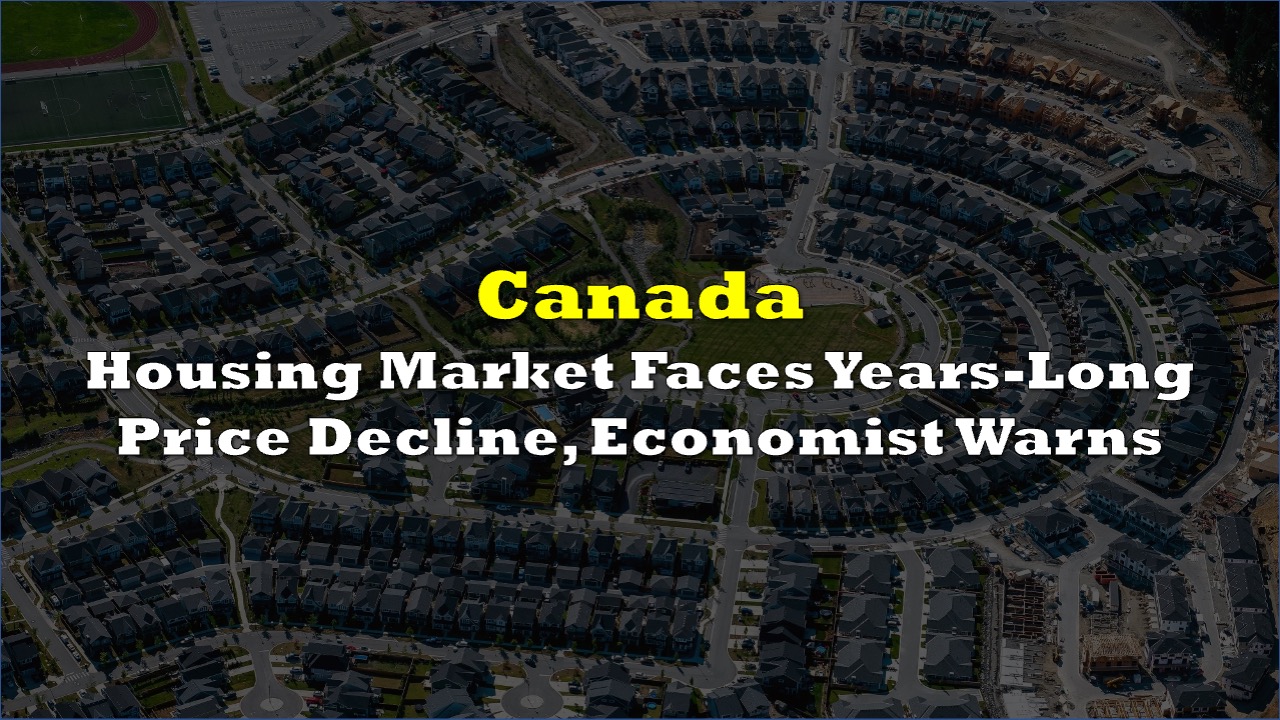

A prolonged real estate downturn will drag Canadian home prices lower throughout 2026, according to Bank of Montreal‘s senior economist who accurately predicted the market’s current trajectory years ago.
BMO senior economist Robert Kavcic forecasts a “long and slow grind” toward affordability, warning buyers and sellers against expecting any near-term recovery.
Canada’s national benchmark home price dropped 4% year-over-year in December, extending losses to 18.6% from the early 2022 peak. The Greater Toronto Area showed detached homes selling for 8% less than the previous year in November, with condo prices down 3.8% over the same period.
Kavcic warned investors in 2022 that unwinding the market’s speculative excess would require years, not quarters. His prediction came as real estate speculation surged and interest rates fell below inflation.
Market fundamentals have shifted dramatically since then. Central bank policymakers delivered seven consecutive rate cuts from June 2024 through March 2025, bringing the benchmark rate into neutral territory. Ottawa has curtailed immigration flows. Investor activity has virtually disappeared.
Annual home sales volumes fell 1.9% in 2025, marking the third-weakest year of the past decade, according to BMO’s monthly housing monitor.
“Incomes still need to catch up and that takes time,” Kavcic said.
Regional performance varies sharply. Southern Ontario struggles most severely, particularly in new condo sales where investor absence has dried up activity. Vancouver faces elevated inventories and buyer’s market conditions, with both condo and detached prices down roughly 5% year-over-year.
Markets in Quebec and Atlantic Canada remain tight. Quebec City led national gains with prices jumping 17% annually, while Montreal rose 5.8% and Moncton increased 4.7%.
Calgary has cooled after strong early-2025 performance, with sales down 14.8% from the previous year and prices declining 3.4%.
Developers continue building smaller condo units even as buyers seek larger single-family homes, creating an oversupply that threatens further condo price erosion. Pre-construction buyers who committed to purchases years ago now confront mortgage rates near 4%—more than double the 1.75% they expected. Many cannot afford to close or sell profitably, forcing them to become landlords in a weakening rental market.
Sellers continue demanding prices that buyers refuse to pay. Kavcic predicts asking prices will eventually decline rather than buyers stretching their budgets higher.
“Many talk about pent-up demand given the lack of sales volume in 2025, but there’s probably also a significant amount of pent-up supply in the form of listings that were sitting and ultimately pulled after not selling,” Kavcic wrote in his December market analysis.
Recovery requires both lower borrowing costs and economic strength—conditions that rarely coincide, Kavcic noted. He calls real estate “dead money” compared to surging equity markets.
“With mortgage rates apparently locked in place this year, affordability still adjusting and investors gone to other asset classes, it’s looking like another year of stagnant activity for Canadian housing,” Kavcic wrote.
Kavcic describes buyer psychology as “reverse FOMO”—prospective purchasers now fear buying too early rather than missing opportunities.
Information for this story was found via the sources and companies mentioned. The author has no securities or affiliations related to the organizations discussed. Not a recommendation to buy or sell. Always do additional research and consult a professional before purchasing a security. The author holds no licenses.