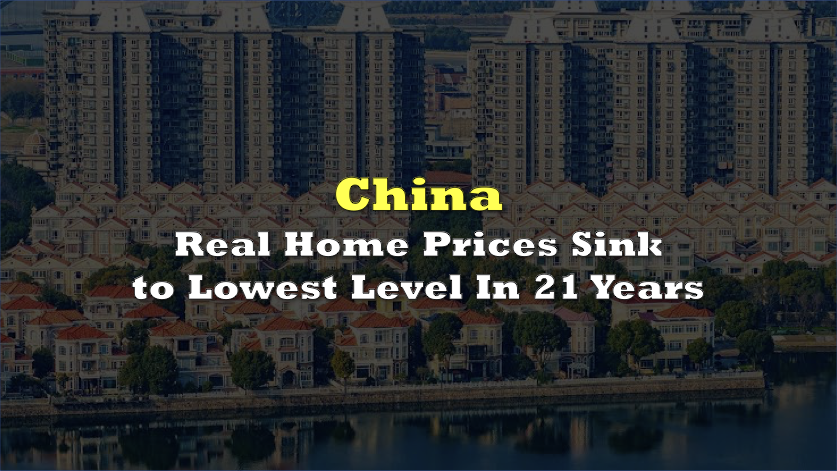

China’s housing downturn has passed a milestone that recent improvements in its largest cities have not erased. Inflation-adjusted residential prices fell below the level recorded when the Bank for International Settlements series began in 2005, even as June data showed limited month-over-month gains in Beijing, Shanghai, Guangzhou, and Shenzhen.
The Federal Reserve Bank of St. Louis’ FRED database, which republishes the BIS series, placed China’s real residential-property-price index at 85.1336 in Q1 2026, its lowest observation in records extending to Q2 2005. The latest figure was down 1.9% from Q4 2025, 7.1% from a year earlier, and 24.7% from its Q3 2021 peak.
The index began at 87.9500 in Q2 2005, meaning inflation-adjusted housing values have now fallen about 3.2% below the series’ initial level.
The BIS measure adjusts residential values using China’s consumer price index. A falling real index means property prices have lost value relative to the broader cost of goods and services, even when the cash price of a home remains higher than it was two decades ago.
 Sponsored · Selkirk Copper Mines
China’s separate nominal BIS residential-price index stood at 113.9785 in Q1, compared with the 2010 base of 100. That index declined 6.3% year over year.
The real index also should not be described as a continuous measure of every Chinese home. According to FRED’s methodology notes, the series covered newly built dwellings in 70 cities from Q1 2007 through Q4 2015, then switched to existing buildings beginning in Q1 2016. The published table starts in Q2 2005.
China’s June housing data offered signs of stabilization in its strongest urban markets, but the broader property system continued to shrink. New-home prices declined 0.1% month over month and 3.3% year over year in June, according to Reuters calculations based on National Bureau of Statistics data. New and existing home prices in China’s four tier-one cities increased 0.1% and 0.3% from May, respectively.
Prices across all city tiers remained lower than a year earlier. Reuters attributed the partial improvement primarily to the largest cities rather than a nationwide recovery.
The National Bureau of Statistics’ city-level tables showed sharp regional differences. New-home prices rose from May in Shanghai, Guangzhou, and Shenzhen, while many smaller cities continued to report monthly and annual declines. Existing-home prices remained substantially below year-earlier levels across most of the 70-city survey.
Those city-level price movements have not translated into stronger development activity. Real-estate investment fell 18.0% year over year to 3.81 trillion yuan during the first half of 2026. Residential investment declined 17.8%, while newly started floor space dropped 23.4%.
New commercial-building sales fell 13.6% by value and 11.6% by floor area. Funds available to developers declined 20.2%, including a 31.7% drop in domestic loans and a 24.9% decline in individual mortgage financing.
The housing decline is increasingly separating China’s industrial economy from its domestic-demand economy. Q2 gross domestic product expanded 4.3% year over year, down from 5.0% in the first quarter. First-half retail sales increased only 1.3%, while real-estate investment remained one of the largest drags on fixed investment, according to the National Bureau of Statistics.
China’s Politburo responded on July 30 by calling for faster deployment of already-budgeted fiscal spending rather than announcing another large stimulus package.