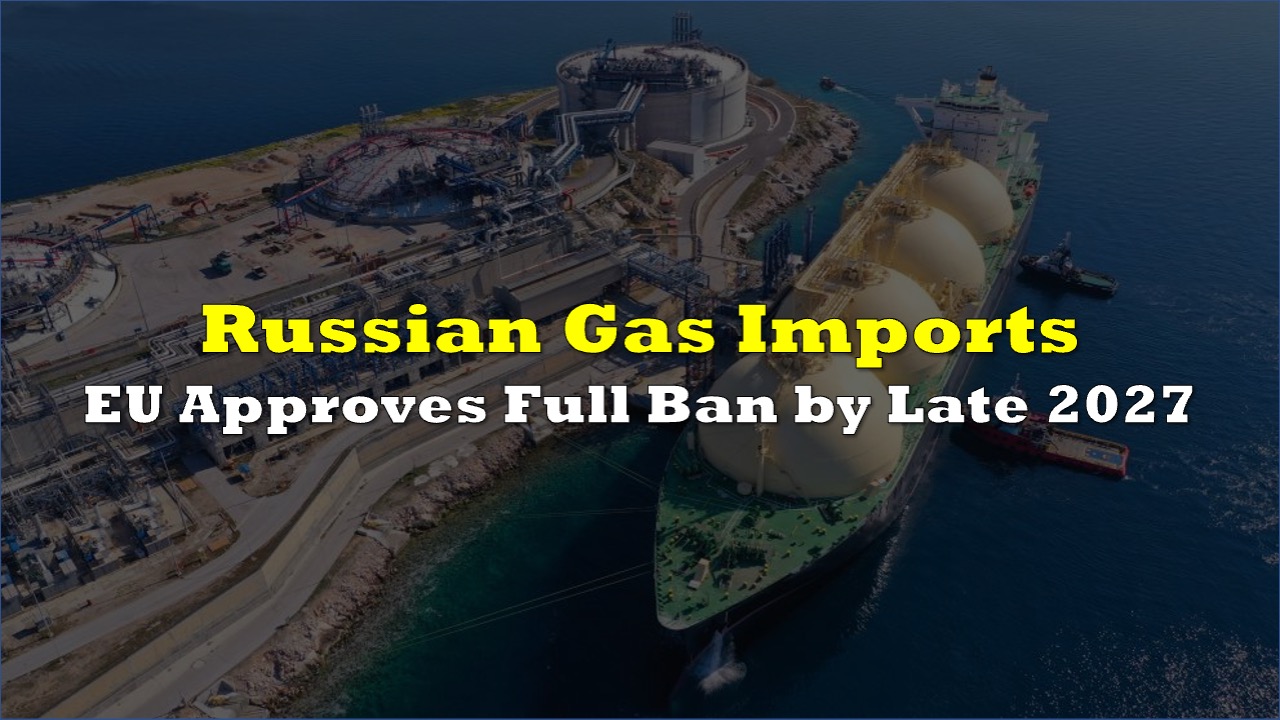

The European Union Council gave final approval Monday to ban Russian pipeline gas and liquefied natural gas imports, severing the bloc’s remaining energy ties to Moscow nearly four years after Russia invaded Ukraine.
The regulation prohibits LNG imports starting January 1, 2027, and pipeline gas from September 30, 2027, with a backstop deadline of November 1, 2027, if storage levels remain insufficient.
The EU will fully ban Russian liquefied natural gas by Jan 1, 2027, and pipeline gas by Sept 30, 2027, after member states gave final approval. pic.twitter.com/if1qlcJiU1
— Open Source Intel (@Osint613) January 26, 2026
The ban takes effect six weeks after publication in the EU’s Official Journal. Spot market purchases will end immediately, while existing contracts receive transition periods. Short-term contracts terminate April 25, 2026, for LNG and June 17, 2026, for pipeline gas.
The European Parliament approved the measure on December 17, 2025, with 500 votes to 120. The Council’s endorsement on Monday completes the legislative process.
EU reliance on Russian gas plummeted from 45% of total imports when Russia launched its full-scale invasion in February 2022 to 13% in the first half of 2025, according to the European Commission. Despite cutting pipeline deliveries, the bloc continued importing Russian LNG, which represented 20% of EU LNG imports in 2024.
The TurkStream pipeline through Turkey to southeastern Europe remains the only operating gas route between Russia and the EU, carrying approximately 15.2 billion cubic meters in the first 11 months of 2025. The regulation bans these imports unless companies prove the gas originated outside Russia or Belarus and merely transited through Russian territory.
Denmark’s Climate and Energy Minister Lars Aagaard said the ban represents “a major step in the right direction” toward ending EU dependence on Russian gas. European Commission President Ursula von der Leyen called it the beginning of “Europe’s full energy independence from Russia.”
The Commission committed to proposing legislation in early 2026 to phase out Russian oil imports by the end of 2027.
National authorities must verify gas origin countries before authorizing imports, a measure designed to prevent circumvention. Member states face requirements to develop diversification plans by March 1, 2026, detailing concrete actions to eliminate Russian gas and oil imports.
The regulation includes penalties for violations and a suspension clause allowing temporary exemptions during energy security emergencies.
Information for this story was found via the sources and companies mentioned. The author has no securities or affiliations related to the organizations discussed. Not a recommendation to buy or sell. Always do additional research and consult a professional before purchasing a security. The author holds no licenses.