
European Union negotiators struck a legally binding deal early Wednesday to halt all Russian gas imports within three years, but critics condemned the extended timeline that allows billions more in revenue to flow to Moscow during its war in Ukraine.
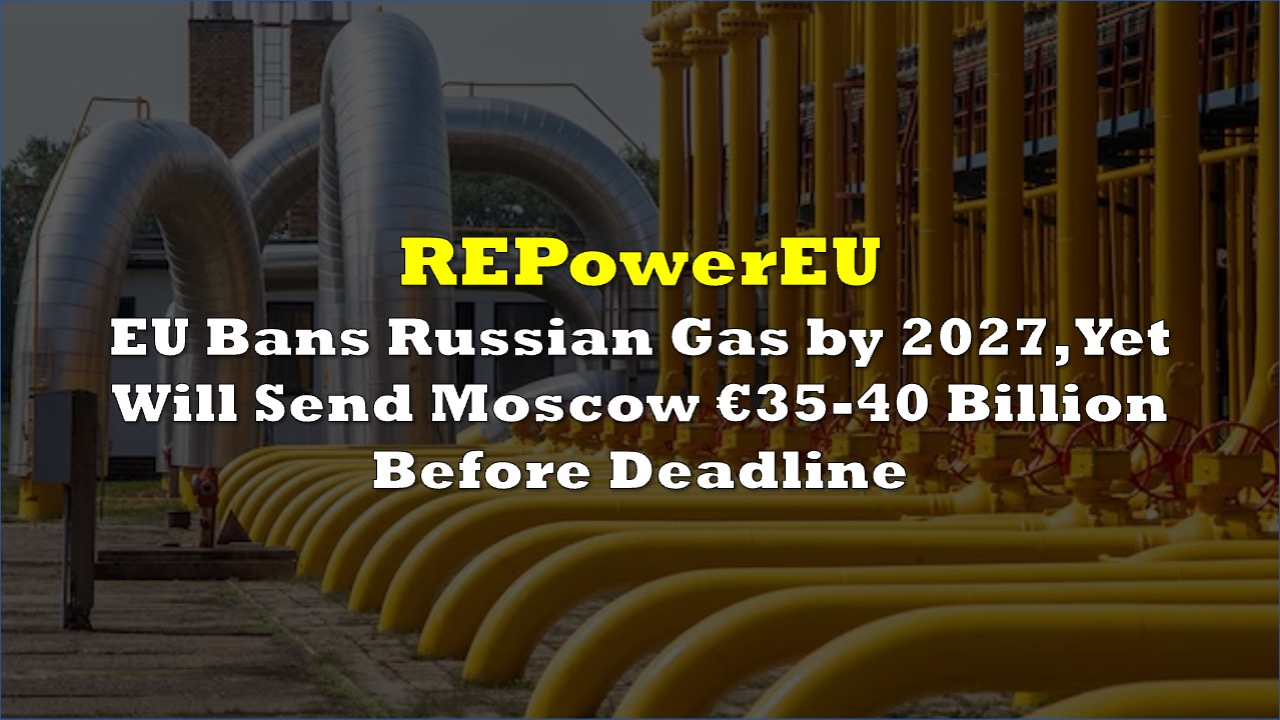
EU governments and the European Parliament agreed on staggered cutoff dates: liquefied natural gas imports must end by December 31, 2026, while pipeline gas imports must cease by September 30, 2027, with a possible one-month extension if member states face storage difficulties.
“Today, we are stopping these imports permanently,” European Commission President Ursula von der Leyen said. “By depleting Putin’s war chest, we stand in solidarity with Ukraine and set our sights on new energy partnerships.”
European Union reaches a final deal on phasing out Russian gas purchases. LNG delivers must stop by Dec 2026, and pipeline gas will end by Sep 2027.
— Javier Blas (@JavierBlas) December 3, 2025
(and yes, of course it does mean that EU will continue buying Russian gas for an extra year-and-a-half, financing the Kremlin) https://t.co/2c7NlTYS5f
In 2024, EU countries purchased 21.9 billion euros worth of Russian gas, an 18% increase from 2023. Analysts calculate the EU could transfer an additional 35 to 40 billion euros to Russia before the ban takes full effect. Europe spent 21.9 billion euros on Russian fossil fuels in 2024, exceeding the 18.7 billion euros sent to Ukraine in financial aid.
The agreement bans short-term contracts from April 2026 for LNG and June 2026 for pipeline gas. Long-term contracts face cutoff dates of January 1, 2027, for LNG and September 30, 2027, for pipeline gas. All Russian gas imports will require prior authorization, and the regulation includes penalties for non-compliance.
Hungarian Foreign Minister Peter Szijjarto said his country would immediately challenge the ban before the European Court of Justice. “Accepting and implementing this Brussels order is impossible for Hungary,” he said. Slovakia is also weighing legal options.
The deal includes a suspension clause allowing Hungary and Slovakia to access Russian gas in case of supply disruption, though such exceptions require formal emergency declarations.
Russia’s share of EU gas imports plummeted from 45% in 2021 to 19% in 2024, with imports declining from over 150 billion cubic meters to less than 52 billion cubic meters. Norway emerged as the top supplier in 2024 at 33%, while the US supplies more than doubled from 18.9 billion cubic meters to 45.1 billion cubic meters.
However, as pipeline deliveries dropped, European purchases of Russian LNG rose. Russia supplied roughly 20% of EU LNG imports in 2024, second only to the US. As of October 2025, Russia accounted for 12% of EU gas imports.
Moscow criticized the agreement through spokesman Dmitry Peskov, who predicted it would erode European industrial competitiveness and raise energy costs. “Europe is thus condemning itself to much more expensive energy sources, which will inevitably have consequences for the European economy,” he said.
The ban is the culmination of the EU’s REPowerEU strategy, launched in May 2022 to make Europe independent from Russian fossil fuels. Despite significant reductions between 2022 and 2023, the EU saw a rebound in Russian gas imports in 2024, prompting the Commission to present binding measures in May 2025.
“We’ve made it: Europe is turning off the tap on Russian gas, forever,” EU Energy Commissioner Dan Jørgensen wrote on social media. “We’ve chosen energy security and independence for Europe. No more blackmail. No more market manipulation by Putin.”
The timelines await final approval from the European Parliament and European Council, though passage appears certain. Member states must submit national diversification plans by March 1, 2026, and the Commission plans to propose legislation to phase out remaining Russian oil imports by the end of 2027.
Information for this story was found via the sources and companies mentioned. The author has no securities or affiliations related to the organizations discussed. Not a recommendation to buy or sell. Always do additional research and consult a professional before purchasing a security. The author holds no licenses.