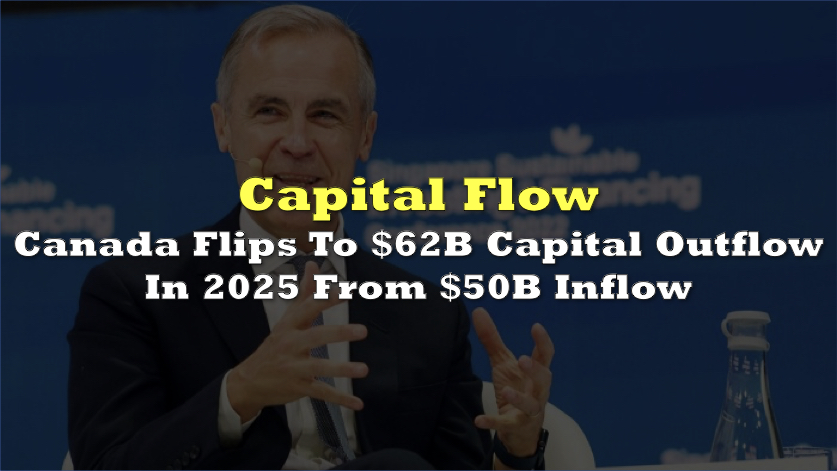

Foreign investors pulled back as Canadians ramped up overseas buying, flipping Canada’s 2025 capital flow balance to a net outflow of nearly $62 billion in the year to September from a $50 billion inflow over the same period last year.
Foreign acquisitions of Canadian securities fell 60% to $58 billion in the first nine months versus the same period last year, as tariff uncertainty and trade volatility weighed on sentiment.
In the first half, international investors sold $22.36 billion of Canadian securities, before flows reversed in the third quarter when more than $80 billion moved into Canadian markets, delivering the country’s first quarterly inflow of 2025, according to Statistics Canada data.
“Foreign money leaving and Canadians investing more abroad defined this year’s capital-flow picture.”
— Raquel Dancho (@RaquelDancho) December 30, 2025
2025’s capital outflow under PM Carney culminated in an unprecedented result, with $62 billion leaving Canada’s economy. That is the Liberals’ record.
This is the money… pic.twitter.com/zo5leGQMEk
Conservative MP Raquel Dancho called the $62 billion outflow an “unprecedented” Liberal record under Carney and arguing the money is going to the US.
“The impact of the tariffs haven’t been as bad as some people expected, and that’s showing up in the economic data, being a little bit better than expected into the back half of this year,” said equity manager John Zechner, tying the late-year improvement to macro outcomes and policy expectations.
He also pointed to rate cuts on both sides of the border and the Liberal government’s pivot under Prime Minister Mark Carney toward financing megaprojects as potential reassurance for investors.
Most of the foreign money that remained in Canada flowed into bonds. Foreign investors bought about $93 billion of Canadian debt in the first three quarters, with roughly 60% going into corporate bonds and the remainder into government bonds.
Tiago Figueiredo, a macro strategist at Desjardins, said the surge into Canadian debt reflects a view that Canada is “in a better fiscal position relative to other countries,” and he flagged demand for US-dollar bonds issued by provinces and corporations as a way to gain Canadian issuer exposure without taking on Canadian-dollar risk.
Desjardins deputy chief economist Randall Bartlett warned that while a downgrade to Canada’s triple-A credit rating is not imminent, it should not be “taken for granted.”
“Canada’s debt is at an inflection point,” he said, adding that if national projects fail to deliver the expected boost or if a US “shock” hits the economy, debt dynamics could worsen.
Even with a strong equity tape, foreign equity flows stayed negative. The S&P/TSX Composite is up 26% so far this year and on track for its strongest gain since 2009, yet international equity flows to Canada have been negative for four straight years, with outflows deepening to $36 billion through September, nearly four times last year’s net selling over the same span.
Aaron Young, executive director of client portfolio management at CIBC, said global investors step back because Canada’s equity market is smaller and sector-concentrated, mainly financials and commodities, with fewer high-growth tech exposures.
Canadian investors increased holdings of foreign securities 27% to $120 billion in the first three quarters, with 93% of purchases flowing into the US, according to Statistics Canada. Young said the “Buy Canadian” impulse has limits because some sector exposure is simply not available at scale domestically.
“If you’re looking to play something like AI, Canada’s not going to be your first stop,” Young said.
Information for this briefing was found via The Logic and the sources mentioned. The author has no securities or affiliations related to this organization. Not a recommendation to buy or sell. Always do additional research and consult a professional before purchasing a security. The author holds no licenses.