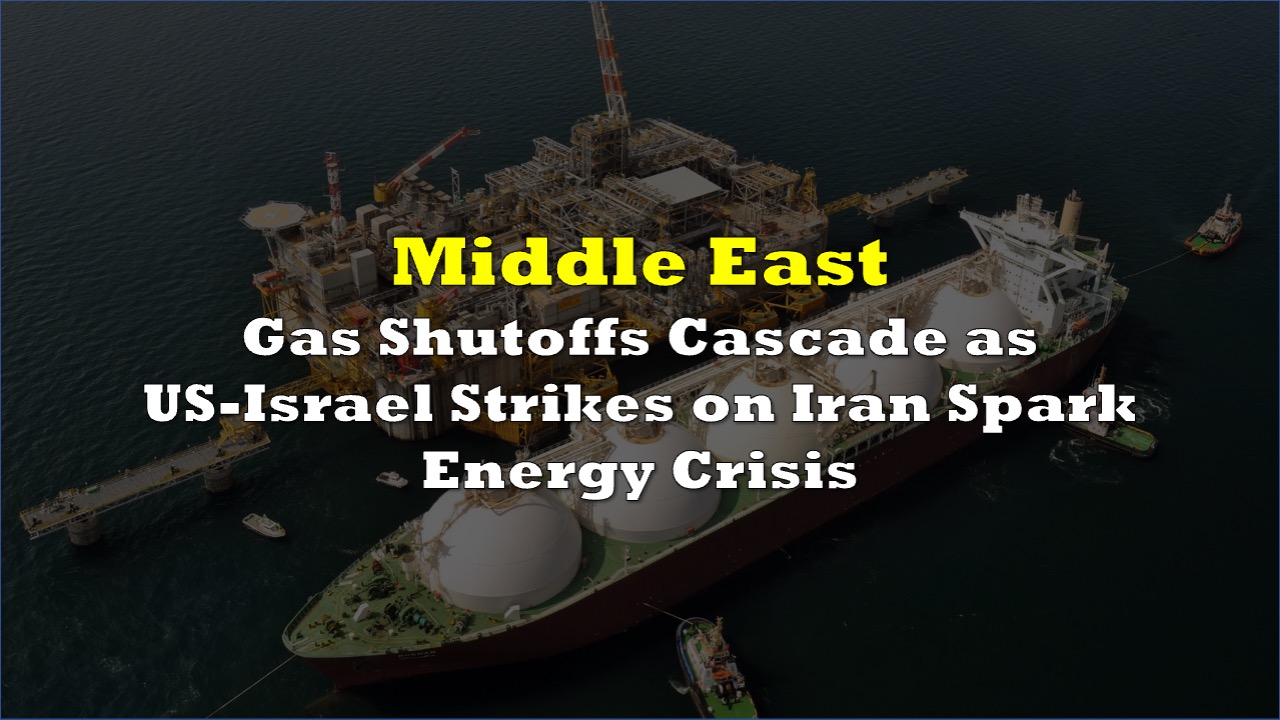

A chain of natural gas shutoffs is spreading across the Middle East after the United States and Israel launched coordinated strikes on Iran on February 28, triggering retaliatory attacks that have damaged energy infrastructure across at least four countries and sent global fuel prices surging.
Israel shut down its Leviathan and Karish gas fields as a security precaution on the day the strikes began, citing instructions from the Energy Ministry. The two offshore fields, operated by Chevron and Energean respectively, supply the bulk of Israel’s gas exports to Egypt and Jordan. Only the older Tamar field, used primarily for domestic supply, remained operational.
Jordan, which sources roughly 85% of its natural gas imports from Israeli fields — enough to power approximately 70% of the country’s electricity generation — subsequently cut its own gas exports to Syria after Tel Aviv halted deliveries.
Syria’s energy grid absorbed the downstream blow almost immediately. Syria’s Ministry of Energy confirmed that reduced electricity supply hours resulted directly from the drop in natural gas imports flowing through Jordan, saying the country faced “the inability to continue pumping gas in accordance with previous agreements” due to regional escalation.
The gas transits through Jordan from Egypt, whose own exports to Israel had already fallen sharply because of the Israeli field shutdowns.
Cascading chain of gas shutoffs. Jordan shut exports to Syria after Israel cut exports to Jordan. https://t.co/Y7zRU3ItP9
— Matthew Petti (@matthew_petti) March 3, 2026
The disruptions extend well beyond the Israel-Jordan-Syria corridor. Iran launched missile and drone strikes on Qatar’s liquefied natural gas facilities, forcing state-owned QatarEnergy to pause LNG production. European natural gas prices jumped nearly 50% following the announcement — one of the sharpest single-day spikes since Russia’s invasion of Ukraine in 2022.
Iran has also moved to restrict maritime traffic through the Strait of Hormuz, the narrow waterway through which roughly 20% of global oil and gas supplies transit daily. While Iran had not formally enforced a full blockade as of early this week, IRGC broadcasts warned vessels that “no ship is allowed to pass.” Ship traffic through the strait dropped sharply, according to energy analysts.
Read: IRGC Attacks Four Tankers Near Strait of Hormuz as US Destroys Iranian Naval Fleet
Oil prices surged on the first trading day after the strikes, with US crude rising more than 8% and Brent climbing roughly 9% to $79.41 per barrel before paring some gains. Analysts warn that a prolonged blockade of the strait could push Brent toward $100 per barrel.
The LNG picture appears more concerning. An international gas expert at Columbia University noted that unlike oil, the LNG market carries no meaningful spare capacity — meaning any sustained disruption to Qatar’s output or Hormuz transit will directly impact every LNG-importing nation, with Europe and Asia particularly exposed.
Iran has also struck oil and gas installations in Saudi Arabia, Kuwait, Bahrain, the UAE, Jordan, and Iraq as part of its retaliatory campaign, widening the regional energy disruption beyond any single chokepoint.
Israel’s Energy Minister said the country’s fields would resume exports once the military determines conditions are safe, without providing a timeline.
Information for this story was found via the sources and companies mentioned. The author has no securities or affiliations related to the organizations discussed. Not a recommendation to buy or sell. Always do additional research and consult a professional before purchasing a security. The author holds no licenses.