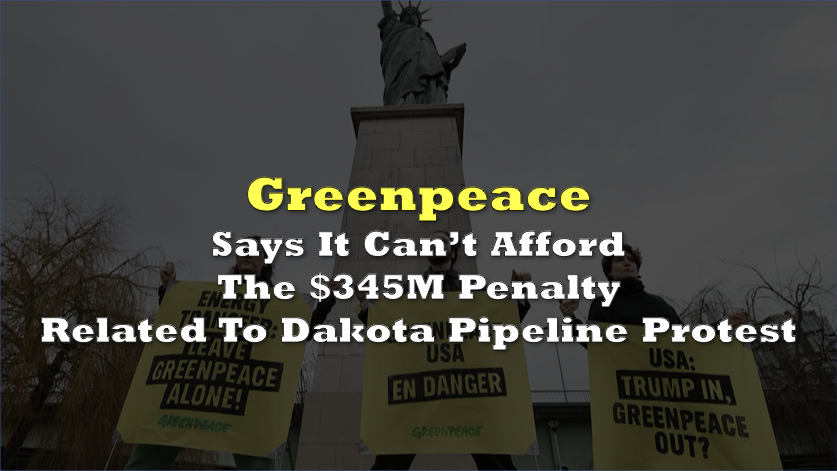

A North Dakota court has moved to order Greenpeace to pay roughly $345 million to Energy Transfer in connection with the 2016–2017 pipeline protests, a sum Greenpeace says it cannot afford.
With the move, the Greenpeace-Dakota Access case from symbolic liability to enforceable financial pressure, with Judge James Gion saying he will sign an order requiring Greenpeace entities to pay roughly $345 million to Energy Transfer in connection with the 2016–2017 pipeline protests, a sum Greenpeace says it cannot afford.
A jury in March 2025 awarded Energy Transfer about $666.9 million, but the court later cut that figure by nearly half after finding portions of the award duplicative or legally excessive.
That means the legal center of gravity remains with Energy Transfer’s argument that Greenpeace’s role went beyond protected advocacy. The company alleged that Greenpeace entities helped drive unlawful conduct tied to the anti-pipeline campaign through defamation, conspiracy, trespass-related claims, nuisance, and business interference tied to blockades, project disruption, and added security burdens.
Public case summaries indicate the trial court disallowed or pared back several components, including claims found unsupported or duplicative, and capped some exemplary damages.
AP reported Greenpeace says it lacks the resources to pay the judgment, with only $1.4 million in cash and $23 million in total assets at the end of 2024. Against a liability of roughly $345 million, that implies a judgment about 15 times total assets and more than 240 times cash on hand.
Greenpeace has said it will appeal and continues to frame the case as a SLAPP-style attempt to suppress activism and chill speech, while Energy Transfer has argued the litigation is about unlawful conduct rather than First Amendment-protected protest.
Information for this briefing was found via the sources and the companies mentioned. The author has no securities or affiliations related to this organization. Not a recommendation to buy or sell. Always do additional research and consult a professional before purchasing a security. The author holds no licenses.