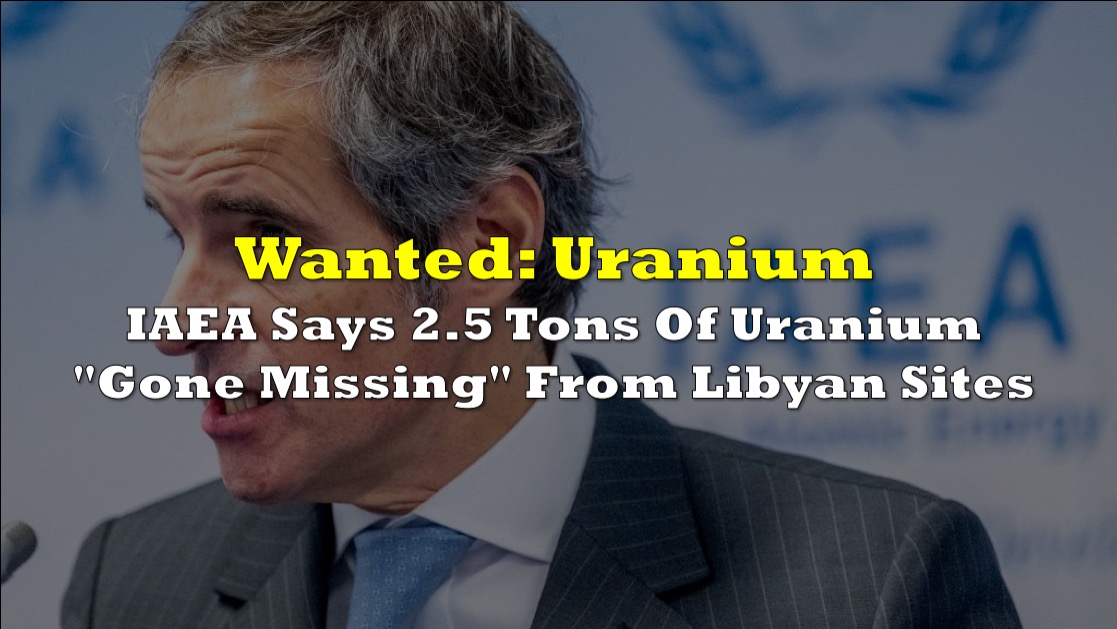

The International Atomic Energy Agency (IAEA) of the United Nations has reported that roughly 2.5 tonnes of natural uranium has gone missing from a location in Libya that is not under government control.
IAEA chief Rafael Grossi informed the organization’s member nations that inspectors discovered 10 drums of uranium ore concentrate had gone missing and “were not present as previously declared” at the facility in Libya.
The agency’s inspectors “found that 10 drums containing approximately 2.5 tons of natural uranium in the form of UOC (uranium ore concentrate) previously declared by (Libya) … as being stored at that location were not present at the location,” according to a statement released on Wednesday.
 Sponsored · Selkirk Copper Mines
“The loss of knowledge about the present location of nuclear material may present a radiological risk as well as nuclear security concerns,” the IAEA said, adding that reaching the site required “complex logistics”.
The IAEA added that it will conduct additional activities “to clarify the circumstances of the removal of the nuclear material and its current location.”
The uranium was thought to have gone missing as a result of an inspection that was originally scheduled for last year but “had to be postponed because of the security situation in the region” and was just eventually completed on Tuesday.
Libya, led by Muammar Gaddafi, relinquished its nuclear, chemical, and biological weapons programs in 2003 after covert talks with the United States and the United Kingdom. Gaddafi’s dictatorship had obtained centrifuges capable of enriching uranium as well as design information for a nuclear bomb, but the country made little progress toward developing a nuclear weapon.
After a NATO-supported rebellion and Gaddafi’s ouster in 2011, the country has been plagued by political crises and conflicting militias backed by foreign powers. Political power in the country is still divided between a purportedly temporary administration in the western city of Tripoli and another in the east backed by military strongman Khalifa Haftar.
Libya’s interim government, established in early 2021 through a United Nations-backed peace plan, was only supposed to continue until a December election, which has yet to take place, and its legality is now being questioned.
Information for this briefing was found via Reuters, AlJazeera, and the sources mentioned. The author has no securities or affiliations related to this organization. Not a recommendation to buy or sell. Always do additional research and consult a professional before purchasing a security. The author holds no licenses.