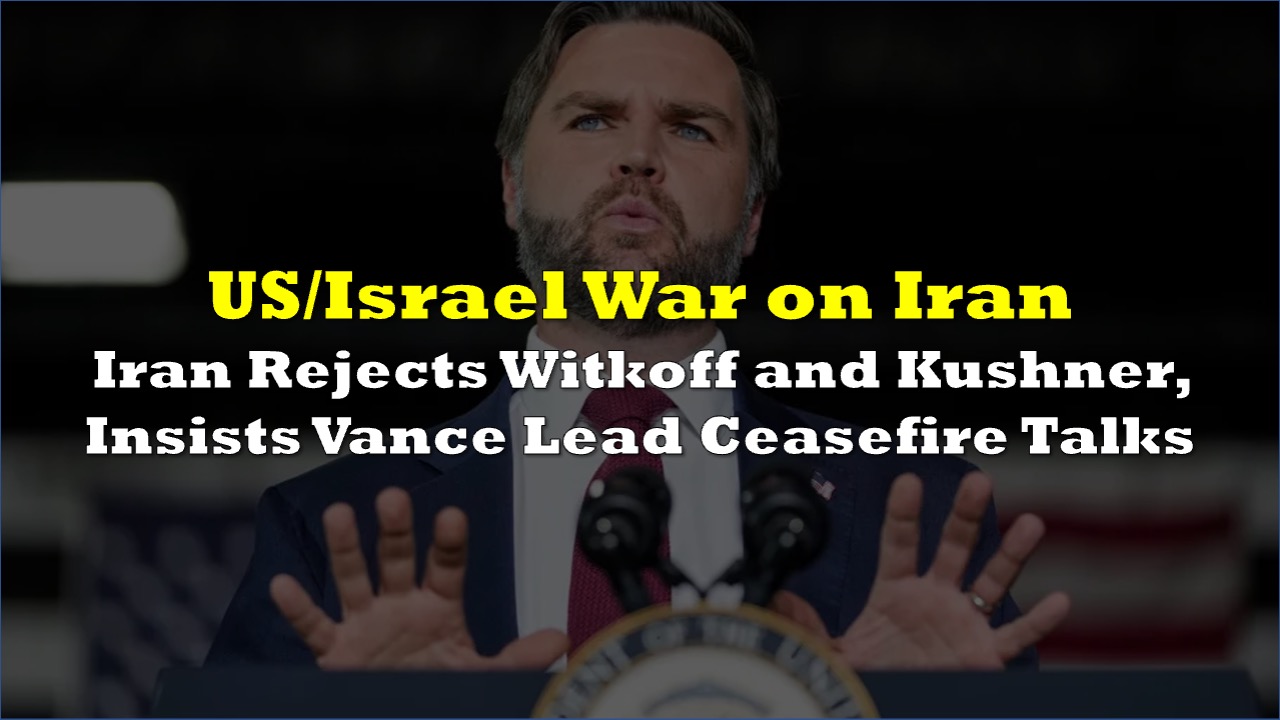

Iran has told the Trump administration it will not re-enter ceasefire negotiations with US Special Envoy Steve Witkoff or presidential adviser and son-in-law Jared Kushner, demanding instead that Vice President JD Vance lead any future talks — a move that exposes deep fractures in Washington’s diplomatic front even as both sides claim progress toward a deal.
The message, passed through back channels to the Trump administration, signals that Tehran views the two men who fronted the last round of nuclear talks as fundamentally compromised. Iranian officials accused Witkoff and Kushner of having “stabbed them in the back” — sitting across the negotiating table in Geneva while the US and Israel were already planning Operation Epic Fury, which launched February 28.
JUST IN: 🇮🇷🇺🇸 Iran tells the United States it does not want to resume talks with Witkoff and Kushner, prefers negotiating with Vice President JD Vance instead, CNN reports. pic.twitter.com/WRbdbPFz2y
— BRICS News (@BRICSinfo) March 24, 2026
Iran believes discussions involving Witkoff and Kushner would not be productive, CNN reported, citing what its sources described as a “deficit of trust following the breakdown of negotiations prior to Israel and the US launching military action.”
An Iranian diplomatic source told the Guardian: “If the negotiations are going to have any outcome, JD Vance should join. With Witkoff and Kushner, nothing will come out of it. We have seen that in the past.”
Iran’s preference for Vance is tactical. Vance is widely seen as a skeptic of US military entanglement in the Middle East and has remained conspicuously quiet throughout the conflict. Iranian officials see him as more likely to want the war over than to use diplomacy as cover for further strikes.
“The perception is that Vance would be intent on wrapping up the conflict,” one regional source told CNN.
Iran may be playing Vance’s 2028 ambitions as much as his foreign policy instincts. He has built his political identity around skepticism of foreign military adventurism — an image increasingly difficult to maintain as the war drags on. An early diplomatic exit from the conflict could serve his political interests as much as Iran’s strategic ones.
The White House rejected the CNN report outright. A White House official called it “utterly false,” describing it as “a coordinated foreign propaganda campaign meant to undermine the president.” Press Secretary Karoline Leavitt said Trump alone determines who negotiates for the United States. Trump himself told reporters that Vance, Rubio, Witkoff, and Kushner were all involved in negotiations — adding: “And I’m involved.”
Sources familiar with discussions say that if in-person talks proceed in Islamabad later this week, Witkoff and Kushner are expected to represent the US, with Vance’s attendance described as a possibility, not a certainty.
Pakistan’s Prime Minister Shehbaz Sharif has offered Islamabad as a venue, saying his country stands ready to “facilitate meaningful and conclusive talks for a comprehensive settlement,” in a post where he tagged both Trump and Witkoff.
Pakistan welcomes and fully supports ongoing efforts to pursue dialogue to end the WAR in Middle East, in the interest of peace and stability in region and beyond. Subject to concurrence by the US and Iran, Pakistan stands ready and honoured to be the host to facilitate…
— Shehbaz Sharif (@CMShehbaz) March 24, 2026
Whether Iran attends remains uncertain. Iranian officials have publicly denied that any formal negotiations are taking place, calling Trump’s claims of progress an attempt to manipulate global oil and financial markets.
2/ No negotiations have been held with the US, and fakenews is used to manipulate the financial and oil markets and escape the quagmire in which the US and Israel are trapped.
— محمدباقر قالیباف | MB Ghalibaf (@mb_ghalibaf) March 23, 2026
Iran separately tabled a set of maximalist counter-demands in response to the US 15-point ceasefire plan, including closure of all US Gulf bases, lifting of all sanctions, a Suez Canal-style transit fee framework for the Strait of Hormuz, and a demand that its missile program face no negotiations. A US official described those demands as “ridiculous and unrealistic.”
Read: Iran Tables Demands: No Talks Without Base Closures, Sanctions Relief, and Hormuz Fees
Information for this story was found via the sources and companies mentioned. The author has no securities or affiliations related to the organizations discussed. Not a recommendation to buy or sell. Always do additional research and consult a professional before purchasing a security. The author holds no licenses.