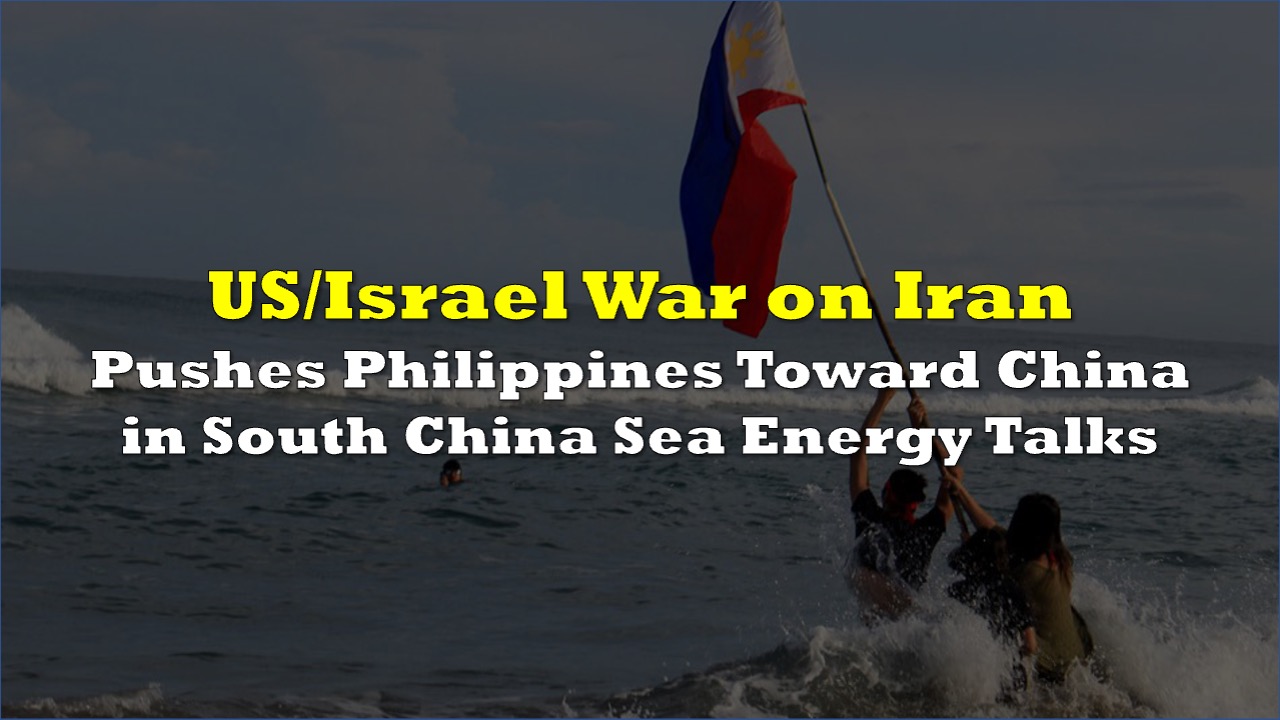

President Ferdinand Marcos Jr. said Tuesday the Middle East energy crisis may provide the opening needed to restart joint oil and gas development talks with China in the disputed South China Sea, marking the most direct signal yet of a broader realignment in Philippine foreign policy driven by surging fuel prices.
Speaking to Bloomberg Television from the presidential palace in Manila, Marcos said territorial disputes have long blocked cooperation with Beijing in the resource-rich waterway. But the same crisis that drove him to declare a national energy emergency — Iran’s closure of the Strait of Hormuz — may now change the calculation.
“That’s something we’ve been talking about for a great deal, but the territorial disputes will get in the way of that,” Marcos said. “Maybe this provides impetus for both sides to come to an agreement. That’s something we are exploring.”
Read: Marcos Declares State of National Energy Emergency Amid Middle East Crisis
Marcos also said a broader reset in Philippines-China relations is no longer a question of if but when. “It’s certainly going to happen. There’s going to be a very, very serious restructuring,” he said, adding that nations may need to “redraw” aspects of their international relationships in response to the shifting geopolitical landscape.
Talks on joint South China Sea energy development originally collapsed in 2022 when then-Foreign Affairs Secretary Teodoro Locsin Jr. terminated them, citing conflicts with the Philippine constitution and unresolved questions of sovereignty, as the Duterte administration wound down.
Marcos and Chinese President Xi Jinping agreed in 2023 to resume discussions, but those talks stalled amid a series of confrontations between Philippine and Chinese vessels in disputed waters — and Marcos himself described the negotiations as at a “deadlock” as recently as late 2025.
The Iran war has now reshuffled the math. As a country that imports virtually all of its petroleum and relies heavily on Middle East supply routes, the Philippines declared a state of national energy emergency Tuesday.
This is big: the Philippines – under Marcos (!) – is reopening talks with Beijing on joint oil and gas development in disputed South China Sea (SCS) waters. Talks his own government had unilaterally ended in 2022 to pivot toward Washington, and which fueled the tensions in the… https://t.co/m41VpFqAoV
— Arnaud Bertrand (@RnaudBertrand) March 25, 2026
China, by contrast, continues to receive Iranian crude despite the conflict and has been aggressively building out its renewable energy capacity — giving Beijing a degree of energy insulation Manila currently lacks.
The Philippines is also in active talks with China on fuel and fertilizer supplies, Marcos confirmed. “They’ve been very helpful with fertilizers,” he said.
Philippine-listed PXP Energy Corp holds a service contract in Reed Bank — a South China Sea area believed to hold significant gas deposits — and has previously explored a joint development partnership with China National Offshore Oil Corp. The partnership has never advanced, with Beijing consistently obstructing Manila’s exploration efforts in the area for more than a decade.
Marcos maintained his country’s formal neutrality on the Iran war itself, which pits a US treaty ally against a country that continues to supply China with oil. The Philippines has neither endorsed the US-Israeli campaign nor publicly condemned it.
“Our foreign policy is very, very simple. It’s peace and the national interest,” Marcos said. “War is never in the national interest as far as the Philippines is concerned. And so we just are hoping that this ends soon.”
The Philippines currently chairs ASEAN and has set an ambitious goal of concluding a Code of Conduct agreement on the South China Sea before its chairmanship ends in 2026. The two governments convened in late January for their first direct political talks in more than a year, ahead of ASEAN-China talks on the Code of Conduct.
Despite the diplomatic warming, sovereignty complications remain significant. Any joint development arrangement must navigate the Philippines’ constitutional constraints and its landmark 2016 arbitral ruling against China’s expansive maritime claims — a ruling Beijing has refused to recognize.
Information for this story was found via the sources and companies mentioned. The author has no securities or affiliations related to the organizations discussed. Not a recommendation to buy or sell. Always do additional research and consult a professional before purchasing a security. The author holds no licenses.