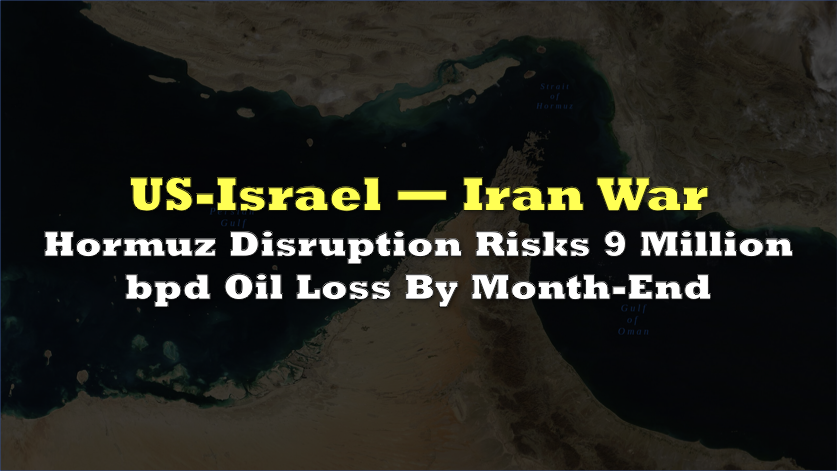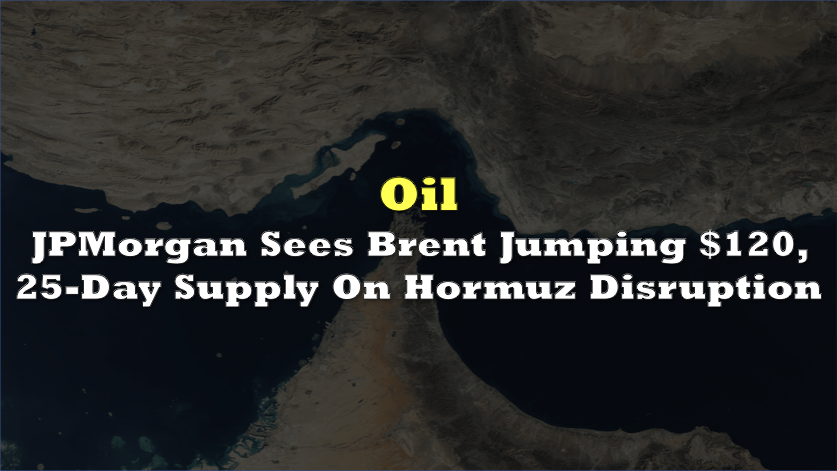

JPMorgan Chase’s core warning is that Brent crude could reach $120 per barrel if Middle East hostilities turn a shipping disruption in the Strait of Hormuz into a sustained regional supply outage, with the bank estimating Gulf producers can maintain normal output for only about 25 days under a complete blockade before saturated storage forces production shutdowns.
The Strait handles 20 million to 21 million barrels per day of crude, condensate and petroleum products, equal to about 20% of global daily oil consumption and nearly 30% of global seaborne oil trade.
The first leg of that stress is already visible in pricing. On Monday, Brent crude for April delivery was up 8.7% at $79.28 per barrel, while WTI gained 7.8% to $72.16. The move followed the Saturday killing of Iran’s Supreme Leader Ayatollah Ali Khamenei by US and Israeli forces.
“Operation Epic Fury” by the US and Israel reportedly used B-2 stealth bombers and high-precision missiles to strike Iranian missile infrastructure, command centers and senior leadership. Nearly 50 senior Iranian leaders were reportedly killed.
Iran then launched missiles and drones at Israel and US bases in the Persian Gulf, including sites in Bahrain and the UAE.
Strikes on Israel reportedly killed at least 11 people. Iran’s initial counter-offensive also killed three American service members and wounded five.
Those numbers matter to oil markets because each additional casualty raises the odds of follow-on military action, broadens the conflict footprint, and lengthens the period during which shipping, insurance and chartering decisions remain impaired.
Even without an official closure, the Strait is already functioning as a constrained corridor. Traffic has reportedly fallen 70% as safety concerns, insurance cancellations and operating suspensions reduced effective throughput.
About 200 tankers carrying crude and LNG have either dropped anchor or diverted away from the route. Hapag-Lloyd and CMA CGM have suspended all transits through the waterway. War risk insurance premiums have risen by as much as 50%, pushing transit economics beyond what many operators can justify.
The second leg of the risk is the one JPMorgan emphasizes and Goldman Sachs also underlines. Once exports stall, Gulf producers can continue pumping only until domestic storage fills.
Goldman Sachs head of oil research Daan Struyven said that if blocked export routes persist, producers could be forced to halt production as storage fills.
“If the Strait of Hormuz is closed for a very long time, you cannot draw inventories forever, and the market may have to rebalance by incentivizing prices to such high levels that you generate demand destruction,” he said.
Information for this story was found via OilPrice.com, Business Insider, and the sources and companies mentioned. The author has no securities or affiliations related to the organizations discussed. Not a recommendation to buy or sell. Always do additional research and consult a professional before purchasing a security. The author holds no licenses.