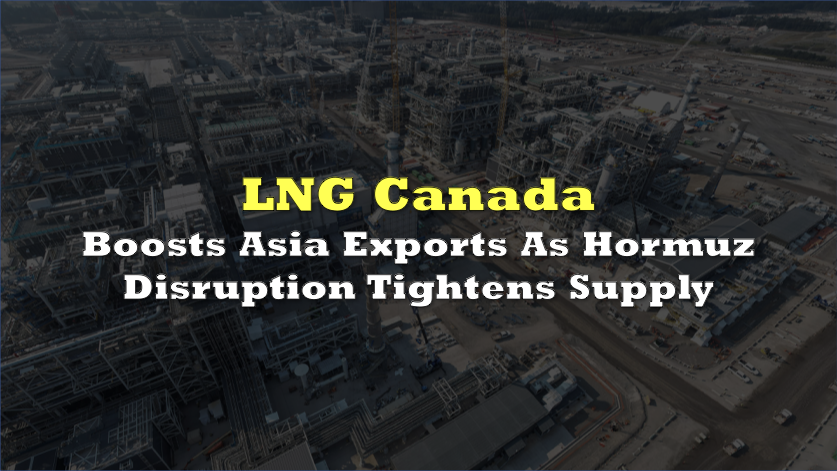

LNG Canada is sharply increasing exports to Asia as the effective closure of the Strait of Hormuz tightens global LNG supply, pushing the Shell PLC-led Kitimat terminal closer to full utilization after six months of underperformance and operational friction.
Kpler data show that during the first 17 days of March, eight ships waited to dock at Kitimat, BC, while export volume reached 550,280 tonnes despite a recent production delay. That pace puts the facility on track to reach almost 85% of its Phase 1 capacity in early spring.
On Tuesday, the Puteri Mahsuri departed with LNG Canada’s 60th cargo to Asia since exports began in mid-2025.
After only four vessels departed Kitimat in December, 10 ships left in January and 11 more in February. For the first three months of 2026 alone, LNG Canada is set to easily exceed the total export volume from its initial six months of operations in 2025.
Ramp-up meets supply shock
The export surge coincides with a severe supply squeeze in global LNG. Before the US and Israel launched attacks on Iran, about one-fifth of global oil and LNG supplies moved through the Strait of Hormuz. Qatar, the world’s second-largest LNG exporter, halted production after Iran attacked Qatari facilities, while LNG shipments from the UAE were also suspended.
LNG Canada estimates a vessel takes roughly 10 days to sail from Kitimat to North Asia, versus about 20 days from the US Gulf Coast via the Panama Canal.
Even so, the facility is not yet at full run rate. Phase 1 nameplate capacity is 14 million tonnes per year, with potential to rise to 15 million tonnes annually through operating efficiencies, equivalent to about 1.25 million tonnes per month.
LNG Canada last week warned Kitimat residents of unscheduled flaring from natural gas combustion, the latest in a series of notices over the past nine months about planned and unplanned flaring, along with increased noise and smoke.
Export mix and market position
RBC Capital Markets analyst Michael Harvey estimates LNG Canada exported about 4.6 million tonnes of LNG to Asia from last June to mid-March. He said the project is “nearing full ramp” and estimated that full export capacity would require about 15 tanker vessels per month.
Of delivered cargoes, 30 went to South Korea, 14 to Japan, seven to China and five to Taiwan.
Last year, LNG Canada shipped more than 2.2 million tonnes, ranking Canada 19th among 24 LNG-exporting countries. By comparison, US exported a record 108.6 million tonnes in 2025, followed by Qatar at 81 million tonnes and Australia at 77.7 million tonnes.
Benchmark Asia-Pacific LNG spot prices have surged 80% in March, but LNG Canada is primarily tied to long-term pricing contracts. The project’s economics therefore benefit less directly from spot spikes than pure merchant suppliers, though tighter markets still reinforce its strategic value to long-term offtakers.
The ownership structure also reflects that long-term sales model. Shell holds 40%, followed by Petronas at 25%, Mitsubishi at 15%, PetroChina at 15%, and Kogas at 5%. Each partner handles offtake in proportion to its stake.
LNG Canada’s expansion path is already being folded into Ottawa’s broader energy strategy. Prime Minister Mark Carney included Phase 2 on the list of major projects of national interest in September for possible fast-tracking.
If built, Phase 2 would double capacity by the early 2030s.
Information for this story was found via The Globe And Mail and the sources and companies mentioned. The author has no securities or affiliations related to the organizations discussed. Not a recommendation to buy or sell. Always do additional research and consult a professional before purchasing a security. The author holds no licenses.