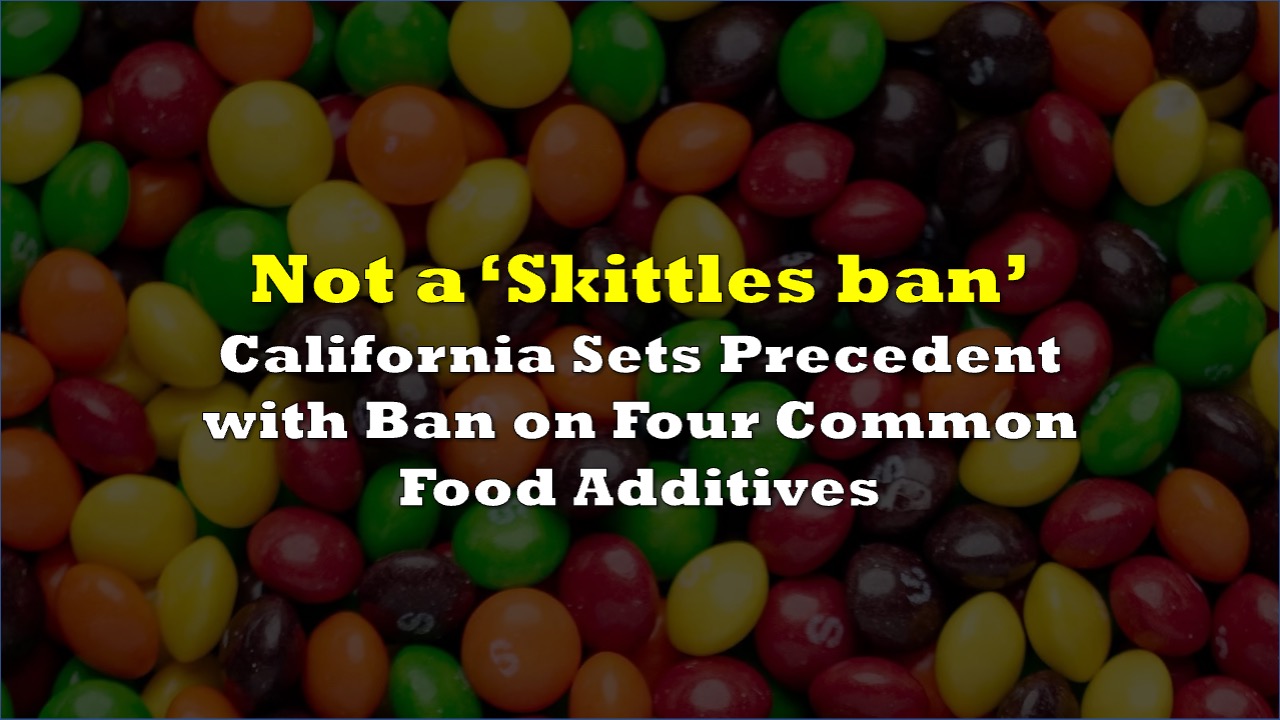

California has become the first state in the United States to enact a comprehensive ban on four food additives widely used in thousands of products, including cereals, sodas, and candies.
The legislation, officially known as the “California Food Safety Act,” was signed into law by Governor Gavin Newsom on Saturday, marking a significant milestone in food safety regulation.
The law, popularly referred to as the “Skittles ban” due to its initial inclusion of titanium dioxide, bans the manufacture, sale, or distribution of four chemical additives: brominated vegetable oil, potassium bromate, propylparaben, and Red Dye 3. These chemicals have been used in approximately 12,000 food products across the country, despite never receiving approval for human consumption from the Food and Drug Administration (FDA).
Advocates have long voiced concerns about the potential health risks associated with these additives, which have already been banned in other countries. In response, Governor Newsom signed the law as a proactive measure until the FDA reviews and establishes national regulations for these additives.
In his statement, Governor Newsom emphasized the importance of ensuring the safety of food products consumed by Californians, while also recognizing the collaborative efforts of the bill’s authors and stakeholders in advancing public health goals.
The legislation targets chemicals used to enhance flavor, appearance, or preservation in food and packaging. Consumer Reports and other advocacy groups have raised concerns about the four chemicals, citing potential links to serious health issues. For example, Red Dye 3 has been associated with cancer in animals, although the research on its impact on human health is inconclusive. The California Food Safety Act addresses these concerns by imposing restrictions on these chemicals, which the FDA hasn’t reviewed for decades.
The law’s potential to affect not only Californians but consumers nationwide is substantial, given the size of the state’s economy. It is unlikely that manufacturers will produce separate versions of their products for California and the rest of the country, according to Consumer Reports. Other states, such as New York, are already following California’s lead with similar legislation.
It’s not a ‘Skittles ban’
European regulators have already banned these additives, except for Red Dye 3 in candied cherries, demonstrating the safety concerns surrounding them. Governor Newsom dispelled the misconception that the law would disrupt the food industry, citing the continued availability of popular products like Skittles in places with existing bans on chemical additives.
Every time pubity posts a headline that seems wild to me, it turns it's clickbait.
— Rob Freund (@RobertFreundLaw) October 10, 2023
No, California did not ban Skittles. It banned four food additives. The law takes effect in 2027.
Skittles just needs make minor modifications by then, like they already did in Europe. pic.twitter.com/nbBFZoKz7n
“This is demonstrable proof that the food industry is capable of maintaining product lines while complying with different public health laws, country-to-country,” Newsom wrote.
The law will take effect in 2027, affording companies ample time to reformulate their products and eliminate the use of these potentially harmful chemicals.
In response to the law, associations representing business interests expressed opposition, arguing that it would create confusion and increase food costs. Nevertheless, the California Food Safety Act has established a pioneering standard for food safety in the US, prompting other states to consider similar measures.
As California takes the lead in addressing potential health risks associated with common food additives, it raises questions about the role of the FDA in regulating these chemicals at the national level. This landmark legislation has the potential to reshape the food industry and improve the safety of products consumed by millions of Americans.
Information for this story was found via the sources and companies mentioned. The author has no securities or affiliations related to the organizations discussed. Not a recommendation to buy or sell. Always do additional research and consult a professional before purchasing a security. The author holds no licenses.