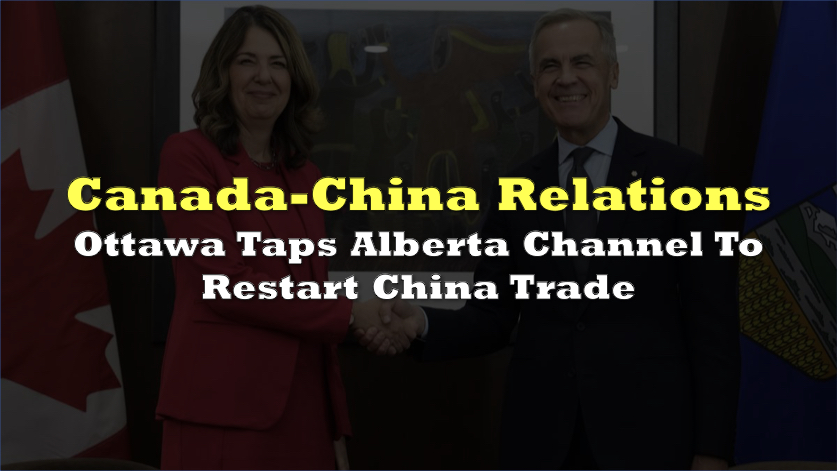

Ottawa is leaning on Alberta’s uninterrupted China engagement as Prime Minister Mark Carney’s team prepares for an expected China trip aimed at cooling a trade conflict and reopening channels for investment and commodity access.
Invest Alberta, the provincial Crown corporation, says federal contact has surged.
“We’ve had more conversations with the federal government in the last six months than at any time in my tenure,” said IAC chief executive Rick Christiaanse, who has held the role since October 2021.
China and Hong Kong generated more than $60 billion in Canadian foreign direct investment last year, the third-largest source of overseas money, with about half landing in Alberta.
Christiaanse’s pitch is continuity as leverage. On his seventh regional visit in four years, with another China trip planned in January, he characterized the moment as “harvest time” for parties that maintained relationships through periods when engagement “weren’t easy,” and argued that the case for disengaging “simply does not exist.”
The situation positions Carney’s approach as export-market triage amid US protectionism under President Donald Trump, but also stress that Ottawa’s rapprochement began in the final months of the Trudeau government. Former foreign minister Mélanie Joly visited Beijing in July 2024, then Canada’s move to mirror US tariffs on Chinese electric vehicles derailed momentum and triggered Chinese retaliation hitting Canadian canola.
But Joly faced sharper criticism for engaging China than her successor, Anita Anand, after Anand’s October Beijing visit, as Trump’s trade posture broadened political cover for a more transactional foreign-policy posture.
What Alberta is selling to China
Most Chinese investment interest in Alberta remains concentrated in oil and gas, with China described as a major customer of the expanded Trans Mountain pipeline.
Christiaanse also cited interest in carbon capture, green energy projects, and Alberta tourism as secondary lanes, with the federal trip potentially serving as a signal that Canada is “open for business.”
A senior Asia-based executive representing Canadian business said mixed messaging from Ottawa leaves Chinese investors uncertain about rules, which sectors are open, and which are too sensitive.
Carney’s office, per the notes, pointed to a statement emphasizing a “long history of co-operation” while promising “guardrails” and explicitly limiting depth where “security threats” preclude a close relationship.
Analysts say strained relations have not materially damaged Canadian brands, while “the larger negative trade impact has been in commodities.” He argued Carney should press for removal of Chinese tariffs on Canadian canola, seafood, and pork, and added that a thaw is already lifting Canadian brand interest in exporting to China.
Christiaanse added that investor conversations have turned more aggressive around diversifying away from US volatility, citing sudden talent-visa restrictions, unpredictable tariffs, and immigration crackdowns as push factors.
Information for this briefing was found via The Globe And Mail and the sources mentioned. The author has no securities or affiliations related to this organization. Not a recommendation to buy or sell. Always do additional research and consult a professional before purchasing a security. The author holds no licenses.